

Assistant Professor and Extension Soybean Pathology Specialist - North Dakota State University, @NDSUPlantPath
Fargo, ND
Joined October 2012
- Tweets2.5K
- Following562
- Followers1.2K
- Likes4.4K


Pinned Tweet
Check out the field research being done by the NDSU Extension Soybean Pathology lab in 2025. ndsu.edu/agriculture/extensi…

Check out some of the exciting soybean pathology research that we have been working on over the past few years across the North Central region!
soybeanresearchinfo.com/rese…

Wade Webster retweeted

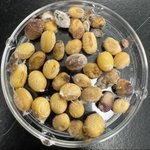
Scouting for Soybean Seed Diseases from Extension at doi.org/10.31274/cpn-2019062….
@AlbertTenuta @cropdisease @MartinChilvers1 @febina_m @dsmuelle @badgercropdoc @cropdoc08 +others @maddishires @MandyBish1 @DylanMangel @BisonBeanDoc @baldpathologist @alabamaED @travisfaske @MahDuffeck @DTelenko #harvest26 #soybean #seed #USSoy

ALT Soybean seeds with mold growing on them.

ALT Soybean seeds with purple discoloration.
While not widespread, some fields that have been sitting at full maturity with recent rains are starting to show seed decay. Especially important for any soybeans being harvested for seed production as germination quality can be an issue.

Despite the drought across much of the state, northern North Dakota still has quite high disease pressure this season. Range of diseases that are present in fields, and some fields at quite high levels.
Photo 1: Stem canker across the entire region
Photo 2: White mold pocketed but high in certain fields
Photo 3: Phytophthora stem rot present in areas that have had consistent moisture. Warm soil temps helped drive disease
Photo 4: SCN cysts across the eastern side of the state.


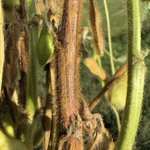
Scouting across the state this week. Even though symptoms developing on leaves look similar to SDS, it’s important to split the stems and look at the pith. Brown pith tissue, especially around the nodes, means this is actually brown stem rot.


Wade Webster retweeted

Late-season soybean diseases can be easy to miss until it’s too late to manage them. 🌱
White mold, SDS and brown stem rot are among the diseases North Dakota farmers should watch for. Learn how to identify, track and manage these threats with tips from @NDSUExtension.
Read more: bit.ly/NDLateSeasonInfection…

Wade Webster retweeted

Now is a great time to scout for red crown rot, SDS and BSR. Thanks to support from @ncipmc @SoyCheckoff and @DTelenko @BorisCamiletti @cropdisease and university and industry colleagues for hosting a field day @CropNetwork


Hot off the press‼️ This is a great diagnostic guide for field scouting of stem and crown rot disease of soybeans. Great resources if trying to identify SDS and Red Crown Rot.


Red crown rot is starting to develop across the U.S., but we still have not yet confirmed it in North Dakota. No need to change management, but this is a great time to scout fields looking for suspicious fields. While the disease can look similar to SDS foliar symptoms, it is important to look at the crown of plants for red discoloration. The red dots (perithecia) often show up with high moisture conditions.


Wade Webster retweeted

A battle so EPIC it could not be contained to one video..... Battle of the Soybean Leaf - Part 1 Dive deeper into this matchup in issue #18 of the Crop and Pest Report ndsu.edu/agriculture/ag-hub/…
Past few days of evaluating field trials. Lots of white mold pressure allows us to better understand fungicide programs for controlling disease. These are from irrigated trials, and I have not yet found any white mold from dry land conditions this season.


I was walking plots and noticed these leaves. Even though they look similar to issues such as SDS, these were actually caused by fungicide applications of triazoles. We often don’t see this in North Dakota, but warm temps and a highly sensitive variety led to its development.


Drought conditions are impacting soybeans and unfortunately presence the of charcoal rot is seemingly making the issue worse in certain areas of the state. You can see the small black survival structures of this fungus inside the split stem


Despite dry conditions in parts of Eastern ND, sudden death syndrome (SDS) symptoms are still appearing. Rain events are expected to increase symptom development. Important to keep an eye out in your area.
These pictures are from research trials evaluating seed treatment effects on SDS development.


Wade Webster retweeted
Northern #corn leaf blight can reduce yield when cool, wet conditions favor disease development. Scout fields around tasseling and watch for long, grayish-tan, cigar-shaped lesions. Learn more #15 Crop Pest Report ndsu.edu/agriculture/ag-hub/…
This will be the last white mold maps I post for the season as we get out of flowering season in soybeans. Dry and hot weather has pulled almost all of North Dakota into low risk of disease developing. Still important information for anyone with late planted beans that are still considering fungicides this season.
NDAWN maps will be still active for a few more weeks on the website. ndawn.info/agriculture_white…


If you’re in the area, come check out all the exciting research we have going on down at the Oakes Irrigation Research Site on August 6th!

We're not done yet! 2 more Field Days are the calendar!
Nesson Valley Irrigation Field Day
August 5
9 a.m. - 1 p.m. CT
ndsu.edu/agriculture/ag-hub/…
Oakes Irrigation Research Site Field Day
August 6
9 a.m. - 1 p.m. CT
ndsu.edu/agriculture/ag-hub/…


White mold risk across most of the state is low this week. Lack of moisture and high temperatures are the biggest limiting factors. Except for the northern tier of the state, fungicide applications may not be necessary if under dryland conditions.


