

Founder & CEO @compute_labs | ex @the_delysium, @rct_ai, & @xsolla | @UCLA @Caltech
CA
Joined June 2022
- Tweets548
- Following728
- Followers8.3K
- Likes2K







If a GPU keeps earning for seven years, why do most loans only count the first three?
Because lenders size the loan to the customer contract. The contract has to pay the debt off in full and anything the GPUs earn after that isnt factored in.
From a lender's view, this makes total sense because contracted revenue is the cash flow they can underwrite. A GPU's earning potential after the contract depends on future pricing and demand, and there isn't much data out there yet to support it.
But the data that does exist points one way. CoreWeave has A100s, which first came out in 2020, under contract into 2029. Azure ran its K80, P100, P40 and V100 fleets for seven to nine years.
So once a 3-year contract retires the debt, the operator owns a cluster that can keep earning for years.
At @Compute_Labs , we handle getting operators financed so they can focus on running their clusters and serving their customers.

1
2
142
A lot of neoclouds come to us with a signed take-or-pay contract and figure the hard parts done.
Honestly, it's only one piece. Before a lender commits anything, every counterparty in the deal must be aligned.
The customer contract has to hold up line by line. Can the customer step down capacity each year, and what happens to their prepayment if they do? Is there a company guarantee?
The OEM has to provide a firm bill of materials and a quote that won't expire halfway through the raise.
The hosting site needs a signed agreement, with power and a RFS date the lender can underwrite.
If any of the above falls through, financing stalls. At @Compute Labs, we work with operators to get every one of those pieces lined up first, so when the deal reaches lenders it's ready to fund.

115
AZ retweeted

Mubadala, Microsoft and SoftBank Vision Fund launched @Hub71ad to bring top tech companies to Abu Dhabi.
Compute Labs recently joined Cohort 19. One of 40 companies picked out of 2,502 applicants.
Our Financing Platform helps neoclouds structure the financing needed to scale compute capacity. Joining Hub71 puts us closer to Abu Dhabi's capital and partners
Read more here: hub71.com/latest-news/press-…

AZ retweeted
Compute Labs has helped neocloud operators secure over $500M in institutional debt term sheets in the last few weeks, and our Financing Platform is now live to get your cluster funded next.
Turn signed customer demand into earning clusters fast.
Get started: platform.computelabs.ai
AZ retweeted
Compute Labs was featured in @CNBC this weekend in Kif Leswing and Isabel O'Brien's piece examining how capital markets are adapting to fund the global AI buildout.
Demand for compute is clearly not the constraint. The bottleneck is the structural mismatch between how AI clusters operate and how institutional credit underwrites:
• The "timing trap" (quote / power / capital): Hardware allocation quotes, colocation power delivery, and credit committee timelines rarely line up naturally
• Capital crowds into hyperscale deals, leaving mid-sized neoclouds caught between dilutive equity and credit funds built for large checks
• Having a customer contract is different from having a bankable one, where prepayments, SLA step-downs, and deployment timelines can actually clear an investment committee
Thank you to the CNBC team for including our perspective on how the financing market is evolving.
Read the full article:
cnbc.com/2026/10/24/nvidias-…

When we started @Compute_Labs, we asked one question: what is the underlying asset powering AI? The answer was compute. So we decided to build everything around it.
Today we launched our Financing Platform.
It helps neoclouds get their GPU deals ready for funders. Then we take them to market.
Thank you to the team, very proud of what we’ve built.

Introducing the Compute Labs Financing Platform.
Financing your GPU cluster shouldn't feel impossible. Capital is ready, but most neocloud operators with customer demand have no capital markets team to turn it into a deal funders can confidently evaluate.
Our platform turns a neocloud's deal documents into a standardized package, with every figure verified by its source.
Neoclouds receive support from intake to close and beyond. Funders get deals they can evaluate with confidence.
platform.computelabs.ai
2
6
240
AZ retweeted
Financing a GPU deal requires keeping every document current and every counterparty in sync. All while the quote risks increasing and the offtaker waits.
We're building one place to make your deal financeable, with our team alongside you.
Compute Labs Financing Platform. Coming soon.
We have been working on this for a long time. Soon the market will see it.
It is for every good GPU deal that should get funded and doesn't.
Financing an AI factory shouldn't feel impossible.
Before any capital is committed, every neocloud operator has to answer questions from lenders, OEMs, data centers and offtakers. They arrive over email, Slack, Telegram and WhatsApp, and the answers change every time a quote or the terms move.
We're building the standard for financing AI infrastructure.
Compute Labs Financing Platform. Coming soon.
1
4
203
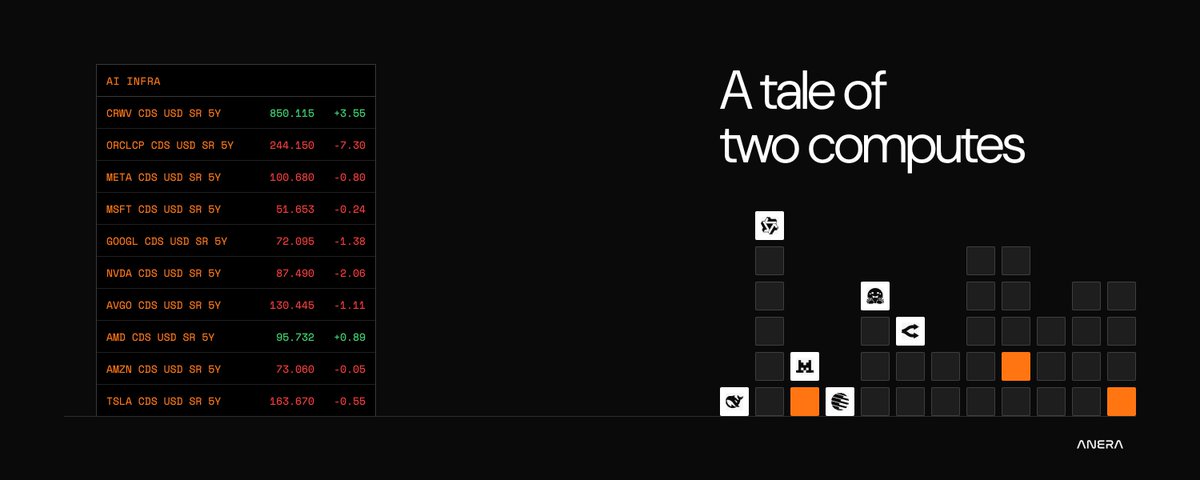
A well written and insightful piece by @hrojantorse
Remarketing risk is tangible for lenders but also an arbitrage opportunity for players who are capable of executing and securing short-term offtakers within three months of a default.

1
2
321


AZ retweeted

AI's hidden cost isn't the models. It's the electricity.
ChatGPT hit 1B monthly users in May 2026 and every single query burns energy. At @plcapital, we don't see a compute crisis coming. We see an energy one 🧵 (1/9)

AZ retweeted

AI agents are already moving money — unverified and unaccountable.
Today, we’re announcing our $5M seed round to build the trust layer for the agentic economy.
Led by Anagram, PL Capital, and Franklin Templeton, with strategic investment from Ripple.
t54.ai/seed
We often compare the AI buildout to the electrical grid.
But people forget that the grid wasn't built solely by utility companies. It was built by bond markets and private capital looking for steady, yield-generating assets.
Right now, the AI market is stuck between two extremes:
• Banks who are too slow and conservative
• Venture Capital which is high-risk and expensive
This presents an attractive opportunity for Family Offices and Private Investors.
The opportunity isn't to "bet on the next OpenAI." The opportunity is to own the physical infrastructure that OpenAI runs on.
At Compute Labs, we help private investors understand the opportunity.
We are turning GPUs into the Infrastructure asset class they are.

2
3
179
Copying the Hyperscaler playbook is the fastest way to kill a smaller Neocloud.
For hyperscalers, spending $10B a quarter is a competitive advantage. For anyone else, it is an existential risk to their balance sheet.
We are seeing a divergence in the market. There are those who own the infrastructure and those who build the intelligence on top of it. Attempting to do both without a massive balance sheet is akin to capital suicide.
The most successful neoclouds in 2026 won't be the ones with the most GPUs.
They will be the ones with the most efficient *cost of capital*.

2
2
141
Are we in an AI bubble? It is the most common question I get asked. And the answer requires looking at history.
If you look at the Railroad Boom or the Electrification of the 20th century, they all started with massive upfront capital spending. To the outside world, it looked like irrational exuberance. But in hindsight, we call it the "Installation Phase."
We are seeing the same pattern today. There is a massive difference between a "Financial Bubble" (which leaves nothing behind when it bursts) and an "Inflection Bubble" (which builds the infrastructure for the next 50 years of growth).
I wrote a detailed breakdown of this distinction for Unite AI. I cover the difference between "Application Hype" and "Infrastructure Reality," and why the data suggests we are firmly in the latter.
Give it a read here: unite.ai/are-we-in-an-ai-bub…
1
99