

Accelerating the AI factory buildout.
Learn more →
Joined March 2024
- Tweets1.5K
- Following230
- Followers7.1K
- Likes2.3K
Pinned Tweet
Introducing the Compute Labs Financing Platform.
Financing your GPU cluster shouldn't feel impossible. Capital is ready, but most neocloud operators with customer demand have no capital markets team to turn it into a deal funders can confidently evaluate.
Our platform turns a neocloud's deal documents into a standardized package, with every figure verified by its source.
Neoclouds receive support from intake to close and beyond. Funders get deals they can evaluate with confidence.
platform.computelabs.ai
Mubadala, Microsoft and SoftBank Vision Fund launched @Hub71ad to bring top tech companies to Abu Dhabi.
Compute Labs recently joined Cohort 19. One of 40 companies picked out of 2,502 applicants.
Our Financing Platform helps neoclouds structure the financing needed to scale compute capacity. Joining Hub71 puts us closer to Abu Dhabi's capital and partners
Read more here: hub71.com/latest-news/press-…

Compute Labs has helped neocloud operators secure over $500M in institutional debt term sheets in the last few weeks, and our Financing Platform is now live to get your cluster funded next.
Turn signed customer demand into earning clusters fast.
Get started: platform.computelabs.ai
In the past few weeks alone, Compute Labs has secured over $500M in institutional term sheets for our neocloud partners. Almost all of them are non-investment-grade operators.
The capital has not disappeared, but standard approaches no longer clear credit committees. Closing GPU financing in this market comes down to creative structuring and knowing the exact credit enhancements, offtake terms, and risk protections each institutional lender needs to see.
That is the gap we close for our neoclouds. Debt markets are still open if you know how to structure the deal.

Compute Labs was featured in @CNBC this weekend in Kif Leswing and Isabel O'Brien's piece examining how capital markets are adapting to fund the global AI buildout.
Demand for compute is clearly not the constraint. The bottleneck is the structural mismatch between how AI clusters operate and how institutional credit underwrites:
• The "timing trap" (quote / power / capital): Hardware allocation quotes, colocation power delivery, and credit committee timelines rarely line up naturally
• Capital crowds into hyperscale deals, leaving mid-sized neoclouds caught between dilutive equity and credit funds built for large checks
• Having a customer contract is different from having a bankable one, where prepayments, SLA step-downs, and deployment timelines can actually clear an investment committee
Thank you to the CNBC team for including our perspective on how the financing market is evolving.
Read the full article:
cnbc.com/2026/10/24/nvidias-…

Yesterday Elon warned that the market is going to see a lot of stranded compute in partially complete data centers. He noted that if anything is missing in a buildout, however seemingly trivial, the compute does not work.
Anyone who has worked on a GPU deployment understands the severity of the execution risk.
B300s or GB300s can ship in a few months, but power, transformers, or switchgear can take years.
Even if a site has power lined up, a delayed permit, unfinished liquid cooling, or bad networking during testing will keep a cluster offline.
An offtake contract only starts paying once the cluster Ready for Service (RFS). OEMs usually want to be paid on or before delivery, while lenders and customers only want to pay once the cluster is live.
If the GPUs were to arrive months before the data center is ready, the operator is stuck paying for hardware that cannot earn a dollar yet.
That is why institutional GPU financing must be rigorous. Before lenders commit capital, they must underwrite the entire buildout.
We built the Compute Labs Financing Platform to help neoclouds and lenders get all of that lined up from day one so clusters get funded and go live on time.
platform.computelabs.ai


We built the Compute Labs Financing Platform to get GPU deals funded.
More than 40 lenders and around 80 neoclouds.
The Information covered the launch:
theinformation.com/briefings…

A third of NVIDIA’s business is startups renting compute. Those same startups are the offtake behind the neocloud deals lenders are now asked to underwrite.
Counterparty credit is the bottleneck in middle market GPU financing.
Our Financing Platform makes those deals underwritable.

NVIDIA CEO @JensenHuang tells @altcap on @BG2Pod that people misunderstand Nvidia's demand. About a third is classical computing growing 30 to 40% a year with no AI labs. A quarter to a third is five or six frontier labs, not two. And a third is startups renting Nvidia like next-gen AWS. In my view, treating Nvidia as a two-lab capex story is a real mistake.
"People misunderstand what's going on. There are basically three large segments.
The first is baseline computing. Data processing, molecular dynamics, physics, simulation, computer graphics, classical machine learning, fraud detection, recommender systems. Classical computing, not AI, not deep learning, not agentic systems. Call it a third of our business. And that business is growing call it 30%, 40% per year. In the absence of any AI labs, Nvidia is not zero. We're quite a large company.
The second part is the AI labs. People see two, but we work with every one of them. Meta Muse is doing fantastic. It's vastly Nvidia. Grok didn't exist three years ago. We didn't run Gemini before, we run Gemini now. Starting this year, we started working with Anthropic. People see a couple of labs, but I see more than that. I see five, six labs. And if you told me that represents not quite one-third of our business, let's say a quarter of our compute, fantastic.
And another third, this is the part that's really great. Because we're at the beginning of a new computing platform shift, a vast number of new startups are coming out. Thousands of them. And what do they do? They rent NVIDIA compute. So a third of our business is kind of cloud computing for the next generation. It's kind of like AWS for today. And that represents about a third of our business altogether.
My sense is that we're in the early innings of the buildout of this new computing architecture. And it's a real big mistake to recognize just a couple of companies and think that they were funding the infrastructure.”
1
12
770
Financing a GPU deal requires keeping every document current and every counterparty in sync. All while the quote risks increasing and the offtaker waits.
We're building one place to make your deal financeable, with our team alongside you.
Compute Labs Financing Platform. Coming soon.
Financing an AI factory shouldn't feel impossible.
Before any capital is committed, every neocloud operator has to answer questions from lenders, OEMs, data centers and offtakers. They arrive over email, Slack, Telegram and WhatsApp, and the answers change every time a quote or the terms move.
We're building the standard for financing AI infrastructure.
Compute Labs Financing Platform. Coming soon.
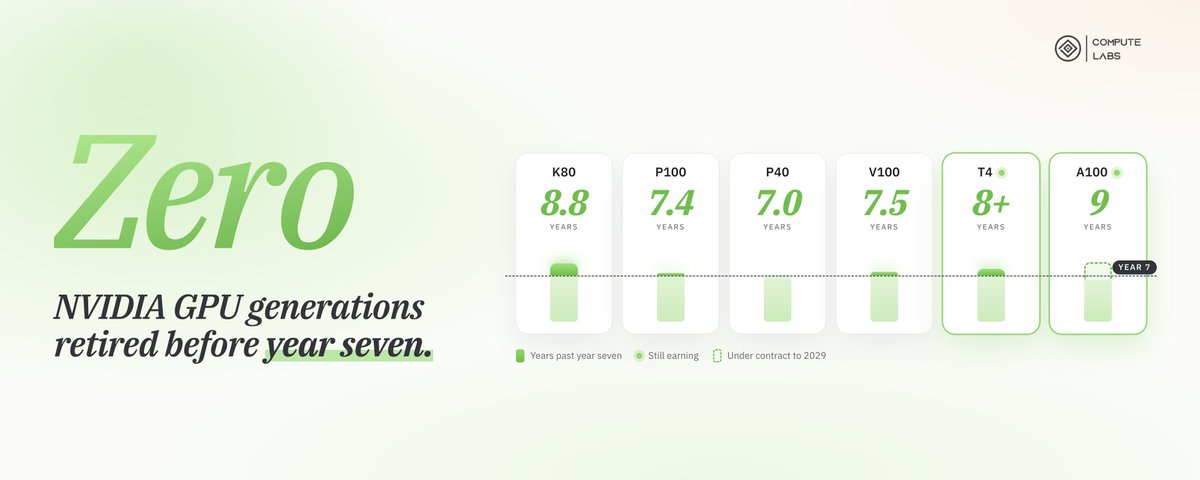
Most financial models assume a GPU's useful life is three years.
Every modern GPU generation that has actually been retired stayed in revenue service for seven to nine years.
The public retirement record, generation by generation:
In July 2025 we bought thirty-two NVIDIA H200s and put them on the on-demand market.
We are publishing fourteen months of actuals from that fleet.
Very little operating data on GPU fleets is public. This is ours.

Institutional capital is actively recalibrating its exposure to legacy software.
With major funds adjusting their tech portfolios and analysts noting potential default spikes for AI-threatened SaaS models, allocators across the board are smartly managing their risk.
As capital rotates out of software, it requires a secure entry point into the physical infrastructure driving that very disruption.
Underwriting a multi-year GPU offtake contract relies entirely on the proven mechanics of project finance.
By isolating the transaction into a standalone SPV, capital is secured directly against the physical hardware and the cash flows of the contract. Whether a partner is providing the senior debt facility or funding the equity tranche, the downside is protected by the metal and the yield is driven by a contracted utilization.
We build the financial architecture that allows the entire capital stack to deploy into this asset class.

In commercial real estate, you wouldn't expect a property manager to buy the building with their own balance sheet.
Yet, the AI market currently forces neoclouds to tie up massive amounts of operating cash as down payments just to secure GPUs. For a fast-growing tech company, locking capital in depreciating silicon stalls their actual growth.
This creates a clear opening for institutional capital.
By treating the cluster like a real estate development, investors can provide this specific tranche of capital, secured directly by the hardware and the customer contract.
We structure the SPVs that align this capital and turn GPUs into yielding infrastructure assets.

5
1,245
GPUs sitting idle in a data center are depreciating liabilities.
Agreements with investment grade customers turn GPUs into an investable product. Too many investors are focused on spot prices while ignoring the strength of the contract.
In the traditional infrastructure world, a pipeline without a contracted buyer is un-bankable. The AI compute market is identical. If you finance a cluster without strictly underwriting the neocloud's end-customer agreements, you are taking naked equity risk on a hardware deployment.
We structure vehicles that securitize these specific cash flows to ensure institutional capital is backed by creditworthy demand.

1
6
855
When institutional capital evaluates a GPU financing deal, due diligence cannot stop at the neocloud operator. Actual revenue is generated by the offtakers renting the capacity.
If a neocloud’s capacity is leased entirely to startups, the credit risk is exponentially higher than a cluster anchored by a multi-year hyperscaler contract.
Our underwriting extends through the operator directly to the offtake. We evaluate the credit quality, concentration risk, and end customer contracts.
True downside protection in AI infrastructure requires underwriting the entire revenue chain.

1
2
677