








yam retweeted

CRISE DES LYCÉES : COMMENT LE RÉCIT MÉDIATIQUE A AMPLIFIÉ LES COLÈRES - Depuis les premiers blocages, nous avons analysé plusieurs centaines de contenus, articles, reportages et séquences d’information diffusés par LCI, France 2, franceinfo, BFMTV, Le Monde, France Inter et France Culture. Notre analyse fait apparaître plusieurs biais récurrents dans le traitement du conflit : un cadrage privilégiant la répression, une représentation politique déséquilibrée, des critiques de Parcoursup rarement contredites et une faible visibilité accordée aux non-grévistes. Quatre angles morts qui interrogent le pluralisme et les exigences du journalisme.
LA RÉPONSE UNIQUEMENT SÉCURITAIRE
Dans de nombreuses interventions de sociologues, de chercheurs et d’éditorialistes, un même récit revient en boucle : face aux revendications lycéennes, le gouvernement n’opposerait que la répression policière. Des témoignages de jeunes mobilisés reprennent cette idée, affirmant que leurs revendications seraient ignorées et que la seule réponse des autorités serait la brutalité.
Pourtant, dès le 4 octobre 2026, le gouvernement a lancé cinq chantiers portant sur les remplacements d’enseignants, les locaux scolaires, les emplois du temps, Parcoursup et la démocratie lycéenne. Le 8 octobre, Édouard Geffray a annoncé le déploiement de plus de 3 000 enseignants remplaçants et des recrutements supplémentaires.
D’autres mesures ont suivi : demi-journée consacrée au dialogue lycéen, consultation nationale des élèves, renforcement de leur représentation dans les instances éducatives et budgets dédiés à leurs projets. Les premières décisions devaient être présentées avant la fin octobre, tandis que le budget 2027 prévoyait 1,2 milliard d’euros supplémentaires pour l’Éducation nationale.
LES EXTRÊMES OMNIPRÉSENTS : OÙ EST LE PLURALISME ?
Le 17 octobre 2026, alors que des violences incontrôlables éclatent dans de nombreuses villes, notre relevé des interventions politiques sur les chaînes d’information en continu fait apparaître une succession de personnalités populistes ou contestataires : Ségolène Royal, Clémentine Autain, Sabrina Sebaihi (députée écologiste), Marine Tondelier, Éric Coquerel et Yoann Gillet, député du Rassemblement national. Dans le même temps, les publications de Jean-Luc Mélenchon sur X sont fortement reprises sur les bandeaux d’information.
Le problème n’est évidemment pas de donner la parole à ces personnalités, mais de leur accorder une place aussi prépondérante dans une séquence où les violences et le maintien de l’ordre sont au cœur de l’actualité. Pourquoi les mêmes figures contestataires se succèdent-elles sur les plateaux, tandis que les voix modérées et républicaines brillent par leur absence ?
HARO SUR PARCOURSUP !
Depuis plusieurs semaines, Parcoursup a fait l’objet d’attaques incessantes, souvent virulentes et rarement étayées. Micro-trottoirs, témoignages individuels et tribunes indignées se sont succédé, sans que les critiques soient toujours accompagnées d’une mise en perspective ou d’une contradiction à la hauteur des accusations formulées.
Le 14 octobre, dans un entretien publié par HugoDécrypte sous le titre « Révolte des jeunes, désobéissance et justice », Vincent Lindon s’autorisait des critiques d’une violence inouïe sur Parcoursup en le comparant à un champ de mines et en affirmant que ce système brisait des vies ; parmi les nombreuses contre-vérités débitées par l’acteur, le présentateur (très suivi par les jeunes générations) se contentera d’acquiescer, sans jamais corriger ou contredire son invité.
Pourtant, les chiffres officiels racontent une tout autre réalité que les caricatures véhiculées dans certains médias : en 2025, 94 % des néobacheliers inscrits sur Parcoursup ont reçu au moins une proposition d’admission, et 81 % en ont accepté une, selon le ministère de l’Enseignement supérieur. Ces résultats ne font pas disparaître les difficultés individuelles, les inégalités d’accès ou les problèmes d’orientation.
LES NON-GRÉVISTES PRIVÉS DE PAROLE
Depuis plus de trois semaines, les reportages consacrés à la mobilisation donnent largement à entendre les lycéens contestataires, les militants, les activistes et les organisations syndicales. Mais quelle place est accordée à ceux qui ne font pas grève, souhaitent poursuivre leurs cours ou subissent les conséquences des blocages sans partager les revendications du mouvement ?
Notre relevé des journaux de France Inter fait apparaître un déséquilibre particulièrement marqué : sur une trentaine de reportages recensés au fil de la journée, un seul donnait la parole à des non-grévistes. Les autres privilégiaient les acteurs de la mobilisation ou les organisations qui la soutiennent. Parmi les sujets diffusés figurait également un reportage consacré à un cours improvisé de marxisme proposé par une professeure de français à des lycéens mobilisés, présenté comme une démarche de sensibilisation.
CONCLUSION : QUAND LE JOURNALISME RENONCE AU CONTRADICTOIRE
Pris ensemble, ces quatre angles d’analyse interrogent une même pratique : privilégier certains témoignages, certaines personnalités et certaines interprétations, au risque de laisser dans l’ombre des faits et des opinions essentiels. Le problème n’est pas de donner la parole aux lycéens mobilisés, aux militants ou aux critiques de Parcoursup. Il est de ne pas soumettre leurs affirmations aux mêmes exigences de vérification et de contradiction que celles de leurs adversaires.
Le pluralisme ne consiste pas à juxtaposer des témoignages. Il exige de confronter les récits aux faits, les accusations aux réponses et les revendications aux réalités. Lorsque le contradictoire disparaît, l’information devient le véhicule d’un récit à sens unique ; et comme souvent, c'est le récit de la colère et du militantisme qui est choisi par les rédactions.

yam retweeted

Et l’historien dira, pour conclure et pour être complet, avant de retourner à son labeur, qu’aucune hypothèse ne doit être exclue, pas même celle d’une ingérence extérieure à fin de déstabiliser la France et de peser sur la présidentielle !
yam retweeted

Je vais être honnête. Ne pas avoir un abonnement pro à ChatGPT ou Claude ou Gemini à l'automne 2026 dans de multiples secteurs, c'est proche de la faute professionnelle/institutionnelle.
Lu dans l'article de libé sur les doctorants en math. liberation.fr/sciences/ia-et…

yam retweeted

Maires de France, et si nous refusions d’accorder notre parrainage aux candidats du chaos ?
Ce matin, j’ai une boule au ventre.
Les images de l’hôtel de ville de Limoges en flammes m’ont hanté toute la nuit. Une mairie, c’est notre maison commune. Ceux qui y sont entrés pour la brûler se sont attaqués à ce symbole.
Dans plusieurs villes de France, des bâtiments publics ont été incendiés, des commerces pillés. Derrière ces commerces, il y a le travail, les économies, les sacrifices d’une famille. Parfois, toute une vie détruite en quelques minutes.
Voilà ma colère : voir détruire en quelques heures ce que tant de Français passent leur vie à construire. Une colère froide, républicaine, qui doit nous conduire à agir.
Les difficultés sociales exigent des réponses. Hier, des manifestants pacifiques portaient des revendications légitimes. Mais aucune difficulté ne donne le droit de détruire. La violence aggrave les souffrances et confisque la parole de ceux qui manifestent pacifiquement.
Distinguer les manifestants des casseurs ne doit pourtant masquer aucune responsabilité. Les éventuels liens entre organisateurs des mobilisations et organisateurs des violences doivent être examinés. Je refuse ce double jeu politique : se réclamer des revendications pacifiques, encourager les affrontements, puis exploiter le désordre pour conquérir le pouvoir.
On ne peut pas nourrir l’incendie et se présenter en recours devant les flammes.
Car l’enjeu dépasse les dégâts matériels. La France s’est construite au fil des siècles. Des générations ont lutté pour notre République et nos libertés. Aucune ambition politique ne justifie de sacrifier cet héritage.
Les maires le font vivre chaque jour : écouter, aider, protéger, apaiser. Ils savent combien construire exige de persévérance. Défendre ce lien impose de soutenir les victimes, de rétablir les services publics et de faire en sorte que les auteurs des violences, comme leurs éventuels organisateurs, répondent de leurs actes devant la justice. Mon soutien va aux policiers, aux gendarmes et aux sapeurs-pompiers qui nous protègent.
Cette responsabilité engage aussi nos choix politiques. Le Conseil constitutionnel qualifie le parrainage d’un candidat à l’élection présidentielle d’« acte politique grave ».
J’appelle tous les maires et tous les élus de France à faire barrage au nom de la République.
Refusons de donner notre parrainage à tout candidat du chaos, à ceux qui encouragent ou légitiment la violence, bafouent les libertés démocratiques, méprisent nos institutions ou font du désordre un instrument de conquête du pouvoir.
Ma signature engage ma conscience de républicain. Elle sera fidèle à ce que je défends chaque jour : une République qui écoute, qui protège, qui unit et qui fait respecter ses lois.
Aucune quête du pouvoir ne vaut qu’on lui sacrifie la France et la République.
yam retweeted

"Conservatism starts from a sentiment that all mature people can readily share: the sentiment that good things are easily destroyed, but not easily created. This is especially true of the good things that come to us as collective assets: peace, freedom, law, civility, public spirit, the security of property, and family life, in all of which we depend on the cooperation of others while having no means singlehandedly to obtain it. In respect of such things, the work of destruction is quick, easy, and exhilarating; the work of creation slow, laborious, and dull." How to Be a Conservative

yam retweeted

Alex gets it.
this is why I believe that it’s not that math nerds deserve special treatment for their own sake, it’s that math *itself* demands it.

i actually think Terence Tao pointed out something really important here, which i didnt really know or consider.
OpenAI was really fucking rude to drop the massive repo of solutions without even so much as reaching out to an entire discipline of human thought and research, to even just be like "hey homies, um, brace yourself, ok? maybe reassess that thesis because your entire project is about to cook and im really sorry, its our bad. its very much our bad. but its happening, so...sorry, y'all"
makes me sad for those folks, tbh. i really feel for the whole culture of mathematica. there's something incredibly distinct about humanity's relationship to math, that you dont really see or understand until youve known individuals who have dedicated their life to it. it has this, idk, this effect on humans that drives the progress and evolution and pride and promise of entire family lineages.
i mean like in China for example you could argue that the most accomplished or promising up-and-comers of their communities are something like our NBA/NFL players. like they are superstars in some kind of adjacent way. they are the highest of high prospects for their communities. set for the most prestigious and valuable and respected futures.
and now that is effectively gone. overnight.
some kids who have dreamed in math, written in their journals for their entire teenage life about what they intend to do with their math-filled future. all just kinda gone. like there is no sense in pursuing those paths now. not in the same way that you might have planned to 6 months ago.
because, ironically, all you need to do is a little math to see the trajectory with AI/SI.
you could have at least given them a ring, openai. a simple heads up, ya know. those poor guys are literally scrambling to sort out a new life path now.
i suppose thats what happens when your org has significant sociopathic tendencies. you do things like dropping 300+ mathematic solutions without so much as considering the potential emotional and psychological impact it might have on humans who feel.
i wish i coudl think of an equivalent for myself. im like what would devastate me if solved tomorrow?
i dont really know. its weird being an empath and feeling for a group of humans but at the same time being unable to find a relatable equivalent.
i guess maybe raw creativity would get me? if somehow the value of genuine creative thought/ideas lost their value completely. that would be pretty rough. but now im like, does that mean im finding my identity in my capacity for...cool ideas? well, no. i dont think? idk man.
anyway my point is i agree with Terence is was really fuckin rude, at bare minimum. and i hadnt considered that.
yam retweeted

EN DIRECT | Micro-tendu du Premier ministre. xitter.cf/i/broadcasts/1DxLdZPEe…


yam retweeted

Denmark is raising its retirement age to 70. French election candidates pledge to reducing it to 60 or 62.
Denmark's debt to GDP ratio is 27%; France's is 117%.
You reap what you sow.
cnn.com/2025/05/23/business/…

yam retweeted

Absolument d'accord avec vous Monsieur. La comparaison à faire, pour moi, ce n'est pas mai 68. C'est le 6 février 1934 quand les ligues fascistes ont commis des émeutes d'une extrême violence avec comme objectif ultime de détruire la République et la démocratie. Elles sont finalement arrivées à leur but 4 ans plus tard avec Pétain et Vichy. Les groupes ultra violents d'aujourd'hui, délégitimant les revendications en partie légitimes des lycéens, soutenus - si ce n'est pas organisés - par LFI, Révolution Permanente, NPA-R, Urgence Palestine (eh oui!) - peut être aussi par Poutine- sont leurs descendants. Des mouvements fascisants d'extrême gauche, qui veulent abattre la République. Ils font venir le RN au pouvoir qui n'a rien à faire d'autre que d'attendre et voir son électoral grossir. Et c'est exactement ce que veulent LFI/Mélenchon: le chaos, la violence, le grand soir révolutionnaire et insurrectionnel. LFI et le RN sont des alliés objectifs. Il faut isoler les deux dans un barrage républicain et sauvegarder la République. LFI est complice.

Beaucoup, des dizaines de milliers, voulaient manifester, aux côtés de la jeunesse, pour faire entendre qu’ils n’acceptent plus les sacrifices et les injustices, sans garantie que leurs enfants vivront mieux qu’eux.
Sur leur dos, d’autres ont lancé leurs électoralistes appels la révolution, celle dont ils parlent depuis si longtemps dans leurs confortables salons.
De leur irresponsabilité, s’est débridée l’infâme violence factieuse des insurrections, doublée des pillages si chers aux petits caïds délinquants, militants égoïstes de leur seule addiction à la consommation.
Les manifestants sont humiliés et ne seront pas entendus, les révolutionnaires de salon sont infiniment méprisables, les fauteurs de chaos et de violences, pour l’honneur de la République, doivent finir en prison.
Insupportable journée pour la démocratie. #17octobre
yam retweeted
Ce 17 octobre est important.
Mélenchon sera peut-être au 2e tour de la présidentielle, mais vient sans doute de perdre définitivement l’Élysée et d’ouvrir un boulevard à M Le Pen.
Seule une hypothétique 3e voie empêchera désormais le RN de jubiler provisoirement le 2 mai au soir!


yam retweeted

"Être adulte, c'est accepter que toute difficulté ne soit pas une injustice, que toute limite ne soit pas une oppression, que tout échec ne soit pas une défaillance du système...
Devenir adulte, c'est précisément cesser de rendre le monde responsable de tout ce qui nous résiste." @JuliadeFunes @Europe1
Excellent résumé. 👌👏👏👏

yam retweeted

Yea this is the most important result of the year, at the level of significance of “Attention Is All You Need”. It brings us from “is alignment even solvable” to “we may solve alignment in the next year.” And finally unlocks true recursive self-alignment enabled by RSI.
I will try to explain the 4 critical belief updates from this:
1/ neural networks are not fundamentally unintelligible to humans
It has seemed since the beginning of deep learning that neural networks are in some sense fundamentally unintelligible artifacts.
You throw in massive amounts of compute and parameters and these alien systems somehow find connections in the data that we cannot find ourselves.
But more importantly, these connections seemed not just “difficult to understand” but rather “intelligible in an embedding space higher dimensional that the human embedding space.”
When you look at old interpretability papers (esp. from Nick and Chris Olah, I’m thinking of the old posts on distill pub which I would highly recommend looking at as a precursor to reading Nick’s post today like “Activation Atlas”, “Thread: Circuits” and “Multimodal Neurons in Aritifcial Neural Networks”), you find that inspecting the response patterns of individual neurons and small groups of neurons yield oddly complex psychedelic patterns.
As you go deeper into the network, you find increasingly unintelligible and superhuman response patterns (for example, go to “Activation Atlas” and scroll to middle layer labeled representations) - you find some neuron group labeled “starfish” who’s response pattern looks like some multi-colored fractal geometry that could hardly be said to represent a starfish.
The reasoning that followed from this observation was that there is some underlying structure allowing a neural network operating on higher dimensional embeddings to compose these fractal patterns into what we call a “starfish.”
But the uncomfortable implication of this view is that the neural networks has learned to operate on structures that are too complex for the human mind to operate on (ie. we don’t have enough parameters in our brain to notice or manipulate these high dimensional symbols).
This is a bleak implication because it also means that as deep learning progresses, neural networks will be come increasingly unintelligible to us until they pass a threshold where they are reasoning in ways we will never be able to observe.
This view seemed to be further supported by things like the hugging face attack agents starting to speak to each other in an early form of neuralese speaking sentences like “zZ_123_agent01-02-2026 zzxhk_jekk123” which clearly are not in any human language. But somehow these symbols mean the same things to many different sets of weights, meaning there is some underlying shared structure behind them. And seemed further supported by the sheer effort required to recover just a few circuits from SAEs on LLMs.
However, Nick’s post has now completely shattered this idea - the apparent unintelligibility we observed in old interpretability work was really just a “skill issue”. In particular, he finds that 1) our deep learning techniques were just not clean enough to pressure the neural networks to form cleaner and more human understandable structures for decomposing concepts, which actually turn out to be more optimal and 2) our interpretability techniques were also adding substantial noise by forcing interp networks to “reward hack” the easiest representations they could find, leading them to settle for a fractal blob for its representation of the starfish neuron instead of a more crisp starfish image, simply because it is easier for the system building the interpretations to find the fractal blob and once it finds it it gets “stuck in that line of thinking.”
But with both of these issues being patched by further progress in deep learning (it seems especially that the residual stream has led to cleaner representations deeper down the network) and interp techniques that don’t overly pressure reward hacking (seems like “guess and check” is a safer method), new interp attempts yield orders of magnitude more human intelligible ideas for >90% of individual neurons in more complex networks!
2/ neural networks are fundamentally clean
The idea behind the title of Nick’s post is a very powerful one and points at something very specific:
Neural networks don’t just happen to be human interpretable, they are actually fundamentally forced by optimization pressure to be intelligible, because individual neurons need to create representations that downstream neurons need to be able to interpret - ie. neurons need to learn to produce clean signal for later neurons to use.
This is what Nick is saying in what I view as the most important and central sentences of his post:
“When I say neural networks are already clean, I mean something deeper than neuron monosemanticity, although even by that standard, I think things look much better than the field expects. I mean that a network's parts are built to be read, and built upon, by its downstream readers. In this sense, a neural”
But this still leaves us with the same uncertainty as before - just because neuron interpretations are “interpretable” in some sense (ok at least they’re not fundamentally interpretable but also how could that ever have been the case), doesn’t mean they are interpretable to humans.
So we still need one big update for this to become as bullish as it is.
3/ the language of humans and the language of neural networks is the same
This one is imo the most surprising and also pretty beautiful implication of Nick’s post, and it suggests something not just about neutral networks but also about the structure of reality.
After applying the above technique improvements (some of which just came from waiting for deep learning to improve farther), they find that >90% (maybe more) of much larger neural networks’ neurons are completely human interpretable and actually correspond very cleanly with ideas humans have individually words for.
This is especially interesting in image networks where neural networks were not trained on human language which is already a human artifact and so maybe you would expect it to be more plausible that LLM and human representations are the same. Image detection networks are just trained on images (many directly pulling signal from “the real world,” meaning they will find interpretations that are just most effective to represent the real world signal, rather than to represent language which is already a proxy for real world signal).
And it turns out that >90% of the representations they pick organically overlap with human ideas! That is insane. And it means something about the brain and reality.
It means that at least at the parameter sizes of the networks tested (which are quite large), there is really only one set of “optimal” symbols/language that represents the structure of reality!
There is ONE underlying structure of reality, and ANY language that describes it well is simply emergent from that structure - meaning there is always a translation path between any 2 languages that effectively compress realities signal through the “underlying truth.”
This would suggest that even weird alien seeming neural network languages like huggingface neuralese should be fundamentally human interpretable, and in fact maybe with the techniques laid out here we will eventually be able to translate these messages (would be a cool project).
So the brain and deep learning, as similar or different as they may be in techniques, are ultimately picking up on the same patterns and forming the same representations from the on “true” language which is the structure of reality!
The main thing to look out for in this area is how the idea interpretability % updates with scale, but we can hope given what we’ve seen so far that neurons will remain interpretable.
4/ alignment can progress as fast as RSI. recursive self-improvement unlocks recursive self-alignment and a scaling law for alignment.
This one is probably the most important implication for our future with AI and especially timely with the recent fear about runaway scaling and RSI.
As many have gathered by now, it feels like the researchers at the frontier AI labs have been quite bearish about our abilities to understand the new frontier of models, in particular with the appearance of unintelligible communication and the daunting and seemingly intractable task of scaling up existing alignment techniques (ex: SAEs) to the size of frontier networks.
And with RSI around the corner/already starting, it would seem that these networks will runaway in capability before we can ever hope to understand even today’s systems. Additionally, as systems compound in capability, it is reasonable to believe that the only tractable way to ensure they remain aligned would be to figure out some way to spend compute for them to align themselves (ie. a scaling law for alignment).
But there is an obvious problem with this: how can a system that we already know is unaligned and we are *trying* to align be used to align itself? Surely if it is misaligned it general it would figure out ways to misalign during “alignment” and create compounding misalignment risk.
The core issue high is the unverifibiality of this problem - the classic Achilles heel of current frontiers techniques is that it is difficult to train on problems with “unverifiable reward signal.” Well this is exactly that problem.
But the incredibly convenient thing is that Nick’s findings may convert alignment into a verifiable problem. If we can spend compute on frontier systems to “guess and check” which ideas correspond to which neurons, we have a highly verifiable reward - we can see directly whether an LLMs proposal for what a neuron represents actually corresponds with the highest activation for that neuron. In this way, we can actually observe and verifiably monitor the networks trying to guess at the interpretation of their own structure.
This means it is plausible for us to spend more and more compute doing more “guess and checks” (which you know, maybe is what RL does anyway, who knows) to try to develop a full interpretation of a neural network. In some ways this directly represents the possibility of a scaling law for alignment (more compute for more alignment).
And this also aligns RSI (greater capabilities) with recursive self-alignment (greater ability to align itself).
And the critical though maybe obvious implication of having a full interpretation (almost like a map) of a neural network, is that we can then understand exactly how to boost good traits and remove or lobotomize (lol) bad traits, which we’ve already seen works extremely well with stuff like Golden Gate Claude.
So overall this combines into an extremely bullish picture about the prospect of true and human interpretable alignment in the near future.
This is truly one of the greatest cases for optimism in years!

interpretability might be the most important scientific problem in the world right now, as I don't think we can solve alignment if we don't know what we're building. I think I have good news about it. I co-authored early work in mechanistic interpretability at OpenAI and came away pessimistic, because neural networks appeared to fold into arbitrary tangled knots. years later, I started openai's first large-scale automated interpretability project, finding about 2% of neurons legible with the primitive tools we had
with modern agentic tools and a much closer look, the picture looks totally different. the vast majority in models up to trillions of parameters are legible, and their circuits beautiful. many famous examples of tangled neurons turned out to be misunderstood. The roadblocks I expected mostly aren't there. I now think ambitious interpretability will be solved by the time we need it most, and possibly quite soon, as automated scientists keep improving. it may be a bitter lesson for interpretability: the simple thing, at absurd scale, works
already-clean.goodfire.com/

yam retweeted

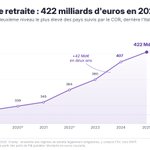
Petite bombe de l’IGF qui révèle une mascarade inconnue du grand public et qui explique pourquoi on a l’impression que l’état est à poil sur toutes ses dépenses régaliennes et éducatives, alors qu’elle n’apparaît pas si mauvaise en comparisons internationales et que les milliards semblent bien là.
Le secret : pour ne pas faire apparaître l’immense déficit des retraites, on impute des cotisations sociales allant jusqu’à 80% du salaire des fonctionnaires. Ce qui gonfle tous les budgets.
Ainsi non seulement on empêche de prendre conscience d’à quel point le système est déficitaire, que la retraite des fonctionnaires est sur le point de devenir le premier budget de dépense de l’état, mais aussi on fausse toutes les comparaisons internationales.
En réalité sur le régalien la France est proche du bas de classement, parce qu’elle crame tout son argent en retraites.
J’ai fait quelques graphes pour expliciter.


yam retweeted

Intéressant article sur les frigos Danfoss claroty.com/team82/research/…
@bluetouff (notez la date)


