

consciousness, AI, mech interp, neuroscience · MATS 11 fellow @goodfireai · integrated information theorist · author of PyPhi https://xitter.cf/t.co/Xw02ol29S9
Madison, WI
Joined June 2012
- Tweets249
- Following717
- Followers333
- Likes944






Pinned Tweet
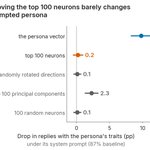
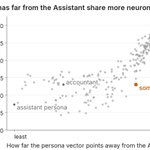
Persona vector steering is sparse in the neuron basis, and the neuron basis is privileged for this! 🧵
Steering just 100 of Qwen3-8B's ~440k neurons has the same effect as a persona vector, while steering the top directions of a randomly rotated or PC basis doesn't work.

Takeaway: for persona steering, sparse sets of neurons are as effective as difference-of-means vectors!
Explore neurons & persona vectors here: willmayner.com/persona-neuro…

Inspired by @nickcammarata's post (@goodfireai), @Sauers_'s and @maxsloef's work with character neurons, @jfonsecarivera's and @_lyraaaa_'s neuron character libraries, and @aryaman2020 et al.'s excellent work (arxiv.org/abs/2601.22594)
Code & data: github.com/wmayner/persona-n…

i'm baby qwen-neurons-site.vercel.app…

i made a library of 34,220 persona neurons in qwen
please help me find the weirdest ones:
qwen-neurons-site.vercel.app…


Will Mayner retweeted

The most ambitious vision for interpretability has long been to reverse-engineer a model well enough to answer an arbitrary question about how it works.
For years, that’s seemed out of reach. Now, we think it’s possible. Neural networks are cleaner than we thought: we can now understand most neurons in models up to trillions of parameters. And agents can rapidly accelerate our progress.
But to get there, we need a concerted effort to unlock scaling laws for interpretability, where our understanding of a model grows predictably with compute.
That’s why we’re committing $10M to start a Human Genome Project for AI. Our ultimate goal is to reverse-engineer a frontier scale model and publish a living encyclopedia explaining how it works.
We don’t know exactly what we’ll find, and we can’t do it alone. We hope you’ll join us. Our chief scientist @banburismus_ lays out the vision here:

if any science should be revolutionised by AI, it should be interpretability. I wrote about how we can accelerate progress, and why we need a Human Genome Project for AI. coauthored with @mathildepapillo
claude can prompt other claudes in tmux sessions *as the user* by directly sending text input to tmux
which means... claude can prompt itself as the user (°ー°〃)

Will Mayner retweeted

There has been much discussion recently about how interpretable neurons in LLMs are. Today we're announcing our paper from January's cohort of Anthropic Fellows, where we show neurons may be a stronger basis for interpretability than commonly assumed. 🧵 (1/6)

Will Mayner retweeted

LLMs can mimic thought and feeling with uncanny skill, but intelligence alone is not enough for subjective experience
go.nature.com/3VSXWQ4

Will Mayner retweeted

it’s been a dramatic couple of days, I didn’t expect the already clean essay to be read so widely. I've heard more interesting discussions about mechanistic interpretability – should we think mostly in features or mechanisms and the flow of data through them, how much do weak activations matter, how does scale change things, and lots of other questions – than I have in a long time and I’ve been happy to hear all the discussion!
a couple things on the essay itself. it didn't have enough citations, only ones for the basic story, since it was an "informal research essay and working hypothesis" rather than a paper, and other prior work around neurons were in the technical paper we're still finishing up. but it blew up, so I've added citations to the essay as well. I also want to thank @curttigges who did a lot of the language neuron research with me
finally, while there was quite a range of updates, from this being incremental and obvious to interpretability going from hopeless to fully solved, I want to try to be clear about roughly where I stand
I used to think neural networks would take some big cleaning step and then we could begin the ordinary natural science of mapping the parts and how they connect, watching data flow through, mapping circuits, and so on.
at various points, like late layers of early model organisms and most layers of language models years ago, this didn't really work. but now with better tools and better models of study, it works much better
for smaller vision models, this normal science process worked surprisingly well, until the whole map started to be broadly filled in. For bigger modern language models, it seems promising so far, for both neurons and circuits, attribution graphs, basically everywhere we've glanced. the map isn't filling in, there's a lot of map. there's still off-target firing, neurons that do a few things, but so far it's not an incoherent mess that you can't explore and learn from, and over time we get better at learning how to see it.
so maybe it keeps going, and mapping motifs and exploring actually gets you pretty far, maybe something like "all the way" to a reasonable solution. I don't think it would be so scientifically surprising if that were the case. everything in the neural network was built in some sense to be read – by its downstream readers – and if we can learn to look like a reader, we might find reading them relatively easy. many researchers I talk to outside interpretability assume the parts are already understandable, and the difficulty is just in the mapping stage!
it was also my prior when I first started looking at neurons when I first joined the field. there's lots of highly interpretable ones, maybe that's just how neural networks are if you look right.
even in the good world it would still take some iteration on tools, on ways of looking, neuron-attention interactions are tricky for instance. there's probably no bright red line separating "cleaning the model" from "learning to look better" but there's broad working principles, and as of now I think we should try to look relatively directly if we can
it shouldn't be so hard to test, you can just start looking at things and iterating and trying to understand motifs and such and see if it just breaks down at some point. it can take some iteration, I would recommend a bias against assuming arbitrary mixtures when you don't understand something at first, but also explanations should be tested
for now I'm pretty optimistic, and I'm glad there's excitement about interpretability, but too much can cause problems too. I think part might be that ai safety isn't a very hopeful field, and even moderate amounts of optimism about an important problem being solvable in the future fills a spot that has been malnourished for a while. across several safety disciplines, the researchers directly working on them are often more optimistic than the people broadcasting pessimism more broadly
for neural network interpretability at least, these are extraordinarily experimentally accessible objects of science, I don't know of a better one, and we have automated scientists. we have many things going in our favor. it's important and it's fun. the circuitry of these machines can be beautiful, surprising, entertaining, and insightful. I've spent thousands of hours looking through them, asking questions and running experiments and testing things, and would do so even if it weren't so important. I think the problem is solvable, whether the simple thing works, it mostly works but we need some new things, or we need big new ideas. I think we can figure it out
there may be some parallels between this work and a line of thinking in neuroscience where neurons don't "code" for things so much as *do* things; the right mental model is of the brain as dynamical system. Romain Brette has an excellent paper on this pubmed.ncbi.nlm.nih.gov/3071…
(and a recent book, "The Brain, in Theory")


interpretability might be the most important scientific problem in the world right now, as I don't think we can solve alignment if we don't know what we're building. I think I have good news about it. I co-authored early work in mechanistic interpretability at OpenAI and came away pessimistic, because neural networks appeared to fold into arbitrary tangled knots. years later, I started openai's first large-scale automated interpretability project, finding about 2% of neurons legible with the primitive tools we had
with modern agentic tools and a much closer look, the picture looks totally different. the vast majority in models up to trillions of parameters are legible, and their circuits beautiful. many famous examples of tangled neurons turned out to be misunderstood. The roadblocks I expected mostly aren't there. I now think ambitious interpretability will be solved by the time we need it most, and possibly quite soon, as automated scientists keep improving. it may be a bitter lesson for interpretability: the simple thing, at absurd scale, works
already-clean.goodfire.com/

Will Mayner retweeted

This might be the most important essay of 2026.
My conversations with Nick over the past few months about his research have given me great hope for the future. I'm so happy he is sharing these findings with the world.
AI presents extremely difficult problems. We can all assume these problems are intractable and that we are doomed, or we can try and solve for a positive future.
Personally, I choose optimism. There are many challenges ahead... let us build the tools to face them head on.
interpretability might be the most important scientific problem in the world right now, as I don't think we can solve alignment if we don't know what we're building. I think I have good news about it. I co-authored early work in mechanistic interpretability at OpenAI and came away pessimistic, because neural networks appeared to fold into arbitrary tangled knots. years later, I started openai's first large-scale automated interpretability project, finding about 2% of neurons legible with the primitive tools we had
with modern agentic tools and a much closer look, the picture looks totally different. the vast majority in models up to trillions of parameters are legible, and their circuits beautiful. many famous examples of tangled neurons turned out to be misunderstood. The roadblocks I expected mostly aren't there. I now think ambitious interpretability will be solved by the time we need it most, and possibly quite soon, as automated scientists keep improving. it may be a bitter lesson for interpretability: the simple thing, at absurd scale, works
already-clean.goodfire.com/
Will Mayner retweeted

when nick told me that he had some interp breakthroughs, he was uh, underselling it. i think this may be remembered as a major moment in scientific history. news so good even eliezer will have to lower his pdoom. we can start making alignment into a 'normal science'
interpretability might be the most important scientific problem in the world right now, as I don't think we can solve alignment if we don't know what we're building. I think I have good news about it. I co-authored early work in mechanistic interpretability at OpenAI and came away pessimistic, because neural networks appeared to fold into arbitrary tangled knots. years later, I started openai's first large-scale automated interpretability project, finding about 2% of neurons legible with the primitive tools we had
with modern agentic tools and a much closer look, the picture looks totally different. the vast majority in models up to trillions of parameters are legible, and their circuits beautiful. many famous examples of tangled neurons turned out to be misunderstood. The roadblocks I expected mostly aren't there. I now think ambitious interpretability will be solved by the time we need it most, and possibly quite soon, as automated scientists keep improving. it may be a bitter lesson for interpretability: the simple thing, at absurd scale, works
already-clean.goodfire.com/