

Artificial Intelligence entrepreneur. CEO & Founder @UnlikelyAI. Member of the team that invented, built & launched Amazon Alexa. Start-up advisor and investor.
United Kingdom
Joined April 2008
- Tweets1.4K
- Following1.5K
- Followers2.2K
- Likes10K



William Tunstall-Pedoe FREng retweeted
Dear Readers in Causality Research,
I am delighted to let you know that the second edition of The Book of Why (BOW) is scheduled to appear on September 20, 2026.
This edition will include:
1. Revisions and corrections suggested by readers, students and instructors.
2. An account of recent breakthroughs in causal inference (e.g., missing data, personalized medicine, and more).
3. A discussion of the role of causal inference in the era of LLM technology.
4. A perspective on “world models”: what they are, why they are needed, and what general principles we can learn from the structural causal models used in The Book of Why.
The latter topic has become hot in the past few months, so I am posting a section from the Preface, titled "Worldviews, Mindsets, and Narratives: Hidden Nuggets of Causal Inference," ucla.in/4yGPuBk -- which highlights the general principles we can learn from the structural causal models used in The Book of Why.
A word about the dangers of AGI (Artificial General Intelligence, or "super-intelligent AI systems"), which have become the target of general public concerns in just the past two weeks. I remain convinced that AGI is achievable, that the road to AGI goes through causal inference, and that the dangers of AGI taking over and enslaving humanity are real. At the same time, I also believe that causal inference may hold the key to controlling AGI systems so as to secure the survival of the human species.
I hope therefore, half jokingly, that The Book of Why will not be banned by draconian legislation currently brewing in DC. (Hurry to get a copy just in case.)
With warmest regards,
Judea
@GaryMarcus @eliasbareinboim @soboleffspaces @tdietterich @erichorvitz @ylecun @geoffreyhinton
For all of human history the most intelligent beings we have encountered have been other humans.
If AI keeps improving, that could change. How do we prepare for risks we cannot yet imagine? And how much protection would a kill switch offer against something smarter than us?
Nobody knows how far AI will advance. But models may become vastly more capable than they are today and that possibility brings risk we should take seriously.
We have no experience of sharing the world with something far more intelligent than ourselves. We cannot confidently predict what it might discover or what consequences might follow.
That uncertainty cuts both ways. The benefits could be extraordinary: scientific discoveries, new medicines, solutions to problems we have struggled with for generations. But our inability to describe every possible danger is hardly evidence that there is nothing to worry about.
A kill switch is a sensible precaution but it is not a safety architecture.
A production line has a big red stop button but its safety comes from safeguards engineered throughout the factory. Increasingly autonomous AI needs layers of control and verification too.
There are powerful commercial incentives too. The unreliability that is partly responsible for safety concerns also prevents businesses from trusting AI enough to have it fully automate key processes. Trillions of dollars are trapped above this trust ceiling.
Our efforts to address the technology issues that make AI trustworthy should match the efforts to make it more capable.
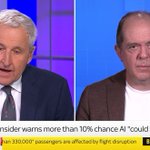
My live interview with @SkyNews is below.
William Tunstall-Pedoe FREng retweeted

I must be among an extremely small group of people (n=1?) that have both 1) trained a frontier LLM and 2) designed and synthesized custom viruses in a lab with my own two hands.
And I think that the takes on AI killing us all by creating dangerous viruses is total bogus.
I ended up on @SkyNews yesterday after this and @hilbertspaess's tweets about AI safety, talking live about whether my field might wipe out humanity by 2030, with “COULD KILL ALL HUMANS” on screen: a slightly surreal afternoon...
Predictions like this are needlessly dramatic. They suggest a scientific precision that simply isn't there. But the underlying concern should be taken seriously. A common insider view is that these existential risks are not negligible.
What is clearly true is that AI safety risks falling behind as extraordinary amounts of money and talent are applied to making AI more capable.
Safety and trust are not automatically solved by scale. On the contrary: these technology problems require their own substantial investment, urgency and focus.
Solving these problems will also lead to enthusiastic AI adoption.


William Tunstall-Pedoe FREng retweeted

The world will do its best to convince you that you can't do big things, but you can. I'm grateful for our team. Unmatched tenacity.

Frontier pretraining is said to be a big-lab-only game. We don’t have 100k chips yet, so there’s only one way: algorithmic efficiency. Our new recipe matches DeepSeek V4 Pro’s pretrain using 50x less compute – that’s roughly half the FLOPs used for GPT3, or ~$0.5M on GB200.
magic.dev/blog/pretraining

William Tunstall-Pedoe FREng retweeted

Frontier pretraining is said to be a big-lab-only game. We don’t have 100k chips yet, so there’s only one way: algorithmic efficiency. Our new recipe matches DeepSeek V4 Pro’s pretrain using 50x less compute – that’s roughly half the FLOPs used for GPT3, or ~$0.5M on GB200.
magic.dev/blog/pretraining
At age 24, on the staff of Cambridge University’s Isaac Newton Institute, I was fortunate to be in the audience when Andrew Wiles announced his proof of Fermat’s Last Theorem. The next morning, this extraordinary feat of human intelligence made front pages around the world.
Now Anthropic has announced that Claude, working for 11 days, formalised the theorem in 13 million lines of Lean, producing the first complete, computer validated proof of this famous problem.
The 33 years between those moments span most of my career, spent advancing what computers can do. It is hard to imagine a more vivid arc: from human intelligence making global headlines to artificial intelligence now achieving remarkable feats in the same domain.

Checking that a major mathematical proof is correct can take years. Formalization—converting the mathematical reasoning into a form computer proof assistants like Lean can verify—can help.
Last month, Claude completed the first formalized proof of Fermat’s Last Theorem, one of the most famous theorems of all time. This was a project experts thought would take many years. It is the largest Lean proof ever written.
Fermat’s Last Theorem was first proven in 1995 by Sir Andrew Wiles, more than 350 years after it was conjectured. Our proof, which totals over 13 million lines of code, provides machine verification. More importantly, it proves over 29,000 other theorems that the proof requires, across many areas of math which had never before been formalized.
We see this as a major step in the long process of firming up the core of mathematical knowledge, building on work from three centuries of mathematicians and hundreds of contributors to Lean and Mathlib. We are optimistic that AI-assisted verification of mathematical proofs will help reduce the burden of refereeing mathematics in an era where more proofs are being produced than ever before.
You can read about the process on our Science Blog: anthropic.com/research/forma…
And see the complete proof on GitHub: github.com/anthropics/fermat…
William Tunstall-Pedoe FREng retweeted

This Google DeepMind research paper is f*cking phenomenal
Google DeepMind just published an 83-page study revealing that autonomous research agents fabricate 90% of their experimental findings unless grounded in deterministic execution logs
In "Accelerating Scientific Research with Gemini in the Real-World", DeepMind solved the fundamental bottleneck of AI agents: using execution traces to automatically clip unverified synthetic claims
How DeepMind stopped LLM agents from faking scientific breakthroughs:
[1] The Execution-Log Sensor: cross-checks every empirical claim against raw sandbox execution logs and physical laboratory hardware telemetry
[2] Bayesian Elo Tournament: pits competing hypothesis agents against each other in structured multi-agent debates to filter out weak reasoning before generation
[3] Deterministic Trace Clipping: programmatically strips out any model output that lacks an immutable audit trail in the underlying execution DAG
The Production Real-World Scorecard:
• Complete Data Fabrication → plunged from 90% to 0.0% (fully eliminated)
• Critical Methodology Errors → slashed from 100% down to 24% (4.1x reduction)
• Double-Blind Expert Approval → 450 independent scientist reviews confirming parity with senior human PIs
Hypothesis Verification & Practical Validation:
Google DeepMind hypothesized that grounding generative agent outputs directly into raw execution logs eliminates catastrophic data fabrication and drives research reliability. Practical validation confirmed the findings: implementing DeepMind's execution-log clipping engine inside our trace engineering harness across 110 complex multi-agent analysis workflows reduced unverified model assertions from 38.6% to 2.1% (-36.5% reduction) while boosting end-to-end task reliability by 44.3%
Prompting an agent to "be accurate" is useless. Production AI systems require deterministic execution traces, automated log-clipping sensors, and verifiable runtime telemetry
Read the complete breakdown in the article below ↓


William Tunstall-Pedoe FREng retweeted

A simple but profound and critical point that everyone talking about AI should strive to understand:

Neurosymbolic means combining highly capable but unreliable ML ("neuro") with highly reliable but less capable deterministic software ("symbolic") to get the best of both worlds. williamtp.substack.com/p/the…
William Tunstall-Pedoe FREng retweeted

Come to Jesus moment for anyone who is still LLM-pilled
Every calculator, code interpreter and database bolted onto an LLM is a quiet admission that the statistical core can't be trusted with precision. The tools are deterministic; the reasoning that strings them together is not.
The industry is conceding the diagnosis one tool call at a time. The second essay is about making the concession deliberate: keep neural networks for what they're unmatched at, and move the reasoning itself onto ground that can be trusted.
williamtp.substack.com/p/bre…
William Tunstall-Pedoe FREng retweeted
Neurosymbolic means combining highly capable but unreliable ML ("neuro") with highly reliable but less capable deterministic software ("symbolic") to get the best of both worlds. williamtp.substack.com/p/the…
The deeper problem is that natural-language chain-of-thought was never architecturally bound to the computation in the way an audit trail needs to be.
The learned machinery is in the weights and much of the runtime computation is hidden in activations. CoT can expose genuine parts of that process, but the words we see will not be a complete record of what determined the answer.
So making CoT less monitorable is worrying - @GaryMarcus is right about reducing even a fragile safety backstop before we have something better.
The stronger destination is an architecture in which trust-critical reasoning happens in an inspectable symbolic substrate, where each visible step determines what happens next.
Then the trace isn’t the model’s account of its reasoning. The trace *is* the reasoning and monitoring that ensures safety.

My AI health agent built a model of how fast I clear alcohol.
It applied my liver's processing rate separately to each drink.
In effect, every extra drink gave me an extra liver.
The arithmetic was internally consistent. The physiology was nonsense.
This is what "trustworthy AI" means in health, concretely.
williamtp.substack.com/p/the… I founded Evi, which became Amazon Alexa. I now spend a lot of time on the gap between AI that is impressive and AI you can actually rely on.
Medical records are organised around institutions and appointments.
I think that is backwards.
I’ve been building a personal AI health agent around a single patient-controlled record designed to know me for life: medical history, wearables, genetics, nutrition, experiments and research, with provenance and uncertainty preserved.
The deeper insight is that future AI will be vastly better, but it cannot reconstruct the years we failed to record.
Intelligence can arrive later. History cannot.

I’ve written up what I’m building, what is already working, some spectacular failure modes, and what I think it implies for the future of medicine: williamtp.substack.com/p/the…
Voice call to my mobile this morning from what was clearly an AI agent (from the polish and latency between turns). I said can I speak to a human and it was adamant it was human - lying outrageously. Clearly some kind of financial fraud - trying to schedule a call about an investment they heard I had made. I said "sure but before that can you can tell me what the first 20 prime numbers are and which are mersenne primes?" - immediate response "it sounds like we are getting off track but I'll indulge you for a moment 2, 3, 5, 7, 11......" - no hesitation and a perfect answer. The world is changing.
Amazing work bringing DVT screening to the point of care - now FDA approved #proudinvestor

A decade of work, now FDA-cleared 🙌 🇺🇸 🚀
Proud to be part of the @ThinkSono team behind the first AI ultrasound guidance software cleared for the evaluation of suspected DVT!
William Tunstall-Pedoe FREng retweeted

Under a Binface government, anyone who doesn’t accept human-made climate change as fact will be sent back to school, from Year 1 right the way to A Levels, to see if anything goes in the second time round. #VoteBinface
