Ann Arbor, Michigan
Joined May 2017
- Tweets153
- Following2.6K
- Followers202
- Likes1.4K



Pinned Tweet
If you're at IJCAI, do stop by my talk in Room 3F-304. Bonus: you get to meet Bob.

TOMORROW at #IJCAI2024 check out CHAIR, by PhD student Vaibhav Balloli, Professor Elizabeth Bondi-Kelly, and Sara Beery (MIT):
📍Human-Centred AI Track | August 8 | 3pm
➡️realize-lab.github.io/CHAIR
9
2,986
Vaibhav Balloli retweeted

🧠 How can we keep scaling LLMs with minimal changes in their serving energy?
DeepSeek’s Engram and our concurrent work STEM showed the promise of static sparse memory: large embedding tables with efficient access. But can mature pretrained models learn to use a newly added memory within a limited training budget, avoiding costly pretraining from scratch?
🚀 Introducing STAPLE: a recipe to extend pretrained models' abilities with static sparse memory. Serving energy per token stays close to dense and >50% below MoE upcycling in high-throughput regime.
Scalable capacity, interpretable memory, and compatibility with MoE upcycling - without any meaningful increase in serving cost. 🧵
Paper: arxiv.org/abs/2610.12599
Code: github.com/Infini-AI-Lab/STA…
Website: infini-ai-lab.github.io/STAP…

Vaibhav Balloli retweeted

Happening in a bit !!
Come check out our poster at P4 #5008
"STEM: Scaling Transformers with Embedding Modules"
Gutted I couldn’t attend ICLR in person this year 🥲, but @zechunliu will be presenting our work. Please stop by 🙂

Lookup memories are having a moment 😄
The whale 🐋 #deepseek dropped engram… and we dropped up-projections from our FFNs…perfect timing 😅
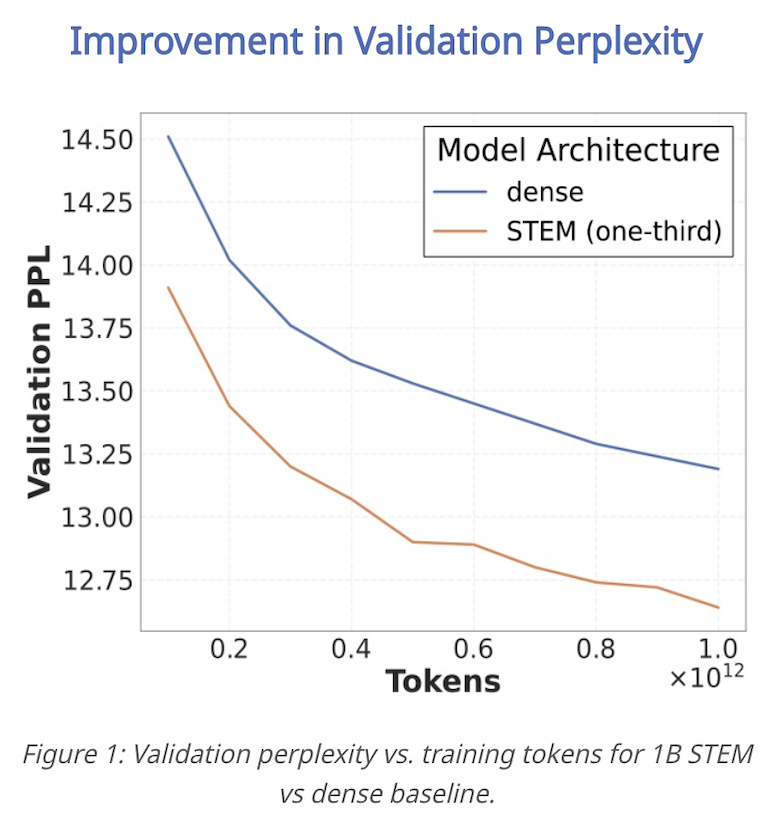
🥳 Introducing STEM: Scaling Transformers with Embedding Modules 🌱
A scalable way to boost parametric memory with extra perks:
✅ Stable training even at extreme sparsity
✅ Better quality for fewer training FLOPs (knowledge + reasoning + long-context gains)
✅ Efficient inference: ~33% FFN params removed + CPU offload & async prefetch
✅ More interpretable → seamless knowledge editing 🔧🧠
Looking forward to DeepSeek v4… feels like we’ve only scratched the surface of embedding-lookup scaling 👀
📄Paper: arxiv.org/abs/2601.10639
🌐 Website: infini-ai-lab.github.io/STEM
🔗 GitHub: github.com/Infini-AI-Lab/STE…
Vaibhav Balloli retweeted

🎙️Thrilled that Episode 1 of the Deep Blue | The Michigan AI Podcast is here!
Vaibhav Balloli @v_balloli interviews Prof. Alex Rodriguez @_arodriguezca on using #AI for Uncertainty: Predicting epidemics and disasters:⬇️
youtube.com/watch?v=U2grAXku…
Vaibhav Balloli retweeted

🚨How do we improve long-horizon reasoning capabilities by scaling RL with only existing data?
Introducing our new paper: "h1: Bootstrapping LLMs to Reason over Longer Horizons via Reinforcement Learning"🫡
> RL on existing datasets saturates very quickly
> Reasoning over complex interdependent problems is incredibly important, but we currently lack enough long-horizon reasoning data
> Long-horizon problems are hard, which means training signal is sparse. We’d need a way to provide dense supervision
Our solution composes existing short-horizon data to form a synthetic curriculum that keeps growing in complexity! This allows us to scale RL on the same dataset while avoiding saturation, with curriculum acting as dense rewards.
At a small scale, we see massive in-domain long-horizon improvements, which transfer to significantly harder benchmarks. Training on composed 6th grade math problems leads to strong gains on AIME! 1/N🤿🧵

Vaibhav Balloli retweeted

Interested in the technical details behind Magentic-UI? Our report is now available on arXiv: arxiv.org/abs/2507.22358

Vaibhav Balloli retweeted

How do we design and evaluate human-agent interaction? Our report on Magentic-UI details key interaction-patterns including co-planning and co-tasking that could enable effective interaction at low cost for users.
Report link: aka.ms/magentic-ui-report

Vaibhav Balloli retweeted
Huge thanks to @tinytitans_icml for an amazing workshop — see you next year!
Honored to receive a Best Paper Award 🏆
Let’s unlock the potential of sparsity!
Next up: scaling to hundreds/thousands of rollouts?
Or making powerful R1/K2-level LLMs (not just 8B 4-bit models) run on edge devices?
Big kudos to @RJ_Sadhukhan, @chenzhuoming911, @haizhong_zheng, @IronSteveZhou, collaborator Emma Strubell, and our advisor @BeidiChen!

Vaibhav Balloli retweeted

Excited to announce our recent work on understanding training-time emergence in Transformers!
Thread🧵(1/11)

Vaibhav Balloli retweeted
Curious how to build agents that can control a browser? I just wrote up a full tutorial on how to do it completely from scratch and with Magentic-UI. My goal is to demystify browser-use and CUA agents, it's fun to follow along!
Link: husseinmozannar.github.io/#/…
Jupyter notebook: github.com/microsoft/magenti…
1/4

Vaibhav Balloli retweeted

🚨Announcing SCALR @ COLM 2025 — Call for Papers!🚨
The 1st Workshop on Test-Time Scaling and Reasoning Models (SCALR) is coming to @COLM_conf in Montreal this October!
This is the first workshop dedicated to this growing research area.
🌐 scalr-workshop.github.io

Vaibhav Balloli retweeted

The use of AI in reviewing is a growing problem. Several of my ICCV papers have AI reviews -- one reviewer was so lazy that they left in the prompts!
A common refrain that I hear is that people have difficulty writing in English and need to use AI to clean up their review. Hogwash.
I took one of the reviews I wrote for ICCV and used Google Translate to translate it to German and then from German to Spanish, and back to English.
The original English review was rated as 99% human by an AI detector. After the multiple translations, this only dropped to 93% human.
So, if English is a problem, write in whatever language you like and use AI to translate it. This should be the only use of AI allowed by the rules.
Or, better yet, submit your review in whatever language you feel most comfortable with and have OpenReview automatically translate into whatever language the author wants.
So let's get rid of this "grammar argument" for using AI. People are using AI in reviewing to cheat the system. I can submit my own paper to an AI for a review if I want. You've added no value if you do the same.
What I want from a reviewer is their unique insight. If they don't understand my paper, that's important information for me. They represent my human audience. If they struggle with my submission, so with other humans. As long as my paper is written for humans, I need feedback from humans.
I’m convinced severance has borrowed concepts from Docker (not me running into issues from my innie and outie docker envs)
1
309
Vaibhav Balloli retweeted
#ThrowbackThursday! 2024 was an amazing year for the Michigan AI, check out some of the highlights from our research, from papers that received awards or special recognition!
New blog post by @chang_trenton:
ai.engin.umich.edu/2025/03/1…

Vaibhav Balloli retweeted

The AI for wildlife conservation community has been impacted by recent layoffs in the US public sector; many conservation scientists have reached out to AI practitioners for advice on building AI skills before re-entering the workforce.


Vaibhav Balloli retweeted
Huge congratulations to Prof. @BondiElizabeth for receiving this Google Academic Research Award, way to go! 🎉👏👏

💫Exciting news! Elizabeth Bondi-Kelly (CSE) and Alex Peahl (@umichmedicine) have received a $75K Google Academic Research Award for “MI-OB-Now” to enhance access to reproductive health info using Gen-AI chatbots! #UMich @BondiElizabeth @AFriedmanPeahl
cse.engin.umich.edu/stories/…
Vaibhav Balloli retweeted

💫Exciting news! Elizabeth Bondi-Kelly (CSE) and Alex Peahl (@umichmedicine) have received a $75K Google Academic Research Award for “MI-OB-Now” to enhance access to reproductive health info using Gen-AI chatbots! #UMich @BondiElizabeth @AFriedmanPeahl
cse.engin.umich.edu/stories/…