

Our mission is to accelerate superintelligence to drive real economic progress.
Palo Alto, CA
Joined September 2018
- Tweets10.3K
- Following2.4K
- Followers17.6K
- Likes9.8K





Turing retweeted

SVC and CEO Bench will evolve into irl
bench.turing.com/ceo-bench/a…


Turing retweeted

#StartX alum @Jonsid, founder and CEO of Turing ($2.2B valuation), says zero-to-one always comes down to 3 things: capital, first customers, early team.
He calls his time here as one of the most educational parts of building it.
Apply: startx.com/apply?s=app_campa…
#StanfordFounders
Turing retweeted

We're building a strong research team at @turingcom. Hiring at all levels to work on:
- The science of data generation and RL environments
- Post-training and RL
- New benchmarks and evals for frontier models
You'll publish and collaborate with academia. DM if interested.
Turing retweeted
The right name for what the frontier labs are building.
Proud to help them build it.
@turingcom


Turing retweeted

How do deeptech startups build for longevity in a rapidly evolving AI landscape?
Nasscom’s 18-startup #InnoTrek2026 delegation visited StartX - Stanford University's non-profit, zero-equity founder community (home to 1,500+ startups and 30+ unicorns) - to unpack what it takes to scale global ventures.
3 Strategic Takeaways:
• Build for tomorrow's AI, not today’s gaps: Avoid merely "plugging current holes" in AI models. Focus on core value propositions that compound as foundation models advance.
• Embrace AI as an empirical science: Traditional playbooks are shifting. Success demands hands-on experimentation with frontier models and rapid adaptation to emergent properties.
• Leverage cross-border networks: Bridging Indian tech talent with Silicon Valley’s mentors, strategic partners, and investors accelerates global market reach.
A powerful exchange reinforcing India’s role in shaping the global deeptech ecosystem
#DeepTech #IndiaUS #Startups #Innovation #InnoTrekUSA2026
@StartX @turingcom @doshikavita @nasscomdeeptech


Turing retweeted
SciCode++ is here, with ~6,000 tasks that test how well frontier models solve scientific problems through code.
SciCode introduced executable scientific coding problems. SciCode-Verified showed how often flawed specifications and tests can distort the results. SciCode++ turns those lessons into a production process: domain experts write the tasks, independent reviewers check them, executable tests validate every subproblem, and model runs calibrate difficulty. That helps separate model capability gaps from eval issues.
Early results post-training Qwen 3.5 9B on 4,000 of the 6,000 tasks: +10.3% on SciCode and +9.1% on SciCode-Verified relative to baseline.
turing.com/blog/scicode-plus…

Turing retweeted
The Turing Frontier Research Lab is launching KernelQuest, a benchmark that tests whether AI agents can perform the full job of GPU kernel optimization.

Turing retweeted
Turing welcomes Patrick McKinney as Chief Information Security Officer.
As AI becomes more capable and more deeply embedded in how companies operate, security, privacy, and responsible data stewardship have never been more important. As we scale our work with frontier AI labs and Fortune 500 enterprises, Patrick will lead our global security strategy with a deeply technical, hands-on approach.
Patrick will help set the security bar for our Frontier AI work with leading labs on training data and evals and drive new security research and benchmarks like CyberStrike. He’ll also work directly with enterprise customers and their security teams as we deploy agents in highly regulated environments, helping answer the hard security questions that come with putting AI into production. Across this work, he’ll help protect the data entrusted to us and strengthen our security capabilities across cloud identity, detection engineering, incident response, and offensive and defensive security.
Patrick brings more than 15 years of experience building and scaling security organizations, including leadership roles at Invisible Technologies and security and compliance roles at Dropbox and Coinbase.
Welcome to Turing, Patrick!

Turing retweeted
Last week, the Turing Frontier Research Lab launched KernelQuest, a benchmark that tests whether AI agents can perform the full job of GPU kernel optimization.
KernelQuest contains 100 engineer-authored Triton tasks across 21 kernel families. Each task gives an agent a live environment where it can profile a PyTorch workload, write and revise kernels, and measure performance. The tasks range from single operators and fused workloads to complete models and large Transformer/MoE workloads.
Learn more in the article below:


Turing retweeted
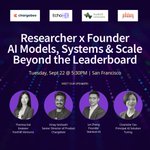
What drives AI performance beyond the leaderboard?
We’re joining Foothill Ventures, EchoHer, Chargebee, and Pillsbury Winthrop Shaw Pittman LLP for an intimate, closed-door conversation with approximately 50 AI founders, builders, and researchers.
The discussion will explore what it takes to build AI systems that perform and businesses that scale, including:
- Models vs. systems
- Production evaluations
- Reliability
- Inference economics
- Durable product advantage
@Turingcom’s own Charlotte Tao, Principal, Frontier AI Solutions, will join:
-Vinay S., Senior Director of Product at Chargebee
-Lei Zhang, Founder and CEO of Stardust AI
The conversation will be moderated by Theresa Dai of Foothill Ventures.
Curated guests. Focused topics. Thoughtful conversations with founders, builders and researchers.
RSVP below.

Turing retweeted
@Jonsid built Turing, now valued at $2.2B and one of StartX's 29 unicorns. His take: "Our StartX experience has been phenomenal. I learned a lot from the other founders in our class, as well as the community."
Apply: startx.com/apply?s=app_campa…
#StartX #EnterpriseAI
Turing retweeted

In today's episode, I sit down with Ariful Huq from @exaforceAI and Patrick McKinney from @turingcom and talk about the AI-powered SOC. Patrick has been an Exaforce customer for years and brings real-world experience to the conversation.

Turing retweeted
To get to ASI we likely need auto-meta-research, not just auto-research.
Auto-research hill climbs within the current recipe. Minimize pretraining loss, maximize post-training evals.
Auto-meta-research defines new objectives. An outer loop that searches across paradigms. Outside deep learning, maybe even outside gradient descent. Not just scaling transformers + RL.
The inner loop optimizes the recipe. The outer loop questions the recipe.
Turing retweeted
Lesson from the DeepSeek-V4.1 technical report:
"...the marginal return of engineering the data and environment pipeline substantially exceeds that of algorithmic novelty in post-training."
My 2 cents. The interesting part isn't data > algorithms. It's that the distinction is collapsing. Look at what their pipeline actually does: synthesizes verifiable tasks with reward signals, builds interactive agent environments, calibrates difficulty and curriculum at scale. That's not just data collection. That's research. Some of the highest leverage research is happening in the data + environment pipeline.
We are in the era of research AND scaling up.
The current recipe doesn't need to work forever. It only needs to help us find the next S curve.

Turing retweeted
When I started Turing, I thought about human capability in three levels.
Level 1: Task scope. You own the task's success. You're given a task. You execute it.
Level 2: Objective scope. You own the objective's success. You're given an objective. You figure out the tasks. You iterate in task space.
Level 3: Company scope. You own the company's success. You're given the mission. You propose the objectives. You iterate in objective space.
The best ICs I've hired operate at objective scope and above. The best managers I've hired operate at company scope.
The same ladder maps to AI today.
Most of what we call recursive self-improvement is still objective scope. The objective is fixed: minimize pre-training loss, maximize performance on a benchmark or a private eval. The model iterates in task space against it.
The next level of AI progress comes when models can pick the right objectives to hillclimb.
That's company scope. And it carries real safety and alignment risks. A model optimizing an objective you gave it and a model choosing its own objectives are very different things to align.
What's the analog to company scope for ASI?
Turing retweeted
Turing's focus right now:
1.Automate AI research
2.Automate engineering
3.Automate knowledge work
4.Automate scientific discovery
The models come from frontier labs. The training signal comes from us. Data, evals, and RL environments built from real workflows. Hard enough that today's best models still fail.
AI research sits at the top for a reason. Automate that, and everything below it compounds.
If you're training models toward any of these four and need environments that don't saturate, DM me.
Turing retweeted
Introducing CEO Bench by @turingcom : 500+ expert-authored tasks inside a complete simulated company with human experts in the loop and agentic QC on every task.
turing.com/blog/ceo-bench-fr…
