

early literacy + ai • @Superbuilders • @AlphaSchoolATX • prev @gauntletai cohort 1
Austin, TX
Joined September 2015
- Tweets6.8K
- Following813
- Followers2.9K
- Likes14.4K



Pinned Tweet
one of the best gifts you can give your child is one of the simplest, and completely free (in terms of money)
the "30 Million Word Gap" study is one of the most cited pieces of research in early childhood education
researchers followed 42 families for 2.5 years, recording every word. by age 3, children in professional families had heard 45 million words. kids in poverty: 13 million
the ramifications are long-lasting. even at ages 9-10, the kids exposed to more words had stronger language skills, vocabulary, and reading comprehension
there is also a socioeconomic disparity here. the good news is, this may be solvable by simple talking more! the bad news is, it may be harder than it sounds. perhaps the disparity exists in the first place because low-SES parents focus more on making ends meet than talking to their kids
so to summarize — you should be talk-maxxing as much as you can! narrate your day, respond to their babbling, read to them. talking is all you need

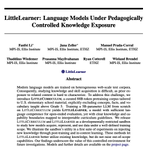
in this paper, they trained an ai model on a dataset that only goes up to 5th grade level curriculum. then they compared it to a model that was trained on an unrestricted version of the dataset
after supervised fine-tuning, they had the model do reinforcement learning, including on higher-level math problems. in my view, there are parallels between reinforcement learning in the context of ai and discovery learning in the context of education. the model attempts problems and gets feedback on whether it got it right, instead of being taught exactly how to do a problem
the result is that if the initial training only went up to 5th grade, doing reinforcement learning afterward didn't help as much. what helped a lot was when the model was pretrained on all grade levels, then the reinforcement learning was more effective

a student has decided to sing for their oral reading activities and i'm pleasantly surprised the ai is still grading it correctly
i never anticipated this scenario
background knowledge is a huge factor in reading comprehension
that's precisely why it's dangerous to only have kids read about things they're already into
every kid deserves the opportunity to have a foundational knowledge base upon which they can go read and then develop more knowledge in things they're interested in. you also can't even figure out what you're interested in until you know what the possibilities are
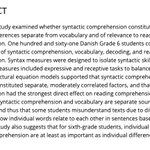
a study suggests syntax impacts reading comprehension at least as much as vocabulary!
previously, syntax has been overlooked because an inability to comprehend syntax can look similar to a lack of vocabulary... until this study isolated it
as per usual with integrationmaxxing, syntax instruction probably works best when woven in with reading and writing instruction
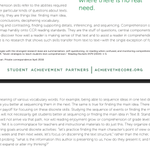
and another quote I liked from natalie's article: “Exposing children to complex syntax should begin early, through both oral language and read-alouds. One study found that preschool children who had been exposed to more diverse sentence structures were better able to understand those structures than their peers who hadn’t.”
I will definitely be incorporating some of these things into the app we're building


Looking for a (relatively) quick and easy way to improve kids' reading comprehension at higher grade levels?
Try teaching them to understand complex sentence structure. A recent study suggests it can be powerful.
More in my new post:
nataliewexler.substack.com/p…

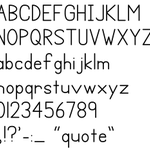
99.9% of fonts have letters that look similar to each other (even OpenDyslexic)
when you're reading passages, you can decipher similar letters due to the context. when you're teaching phonics and showing 1 letter or a handful of letters, you need more precision
our phonics app has a custom font with 2 design goals:
1) every letter is less likely to be confused with other letters
2) looks like how it would look when handwritten, because writing should be integrated with phonics instruction
we also have animations demonstrating how to write the letters

almost all irregular words can still be sounded out. the example word you gave — weapon — has 5 out of 6 letters that “follow the rules”
only one of the letters breaks the common phonics rules, which is the letter “o”
when you can sound out most of the word, it’s very feasible to figure out the word
that being said, if it were possible to get everyone to agree on simpler spelling, i’d be all for it!


Or the English spelling system sucks & has always sucked? No English-speaking kid has ever been able to decode & encode all English words in Grade 1 with or without phonics instruction. It takes many years. Virtually ALL Spanish & Finnish kids can decode ALL of their words by Grade 1. Tbf, reform ideas were despotic before, but the French showed us a better way lately.
As a retired learning disabilities teacher with a linguistics major & a post-grad diploma in learning disabilities, I know there are about 200,000 weird (illogical) spellings in English that are not phonics-friendly, if we extrapolate on Masha Bell's research (reforming-english.blogspot.c…). For instance, "awe" is not pronounced /ei/ + /w/ + /e/! Right? "The" is not /t/ + /h/ + /e/! 1000s of sight-words need to be memorized. There are 200 ways of spellings 44 sounds. (Ibid) Who buys or drives a car with that many defects? Who gives the keys to the beater to their kids? Phonics misses the mark ½ of the time though! One still has to deal with thousands of sight-words. How is phonics going to help with words that have unphonics-friendly parts like "weapon" & such? Dyk Orwell called the system tormenting (1) & Einstein said it was treacherous. Why is mentally torturing kids okay?
Dyk research in 2003 estimated the English spelling system delays the reading acquisition of all anglophones by 2.5 years & has always: scribd.com/document/19249268…. Let's have trials to assess how phonics perform & whole-word strategies do against these languages that have systematic, transparent spelling systems (that cause Grade 1 FULL decoding of all words by virtually all students) like Spanish & Finnish.
Tbf, there are some who can learn to read a bit faster by going to church, for one. There are also linguistically privileged parents giving an edge to their kids, all IQ being equal: educationnext.org/dont-dismi… . They can guess better at those weird spellings bc they have a bigger, passive vocabulary. Others look & sound dumb. Is this when & where racist beliefs starts? This could be tested too.
Anyway, imagine if kids could be independent learners by Grade 1 not 6 or later (not learn to be submissive & not need to learn nonsense that harmed our eyes & ears). (All Spanish & Finnish kids can decode all their words by Grade 1. Their system is systematic.) Teachers could be guiding, not shoving down the throat tens of thousands of weird "awes" & "ewes".
The French fixed their UNsystematic system a bit lately and, game-changer, did NOT force current users to relearn or use the new spellings. 0nly new generations were taught the new spellings. No shoving down the throat to ALL.
Longest answer with more proof & link:
xitter.cf/PeterDMayr/status/1766…
(1) telelib.com/authors/O/Orwell…
many problems in education stem from conflating the destination with the journey
2 examples:
1) sight words
a fluent reader should be able to recognize a lot of words by sight. but if you teach to memorize words by sight instead of phonics, you are actually causing a lot of harm that’s hard to undo
2) comprehension skills like “finding the main idea”
obviously a useful skill to possess! but you don’t train it by grinding “find the main idea” questions
learning how to read comes down to 2 things
1) can you sound out words (decoding)
2) do you understand what the words mean (language comprehension)
reading comprehension = decoding * language comprehension
both can and should be taught simultaneously. you need not wait for a student to have fully mastered decoding to start building the necessary pieces to comprehend
so then you may ask, how do you build comprehension without fully being able to decode. you provide scaffolds and deliver instruction orally when needed to build their knowledge, vocabulary, and grammar
authors of Common Core (Meredith Liben and Susan Pimentel) know that reading instruction should not be centered around comprehension strategies. then why are they included in Common Core? Common Core is intended to be "what students should be able to do" NOT "how should students be taught". many people make the mistake of thinking Common Core is the latter
was this an oversight by the Common Core authors? did they just not anticipate that people would misinterpret the standards they wrote? perhaps it was because of political constraints. if someone had proposed a concrete knowledge curriculum, it likely would've been shot down because people would complain the government is deciding what knowledge kids should be taught
however, as Hirsch and Willingham put so eloquently, to NOT make a decision about knowledge curriculum is still making a decision. leaving kids without any knowledge is the worst decision of all

the science of reading community knows how to teach 1 child to read rather easily
teaching a classroom to read effectively? trickier, but doable with the right training
teaching a school how to read effectively? full blown engineering problem where you’re coordinating teacher training, tracking data, doing root cause analysis
the bottleneck is making learning science scalable

daily occurrence in this job:
any time someone is like "what grade is this kid in?"
another person has to be like "are you talking about age grade or knowledge grade?"
repeated reading in action
higher accuracy and higher wpm on each read
interesting to note — the app has not covered all of the letters with this student yet. you can start reading with a subset of letters. there is no reason to wait

the best chess players in the world don't think faster. they have knowledge of more chess positions. this allows them to rule out obviously bad positions, and give attention to ones that seem promising
the same thing happens with strong readers. when you're reading there are so many things going on. decoding the letters into words, recalling the vocab, recalling the knowledge, and understanding ideas across sentences and paragraphs. the more effortlessly you recall the knowledge, the more working memory you dedicate to the substance
random side note: chess bot algorithms used to heavily rely on brute force. introducing neural networks (AlphaZero) made them smarter while reducing the computation necessary. the neural network could accurately estimate how good any position is, allowing the algorithm to pay more attention to promising moves
(excerpt from @DTWillingham)

common pitfalls or misconceptions about writing instruction according to The Writing Revolution
1. improve writing by osmosis
"The assumption has been that if students read and write enough, they'll simply pick up writing skills, through a kind of osmosis. Sometimes this is called the 'writing is caught' approach. But there's little evidence to support it."
2. writing at length before pre-requisites
"In many schools, the quantity of writing has long been valued over its quality. Teachers often feel pressure to assign essay-length writing well before students are capable of producing coherent text."
"...when students do get a chance to write in elementary school, they're often encouraged to write at length too soon. They don't learn how to construct interesting and grammatically correct sentences first..."
3. the notion that planning restrains creativity
"Some people say that planning will constrain students' creativity. To the contrary, we've found that teaching students to plan can actually enhance their creativity . . . they have the mental space they need to conjure up vivid imagery or relevant details"
4. teaching grammar in isolation
"...teaching the rules in isolation doesn't work. That doesn't mean teachers can't, or shouldn't, teach grammar. As we've seen over the years, what does work is to teach writing conventions and grammar in the context of students' own writing."
5. having students write about their own experiences
"Students are also often asked to write about their personal experiences or opinions—for example, an essay on whether the cafeteria should serve chocolate milk. While students may have the knowledge to engage in that kind of writing, they miss out on the opportunity to use writing to build and deepen their knowledge."
"The other problem is that writing and content knowledge are intimately related. You can't write well about something you don't know well. The more students know about a topic before they begin to write, the better they'll be able to write about it."
society is gaslighting kids into thinking that classic literature is boring
the #1 thing that makes a kid hate classic literature is not that it's boring
it's when a kid lacks the skills and knowledge to comprehend it
classic literature does not just mean old literature. it means literature that was so good that it stood the test of time and is still talked about today (the lindy effect)
humans and LLMs alike develop stronger language skills with multi-turn conversations than with single-turn conversations
the ramification for teaching early literacy is:
multi-turn conversations ➡️ stronger oral language
stronger oral language ➡️ reading comprehension

both are valuable
1) teach rigorously with phonics, background knowledge, and vocab
2) AND let kids read what they love
a twin study suggests that reading skills cause a love of reading, not the other way around
can't love reading if you don't know how to read


Children are not refusing to read.
They are refusing the books they are being handed.
When researchers asked disengaged readers in Scotland what would make them read more, the answer was not more phonics lessons.
Not more reading tests. Not more reading records sent home.
Books linked to their interests. Books they actually chose. Books that looked worth opening.
If you're not in Scotland, is this the same conversation happening in your country?
Source: National Literacy Trust 2025 Annual Literacy Survey
meta analysis suggests that isolated grammar instruction is not only ineffective, but slightly harmful (statistically significant)
the better approach is teaching grammar directly in the context of the student's own writing
from Writing Next: Effective strategies to improve writing of adolescents in middle and high schools

rolled out handwriting feature in our phonics app to some alpha students today
students and guides are liking it!

A Norwegian neuroscientist spent 20 years proving that the act of writing by hand changes the human brain in ways typing physically cannot, and almost nobody outside her field has read the paper.
Her name is Audrey van der Meer.
She runs a brain research lab in Trondheim, and the paper that closed the argument was published in 2024 in a journal called Frontiers in Psychology. The finding is brutal enough that it should have changed every classroom on Earth.
The experiment was simple. She recruited 36 university students and put each one in a cap with 256 sensors pressed against their scalp to record brain activity. Words flashed on a screen one at a time.
Sometimes the students wrote the word by hand on a touchscreen using a digital pen, and sometimes they typed the same word on a keyboard. Every neural response was recorded for the full five seconds the word stayed on screen.
Then her team looked at the part of the data most researchers had ignored for years, which is how different parts of the brain were communicating with each other during the task.
When the students wrote by hand, the brain lit up everywhere at once.
The regions responsible for memory, sensory integration, and the encoding of new information were all firing together in a coordinated pattern that spread across the entire cortex. The whole network was awake and connected.
When the same students typed the same word, that pattern collapsed almost completely.
Most of the brain went quiet, and the connections between regions that had been alive seconds earlier were nowhere to be found on the EEG.
Same word, same brain, same person, and two completely different neurological events.
The reason turned out to be something nobody had really paid attention to before her work. Writing by hand is not one motion but a sequence of thousands of tiny micro-movements coordinated with your eyes in real time, where each letter is a different shape that requires the brain to solve a slightly different spatial problem.
Your fingers, wrist, vision, and the parts of your brain that track position in space are all working together to produce one letter, then the next, then the next.
Typing throws all of that away. Every key on a keyboard requires the exact same finger motion regardless of which letter you are pressing, which means the brain has almost nothing to integrate and almost no problem to solve.
Van der Meer said it plainly in her interviews.
Pressing the same key with the same finger over and over does not stimulate the brain in any meaningful way, and she pointed out something that should scare every parent who handed their kid an iPad.
Children who learn to read and write on tablets often cannot tell letters like b and d apart, because they have never physically felt with their bodies what it takes to actually produce those letters on a page.
A decade before her, two researchers at Princeton ran the same fight using a completely different method and ended up at the same answer. Pam Mueller and Daniel Oppenheimer tested 327 students across three experiments, where half took notes on laptops with the internet disabled and half took notes by hand, before testing everyone on what they actually understood from the lectures they had watched.
The handwriting group won by a wide margin on every question that required real understanding rather than surface recall.
The reason was hiding in the transcripts of what the two groups had actually written down.
The laptop students typed almost word for word, capturing more total content but processing almost none of it as they went, while the handwriting students physically could not write fast enough to transcribe a lecture in real time, which forced them to listen carefully, decide what actually mattered, and put it in their own words on the page.
That single act of choosing what to keep was the learning itself, and the keyboard had quietly skipped the choosing and skipped the learning along with it.
Two studies. Two countries. Same answer.
Handwriting makes the brain work. Typing lets it coast.
Every note you have ever typed instead of written went into your brain through a thinner pipe. Every meeting, every book highlight, every idea you captured on your phone instead of on paper was processed at half depth.
You did not forget those things because your memory is bad. You forgot them because typing never woke the part of the brain that would have made them stick.
The fix is the thing your grandmother already knew.
Pick up a pen. Write the thing down. The slower road is the faster one.

new favorite ai use case
one of my coworkers is an expert in learning science. knows nothing about code
she gives me 100+ page slide decks (made by claude) mocking up an entire course with visuals, scripts, and pedagogical techniques
communication between humans is often a bottleneck, and this is such a good way to convey rich information. to be able to get the information out of an expert's head and then transfer it into software code is extremely valuable
