

Make your AI Agents self-healing - Open Source
🌍
Joined January 2022
- Tweets441
- Following17
- Followers1.4K
- Likes404



Latitude.so retweeted

Evaluations: solved.
We’ve shipped Agent Score, a single number to track how your agents are doing over time.
Every day, it evaluates outcome, reliability, cost, speed, and safety out of the box. And you can extend it to look for any kind of signal specific to your use case.
Most eval systems are reactive and have incomplete coverage. We analyze 100% of your traces and give you actionable insights you can dispatch to your coding agents automatically.
Available now @trylatitude

Latitude.so retweeted
Not enough people are talking about how Astra and specifically recurrent depth, while it is an amazing achievement, is a huge issue for reliable AI.
I have a lot to say, article coming soon.

A lot of hype around OpenAI's Astra model here on my timeline today. Apparently, this goes back to a new article from The Information, which said Astra is a "recurrent depth or looped transformer".
It's always interesting to read about new or different approaches (including rumors about what the closed labs may be up to), but let's debunk this a bit.
About 2 months ago, I shared the architecture details of Nanbeige, for example, where "Nanbeige4.2-3B is pretrained from scratch on 28T tokens with a Looped Transformer that reuses the layer stack to increase capacity without adding parameters."
Yes, that's it. The looped transformer idea is just reusing layers in the transformer block.
In the case of Nanbeige, the main idea is to reuse the same 22-layer stack (=transformer block) twice instead of once. So, effectively it extends the 22-layer architecture to 44 layers, but without duplicating the weights.
In simple terms, this roughly doubles the size of the model (if we ignore the embedding and output layers for a second). But instead of requiring 2x the storage and RAM to host this model, it stays at the same size since we reuse the components. However, it's almost 2x as expensive in terms of compute, because we run the embedded text through almost 2x as many layers.
Why? In the Nanbeige 4.2 technical report, the researchers found that two passes gave the best trade-off and retained about 75% of the token efficiency of a standard architecture. (More passes gave barely any gains but made the training much slower and much more expensive.)
While, as far as I know, Nanbeige 4.2 is the first notable open-weight model that adopted this approach, the idea goes back to the NeurIPS paper "Mixture-of-recursions: Learning dynamic recursive depths for adaptive token-level computation". Actually, this paper proposes a mechanism that is a bit more sophisticated by adding a learned router that determines whether each token receives one, two, or more passes. So, easy tokens can exit early while harder tokens receive additional computation.
In sum, Astra may be a really good model, but this shouldn't be about this "looped transformer aspect," which is just a tiny architectural tweak.
Also, the statement "the new technique works in a way that obscures some or all of the AI's reasoning, otherwise known as 'chain-of-thought'" is not necessarily true with respect to the looped transformer method. It's possible that The Information journalist refers to some other technique or misunderstood the looped transformer method.
Reusing layers does not by itself suppress visible chain of thought. It adds computation in hidden states before the next token is emitted, just as ordinary transformer layers do.
But based on the information we have, the only plausible interpretation here is that if a model uses more of these recurrent passes, it may need to generate fewer intermediate reasoning tokens. So then more of its computation happens in latent activations that cannot be read as text. But we would get the same effect if we were scaling up the model size, like GPT 5.6 Luna -> GPT 5.6 Sol.

Latitude.so retweeted
used the Latitude MCP to create a custom dashboard for a set of Hermes agents. pretty easy to see which ones have issues without doing much work.
@NousResearch


Latitude.so retweeted

Memory observability is essential and its starting to get talked about now
Now you can observe it and how it evolves, to debug and assess potential pollution damage
Try it out now at @trylatitude

Latitude.so retweeted

Lots of comments about Raindrop's release yesterday.
Here are my thoughts in response:
- There's nothing in Raindrop's release that you can't already do with @trylatitude
- This is not true the other way around, see Behaviors (main reason customers are onboarding into Latitude nowadays).
- Latitude runs all its evaluations in a sandboxed scripting environment: you can freely combine code rules with semantic queries and llm judges in a single evaluation pass, that's the core strengh of our custom signals.
- Latitude does not use sol xhigh to run llm judges (because it's a stupid idea), we run cost optimized classification models that are probably a bit more expensive than Raindrop's custom classifier but not enough to suppose a meaningful difference.
- It's cool that they trained a custom classifier! We might do it, but it's not the current priority.
Latitude.so retweeted
Back from my euromaxxing vacations, did we invent AGI already or do we still need observ?
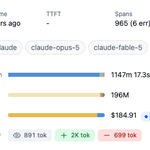
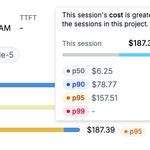
In any case, we've now made it super easy to track costs in your Latitude projects

Latitude.so retweeted
Self-healing systems mean your project keeps getting PRs that fix bugs while no one’s looking, on a Saturday.
Thanks to @trylatitude
github.com/latitude-dev/lati…

Latitude.so retweeted
We just shipped memory observability at latitude
If your agents keep persistent memory, we now treat every write like a commit — full history, diffs, and the session that caused it
Finally you can actually see what your agent remembered (and when it got it wrong)


Latitude.so retweeted
You can now run experiments on Latitude to compare metrics/signals/behaviors distributions across cohorts.
Very useful to understand how new agent releases are performing!

Latitude.so retweeted
@trylatitude launched 3 weeks ago, and we are now averaging ~100k package downloads and ~10k docker pulls per month.
Latitude.so retweeted
It's friday so took the time to sponsor some of the OSS dependencies we rely on @trylatitude
We are now proud sponsors of @honojs @biomejs @pnpmjs @DrizzleORM @vitest_dev Knipjs
Latitude.so retweeted
@trylatitude detects semantic moments down to the exact message, then lets you jump straight to them from the conversation timeline.
Super useful for long convos.


Latitude.so retweeted
Weekly reminder that you should be using @trylatitude and I'd love to talk to you if you have any reason not to.

Latitude.so retweeted
Ships with new telemetry, supported out of the box in @trylatitude

AI SDK 7 is now available.
Introducing: reasoning control, agent-level tool approval, tool and runtime context, file and skill uploads, MCP Apps, durable workflows, terminal UI, sandbox support, harness integrations, telemetry, lifecycle events, and more.

ALT AI SDK 7 Develop, run, and observe agents.