

Uncertainty in the face of optimism
Joined July 2011
- Tweets194
- Following91
- Followers334
- Likes41
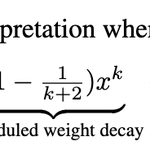


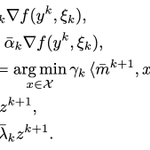
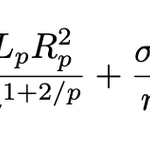


This looks exactly like the O(1/steps) schedule we theoretically arrive at with SODA arxiv.org/pdf/2605.11172
I should check out your papers!

It might be interesting for you to look at arxiv.org/pdf/2605.11172 where we weight decay towards the initialization - we'll soon put out the updated accepted version which applies this idea to fine-tuning (where init=pre-trained model)
Ah I see, it’s the muKL regardless of normalization that does it, e.g., the O(k^-1/3) achieved here for SGD proceedings.neurips.cc/paper…
You mean in their experiment and without normalization/clipping? AdamW would be ~consistent with your theory, but SGDM does not fit into FW so how do we explain?
Interesting! I'd be curious to see if they use normalization for SGD. If yes it would be consistent with your theory (since it would be Frank-Wolfe). Otherwise I would expect the exponent to potentially be different as in eg xitter.cf/tmpethick/status/20668… where "SGD" is not normalized


It might be interesting for you to check out angular muown and magnitude-direction decoupling that came out concurrently
arxiv.org/pdf/2606.23637
arxiv.org/pdf/2606.25971
There’s a simple argument for why aggressive wd/normalization hurts for the last layer (if one does not compensate by introducing a learnable scalar) xitter.cf/tmpethick/status/20545…
It is common to exclude the unembedding layer from using weight decay, but why? Essentially, applying weight decay to the last layer will constrain the logits of the model and consequently prevent high-confident output. 👇
xitter.cf/tmpethick/status/20541…
We now have a poster!
xitter.cf/tmpethick/status/20668…


The slides from my talk at @Inria this week on "when to use what Schatten-p norm in deep learning" are now available here:
pethick.dk/talks/2026_Inria_…


A theoretical take that might be interesting to you: xitter.cf/tmpethick/status/20668…
Thomas Pethick retweeted
Yes, I think there is something interesting to be said here: take a look at @leloykun's blogpost leloykun.github.io/ponder/mu… "So, in a sense, you can interpret Muon with the old coefficients as doing steepest descent under the Schatten-32 norm"

Thanks for trying this! The update looks somewhat different from the proposal. I would maybe start with QDWH or power iterations as eg used in Dion originally and not worry about per iteration cost to begin with

Btw I should say that I find it quite remarkable/impressive that you put together a method that is so strongly backed by theory in retrospect (and thus very amenable to tweaking)
Thanks for sharing! The claim I was trying to convey support of is somehow more narrow: within class of Schatten-p norms, smaller p can be optimal. There’s still interesting work left in generalizing to/understanding Shampoo/SOAP, PSGD etc
Yes, I think there is something interesting to be said here: take a look at @leloykun's blogpost leloykun.github.io/ponder/mu… "So, in a sense, you can interpret Muon with the old coefficients as doing steepest descent under the Schatten-32 norm"
Thanks for sharing! I think the result complements your work quite well because it is essentially interpolating between *unnormalized* “SGD” to “signSGD” (normalized) - I comment on this somewhere in the method section
The theory also seems to be consistent with this observation on Nesterov momentum from @_arohan_
xitter.cf/_arohan_/status/206474…

“Shampoo falls halfway between Muon & Adam” was the very confident claim.
This has been addressed. It had to be done.
Nesterov largely have not been useful in language models from my experience and now for that I got the answer as well. Not enough effort has gone to these submissions.
This is why we do tuning budgets anf made as fair comparison as possible @zacharynado
arxiv.org/abs/2502.15015

You might want to take a look at this work - you can extract the large batchsize requirement simply by optimizing the oracle complexity: xitter.cf/tmpethick/status/20668…
5/ In the process we derive a batch size scaling rule for arbitrary Schatten-p norms, which interestingly:
- for p=∞ recovers the BST scaling rule from xitter.cf/ruuustem_10/status/203…
- and suggests small batch size for Euclidean ala xitter.cf/micahgoldblum/status/1… and xitter.cf/orvieto_antonio/status…

