MTS @MicrosoftAI working on frontier VLM training and multimodal reinforcement learning. ML Theory PhD @GeorgiaTech, Math BS @USC.

Atlanta, GA
Joined December 2019
Exciting 3T native multimodal pretraining happening at @MicrosoftAI! Post-training 🔜
We now have state-of-the-art pre-trained base models in the 3T-parameter weight class, built entirely in-house at MAI. Post-training results coming soon -- stay tuned! Lots of details in our technical blog post. microsoft.ai/news/frontier-p…
5
290
This work has been accepted to NeurIPS 2026 - see you in Atlanta!
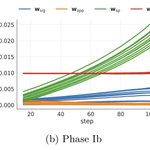
New paper — the last and best from my PhD! We show the first end-to-end feature learning analysis of how neural networks overfit to spurious correlations. Our theory implies phase transitions in SGD learning dynamics that match empirical results. Paper: arxiv.org/abs/2606.30444
2
35
6,010
I've transitioned to Member of Technical Staff @MicrosoftAI focused on frontier VLM training and multimodal reinforcement learning. Looking forward to an exciting new chapter!
1
1
40
1,064
New paper — the last and best from my PhD! We show the first end-to-end feature learning analysis of how neural networks overfit to spurious correlations. Our theory implies phase transitions in SGD learning dynamics that match empirical results. Paper: arxiv.org/abs/2606.30444
5
4
2
83
12,368
Even more interesting, if the spurious correlation is sufficiently weak, we show empirically that the XOR signal can eventually be learned. (Though the spurious feature is not forgotten!)
1
2
313
Overall we believe this is a step towards a rigorous foundation for popular robustness algorithms like Just Train Twice and Deep Feature Reweighting, and could even inform new robust interventions. This paper was the result of a wonderful collaboration with @v__muthukumar!
2
260
Very cool work from new colleagues at @ms_aifrontiers: most LLM benchmarks are redundant!
Most LLM benchmark scores are predictable before you ever run them. New from the MS AI Frontiers team: BenchPress. The 84-model × 133-benchmark score matrix turns out to be effectively rank-2, so matrix completion fills in the rest. 5 probes recover a model's whole profile. Paper, code, demo 👇
1
500
Overdue update: I've defended my dissertation and graduated from @GeorgiaTech! Next, I've joined @MSFTResearch @ms_aifrontiers as a Senior Researcher working on future capabilities of multimodal agents 🚀
8
1
1
51
3,175
Huge thanks to my advisors @v__muthukumar @Thejakeyboy, 2-time hosts at Microsoft @neelsj @VibhavVineet, and all my wonderful collaborators (many of whom are not on twitter). I had a truly fulfilling PhD experience thanks to you!
1
4
195
I like the characterization of AI as an "alien collaborator" for math. We have a forthcoming theory paper where AI was invaluable for optimizing delicate technical conditions -- but only humans could translate ideas and goals into self-contained math questions the AI could parse
Recently, I have started getting appreciable value from AI for my own mathematics research. While model improvements were necessary for this to happen, I think another key factor was reflecting on recent success cases, in order to build a better mental model for the comparative strengths of AI. Previously I would think in terms like "AI is good at extremal combinatorics, but bad at derived algebraic geometry"; a more nuanced perspective allowed me to identify directions where AI could truly accelerate my work. A few months ago, Tao described AI as a "junior collaborator". Currently I think of it more as an "alien collaborator", which is already superhuman at certain skills (e.g., assembling puzzle pieces, juggling delicate technical conditions, making local optimizations) but lackluster at certain others (e.g., creating new puzzle pieces, generating diverse ideas). Much of what I write is in the spirit of taming overhype, but it's important to give credit where credit is due: AI has progressed to the point where AI tools, and education on how best to use them, need to become a core part of any mathematics Ph.D. curriculum.
1
521
The updated version of this paper has been accepted at @TmlrOrg 🚨🚀 Very excited about implications of our results for SOTA robustness algorithms & understanding spurious correlations more generally. Journal version link: openreview.net/pdf?id=h81ztb…
Heading to #ICLR2025 to present our SCSL workshop paper on understanding how last-layer retraining methods mitigate spurious correlations! openreview.net/pdf?id=B2W51a… Stop by on Monday, April 28 to chat and learn more 🙂
1
3
11
1,893
Cramér on Lindeberg: "When he was reproached for not being sufficiently active in his scientific work, he said 'Well, I am really a farmer.' And if somebody happened to say that his farm was not properly cultivated, his answer was 'Of course my real job is to be a professor.'"
2
295
Tyler LaBonte retweeted
Multimodal reasoning with Phi-4-reasoning-vision, new work on scaling LLM inference, benchmarking AI agents in network operations, cinematic video generation, adaptive evaluation for LLMs, and using AI to improve individual and population health. msft.it/6013QiQgx
3
8
1
30
11,726
It's been the privilege of my career to help build the newest Phi series model from @MSFTResearch! Phi-4-reasoning-vision-15B is open-weight & competitive on perf with 10X less compute/tokens. Read the blog for math and CUA case studies, hybrid reasoning, data insights, & more!
Vision-language models improve multimodal systems, but can make them slower, costlier, and harder to deploy. Learn how Phi-4-reasoning-vision-15B, a compact and fast multimodal reasoning model, blends strengths of different methods while reducing their limits: msft.it/6014Q5X0u
10
914
Nice work from GT colleagues about how next-token prediction naturally captures long-range structural dependencies!
(1/6) Why does next-token prediction work so well, even for long text? 🤔 Check out “Provable Long-Range Benefits of Next-Token Prediction”. A rigorous explanation for LLM’s long-range coherence/reasoning. Joint work with Santosh Vempala📄 arXiv: arxiv.org/abs/2512.07818
2
320
Fara has been one of the most exciting projects to watch evolve @MSFTResearch over the last few months. From my perspective, Fara is a real advance towards natively multimodal computer-use agents (e.g., no accessibility trees). Congrats to Corby and the team on the release!
Microsoft just dropped Fara-7B, its first on device AI Agent that can use your computer just like you would: it clicks, types, fills out forms and completed tasks just by “seeing” the screen. It’s best-in-class in terms of accuracy and cost from yours truly at Microsoft AI Frontiers and you can use it today
2
289