

Husband. Dad. Sometimes athletic.
British Columbia via Alberta
Joined April 2012
- Tweets203
- Following175
- Followers138
- Likes44.8K



Let’s put a finer point on this. If BC’s private sector had kept growing at its 2001–2017 pace, we’d have ~250,000 more private-sector jobs today.
That’s ~$2B a year in provincial revenue without a single tax increase.
Private sector job growth beats tax hikes.
Make BC a great place to attract and grow business, and the jobs will follow.


The basis of our prosperity begins with a strong private sector economy. Since 2019, B.C. private sector jobs grew 3.3%. Public sector jobs grew 46.4%.
Source: Business Council of BC @BCBCLaura @BizCouncilBC #bcpoli #cdnpoli

With this decision, the Federal Court of Appeal is pulling back from UNDRIP.
But the result would be different in BC for so long as DRIPA is in effect, and the Gitxaala decision of the BCCA (which the province of BC is appealing to the SCC) supports that conclusion.
The applicable scope of DRIPA in BC is enormous. Why? Because of Section 8.1(3) of the Interpretation Act. It says that “[e]very Act and regulation must be construed as being consistent with the Declaration.”
For those who don't know what the Interpretation Act does, it is essentially a legislated manual or dictionary for how courts ought to interpret laws.
So what does this mean? Every single law in BC remains fair game for a court to consider whether that law is consistent with UNDRIP.
The litigation possibilities are endless.

Big decision with implications for Indigenous rights, Duty to Consult and the application of UNDRIP.
The Federal Court of Appeal unanimously agreed that the federal UNDA legislation to implement the United Nations Declaration on the Rights of Indigenous Peoples (UNDRIP) doesn't override Canadian law until the Canadian government, in consultation and co-operation with Indigenous peoples, explicitly establishes such a process.
The Court upheld the Canadian Nuclear Safety Commission's approval of a nuclear waste landfill to be built near the Ottawa River at the Chalk River laboratory. Kebaowek First Nation had previously successfully challenged that approval, but that lower Court's decision is now overturned.
cbc.ca/news/indigenous/kebao…

The NDP says $130B in major projects are at risk if DRIPA is repealed.
Partnerships don’t need DRIPA. LNG Canada and Coastal GasLink (~$40B) were approved in Oct 2018: LNG Canada with the Haisla Nation, Coastal GasLink with all 20 elected First Nations along its route. DRIPA didn’t come into force until Nov 2019.
Meanwhile, Eby himself says the Dec 2025 Gitxaała ruling on DRIPA “puts courts in the driver’s seat, instead of British Columbians,” “created confusion and concern,” and exposes the province to “unlimited legal liability.” It’s now headed to the Supreme Court of Canada, and more than 20 lawsuits have already been amended to cite it.
Eby even tried to suspend parts of DRIPA, then backed down under pressure from his own caucus.
Reworking or repealing DRIPA doesn’t erase projects. Eby admits the uncertainty is real. He just couldn’t get his own caucus to fix it.
#bcpoli

BC has $130 billion in major projects on the way BECAUSE of partnerships with First Nations, not in spite of them.
Doerkson's plan to repeal DRIPA would put all those jobs and projects at risk. #bcpoli
This should be a bipartisan issue, not a bogeyman third rail.
Results over ideology.

How do you pay for health improvements if you don't raise taxes?
Here's a thought experiment.
From 2017 to 2026, total health spending increased from about $20B to $43B, or 2.09x.
"Corporate" (much of it health authority bureaucracy) went from $1.4B to $3.8B, or 2.67x. "Community" (much of it primary care bureaucracy) went from $1.3B to $3.5B, or 2.73x.
Let's say those two areas ONLY increased by 2.09x (same as overall increase).
That would result in a savings of $1.6B. Per year.
What could you pay for with that? Well, about 28 MILLION family doctor visits, or more than 5 visits for every single person in BC.
And those cuts to bureaucracy are nothing. There's much more where that came from.
This is why accountability for health spending and results matter.
So how do you pay for health improvements if not from taxes? Follow the (existing) money.

This is good. Everything should be on the table when the current setup is leaving so many people behind.
Bad leaders force artificial constraints within an existing system. Great leaders force outcomes to drive, with system modifications tabled to get those outcomes.
Two things can be true at once:
1) Every British Columbian deserves high-quality health care.
2) Not all British Columbians are getting it.
By their own admission, health care is in crisis. That’s why the NDP’s “Public Health Guarantee Pledge” is an empty stunt.
They'd rather pledge fealty to an ideology than explore solutions that could improve results.
Yet the system they’re asking others to pledge to doesn’t exist today, even under the government they run.
Why? Some examples. An estimated 25,698 British Columbians went outside Canada for treatment in 2025, the highest share of any province. BC cancer patients were sent to Bellingham, WA for radiation. The NDP also spent at least $27M at private clinics to clear surgical backlogs.
Meanwhile, they’re proposing tax hikes on high earners, including many of the doctors they’re trying to attract.
So what does this pledge actually mean? Is a publicly funded cancer patient treated at a US clinic “public health care”? Is a surgery the NDP paid a private clinic to perform "public health care"? If the answer is yes, the pledge is meaningless. If it’s no, the NDP has already broken it.
And the results speak for themselves. The ministry’s own data shows 793 ER closures in a single year. The median wait from GP referral to treatment has climbed from 26.6 weeks in 2017 to 32.2 weeks. Orthopaedic patients now wait over a year.
And the bureaucracy grows. BC’s health system has 70+ presidents and vice-presidents. Alberta has fewer than 10. Corporate and executive spending is up 176% since 2017, outpacing acute care (98%).
More layers don’t mean better care. Every new layer has to coordinate with every layer already there, so complexity grows much faster than headcount. Seven health authorities, each with its own CEO, board and executive team, all answering to the Ministry and to each other. That’s not a health system. It’s a vetocracy, where every approval point can stall the next.
Strong management means that in a crisis, you drop the dogma and find what works. Every viable solution should be on the table so all British Columbians can get high-quality care.
A pledge won’t shorten a single wait list. Results will.

Protecting public health care is how we build B.C. strong.
Today in Delta, I signed our Public Health Care Guarantee. Every BC NDP candidate has signed it too.
It’s our pledge to keep American-style privatization out of B.C. We won’t let anyone charge you for care that’s covered by your health card, let people pay to jump the queue, or pull doctors and nurses away from our public system.
We can guarantee it. The BC Conservative can't.


Tone from the top matters. And on this one, @Dave_Eby failed.
But it isn’t the first time. In 2024 after narrowly winning the election, Eby made sure that all but one of his MLAs got raises through Cabinet, Junior Minister or Parliamentary Secretary roles. Once that was settled, they promptly cancelled the fall seating of the Legislature.
When you campaign on affordability, make sure you’re not also living a two tier version of it.

Just now, David Eby confirms that he has his kids in $10/day taxpayer-subsidized daycare.
Approx. only 10% of BC daycare spots offer $10/day daycare. Most families who want in can't get a spot.
As Premier, Eby earns $227k/year. Eby's wife is a doctor. Their household income is likely well over half a million dollars per year.
We don't resent British Columbians who are successful (we want more people to succeed).
But where there are wait lists, surely a wealthy family like Eby's shouldn't be taking advantage of $10/day daycare. Think about a working single mother? David Eby deserves the spot more than her?
(1/3) This post is making the rounds in #BCPoli as evidence of NDP success. As with every piece of visualized data, it needs to be scrutinized. The biggest problem? It uses one national inflation rate for every province, so a dollar in Vancouver counts the same as a dollar in Winnipeg.
Adjust for what things actually cost where you buy them and BC goes from 2nd to 10th of 10 provinces.


(2/3) The momentum is weaker than it looks. BC’s real income per person grew 2.0% a year from 2001–2017, and 0.7% a year since. BC closed the gap with national leader Alberta largely because Alberta fell after the oil crash, not because BC sped up.

(3/3) The NDP inherited strong tailwinds: a balanced budget, a housing boom, fast population growth, low interest rates, and construction on LNG Canada, TMX and Site C. Then Ottawa’s pandemic transfers lifted 2020–21.
Heading into 2027, the BC's population growth has all but stalled, its debt service costs are ballooning, and we’ve seen eight credit downgrades. All in a rising rate environment.
The 2024 number is about as good as it gets until the direction changes.
BC has a spending problem.
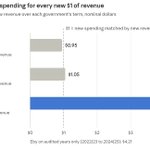
Since 2016, population and inflation are up 55%. Provincial revenue is up 66%. Spending is up 93%.
Adjusted for inflation, BC now spends $3,200 more per person than it did in 2016. If spending had simply kept pace, we’d have a ~$10B surplus instead of a $13B deficit. Imagine BC taking that money to build a sustainable sovereign wealth fund that compounds over time, instead of a mountain of debt that rolls over at higher rates.
And for the finance nerds, we’re borrowing the difference just as $82B of debt comes due over the next decade. Nearly all of that debt will have to be refinanced at higher rates, further snowballing the debt problem.

There is a real urgency to attracting talent, business and growth to BC.
One reason is because $82B of BC’s debt comes due over the next 10 years, and it will need to be refinanced at higher rates. This is before any new borrowing, which is already forecast to push interest costs from $6.4B to $8.7B a year by 2028/29.
The chart below shows BC’s bond maturities and their current rates, and what happens to interest costs when they’re refinanced in today’s rate environment.
Even at 4.9%, we add another $880M a year in interest expense by 2036. But yields just hit a three-year high, and all four credit rating agencies have downgraded BC over the past year or so. There is no guarantee we can refinance at 4.9%. At 5.5%, it’s another $1.4B in interest expense per year.
We can try to tax our way out of it, but the better path is to grow our way out of it.
The goal needs to be making BC the best province in Canada to take that new job or launch your business.

You can’t tax yourself to prosperity on a private sector that isn’t growing, and since Eby came to office in 2022 BC has been the worst performing province for private sector job growth.
It shows in who’s choosing to live here. BC was attracting on average 20,000 Canadians per year from 2014 to 2022. Since 2022 that has collapsed to an average of 2,000 Canadians per year.
So what needs to happen? BC’s natural environment sells itself. People want to live here. But that can only go so far. We have to make BC a competitive place to work and build a business.
Grow the tax base by incentivizing people to move here and businesses to have the confidence to hire them. After that, control spending and the debt comes down.

Amazing that some will look at this and think:
"More please".

Three things that have surged under @Dave_Eby's leadership in BC: Drug use, insolvencies, and provincial debt
Absolutely disastrous leadership. Vote for change!


I have no idea what an annuity assist is.
But this otherwise reads as bad policy where loose credit guidelines lead to abuse of a system meant to help.
Remember CEBA? The Federal government has $8.1B in CEBA loans outstanding as of 2024. $3.4B of that is in default.
Being a lender is hard. If this is to be successful, then we need more details.
Otherwise it reads as borrowing high and lending low, and further adds millions of dollars to an already growing interest burden that British Columbians are paying.

$1 million in interest free loans for up to 6 years, $6 mllion annuity assist businesses find new markets , and $5000 to hire youth. @Dave_Eby 👏👏👏
Much like health care in BC, the NDP want you to support a system you pay into but get less from. No-fault insurance saves money, but it can leave seriously injured people short at the exact moment they need help.
The NDP used to agree. In 2017, Adrian Dix wrote in his own letter to a trial lawyer: "No to no fault and the like."
ICBC says no-fault cut premiums 20–28%. Reverse all of it and you get premiums that are roughly 25–40% higher, not 100%. But you don't need a full reversal. The Conservatives are proposing caps on minor-injury claims, which should keep any increase smaller still.
Systems should always be revisited to see if the desired outcomes are being achieved. In this case, no fault dropped premiums but also left many injured British Columbians without a proportionate remedy. It should be fine to call that out and modify to achieve a better balance.
NEW - The NDP is calling Lorne Doerksen's letter to BC's legal groups and the Insurance Bureau of Canada “leaked” and “secret.” The letter was an open letter shared among the province's roughly 14,000 lawyers. In 2017, Adrian Dix sent a similar letter to trial lawyers. #bcpoli


Re: Insurance in #BCPoli.
What I want to see is the Province speed up the legal adoption of full self-driving. That's what will bring premiums down, but more importantly will improve safety.
Want to talk tax in #bcpoli? The chart below shows the trend of interest costs to BC's government. Buried in interest costs are the hidden tax of excess debt amplified by credit downgrades and rising bond yields.
Credit quality determines cost of debt, and all credit agencies have downgraded BC's credit rating since Eby took power in 2022.
Credit ratings are akin to a personal credit score but for a government, and BC's credit score has fallen. But that's just one part of the story. You have to apply that score to the amount of debt that is being financed.
When Eby came into power in 2022 BC’s debt was $90.7B. 2026 is projected to end at $154.8B. And Eby’s own budget forecast shows that 2029 will see that number skyrocket to $235B. That’s a 250% increase over seven years, and it is before the latest round of goodies promised in this election cycle.
This costs every BC resident. The budget estimate for 2026 is $6.5B in interest charges. That rises to $8.9B in 2029, or about $25M per day.
That is money that doesn't build anything. It just pays bondholders.
But the kicker is that the estimate is priced off of a steady yield of around 4.7% or 130 bps over the Bank of Canada ten year bond.
That yield that has already jumped 50 bps, and is not factored into the forecast below.
So two trends are costing B.C. residents. Overall borrowing costs are rising globally thanks to bond yields rising. And then BC’s credit quality continues to fall with no plan for change.
This is not how you "Build BC Strong". It is how you transfer money from taxpayers to bondholders.

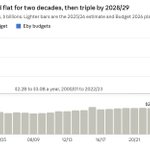
Lots of talk of raising taxes with the #bcpoli election coming up. But the other side of taxation is spending. Almost four years into the Eby era, are we actually seeing prudent capital management or just overspending?
Below is a chart showing BC Provincial Government spending as compared to its revenues since 2000.
For about 22 years, both the Liberals and NDP managed to keep spending roughly matched to revenue, with the Liberals spending slightly less and the Horgan NDP spending slightly more.
Then came David Eby.
The question this election is whether his spending decisions are resulting in better outcomes for British Columbians.
