

Cofundador de Business Cyborgs. Ayudamos a empresas en LatAm a poner la IA a trabajar en su operación, con criterio. Bogotá.
Bogotá
Joined June 2010
- Tweets3.2K
- Following2.2K
- Followers1.6K
- Likes512





Pinned Tweet
Comprar inteligencia es fácil. Hacer que tu empresa la reciba es lo difícil. Si el trabajo no se puede leer, un agente no lo puede operar. Escoge un flujo. Hazlo legible. Luego sí, ponle IA.

Camilo Serna Zamora retweeted

Mi aprendizaje de la semana en IA: - Este no es un post pago, es absolutamente real -
Esta semana le fui infiel a Mercado Libre @ML_Colombia. No fui yo. Fue mi agente de IA 🤖
No encontraba un producto con las especificaciones exactas, así que le pasé el encargo a mi agente de IA (usé Instinct): búscalo en cualquier tienda en línea.
Le pedí que lo intentara varias veces en Mercado Libre. Al final me avisó que un bloqueo del sistema no lo dejaba leer bien las fichas.
Lo encontró en Almacenes Éxito, con una ficha clara y completa.
Compré en @almacenesexito
Mi costumbre era inercia. El agente no tiene costumbres: busca, lee y decide con lo que encuentra.
Por eso, con Camilo Serna @tekelala trabajamos una idea en todo lo que hacemos: la información de una empresa tiene que estar escrita para dos públicos a la vez. Las personas (humanos) y las máquinas (IA).
Si un agente no puede leer tu ficha, tu cliente fiel también se va.
Pronto escribiré un Substack completo con este caso..
Greg Isenberg cuenta que todas las empresas quieren conectar sus datos a agentes y se encuentran con cinco versiones del mismo cliente y PDFs que nadie puede buscar. David Haber de a16z habla de agentes que se hacen cargo del resultado completo, y de cómo en los procesos largos el valor se va perdiendo en cada entrega. Es lo que vemos en Business Cyborgs. Las herramientas ya las tienen casi todos, lo que más mueve la aguja es ordenar el dato y que alguien se haga cargo del proceso de punta a punta.
Las dos piezas: xitter.cf/gregisenberg/status/21… y xitter.cf/a16z/status/2110400337…

How AI for the enterprise is evolving, from owning a task to owning an outcome:
1. Assistant: handles one task in seconds, like sending a follow-up email. Companies pay for it out of their software budget.
2. Agent: handles one interaction in minutes, like a customer's refund call. It takes on work people used to do, so it gets paid for out of the labor budget.
3. Long-running agent: works toward a goal for weeks or months, like getting an injured client the biggest settlement possible. Because it owns the result, the company selling it can price on the outcome it delivers.
Full piece from a16z's @dhaber on long-running agents in high-value customer journeys: a16z.news/p/winning-the-rela…

Lo que cuenta Eric Glyman de Ramp es lo que vemos en Business Cyborgs. Repartir licencias de IA no es adopción. Adopción es resolver un problema real con algo simple. En Ramp, un prompt que captura los pedidos de clientes desde las llamadas los llevó de 300 a 20.000 al mes.


Una analista armó con IA un prototipo: metas por familia de productos y a qué clientes llamar. La meta era subir ventas 5–10%. Uso operativo al revisar: cero.
El criterio ya estaba fuera de su cabeza. Faltaba que alguien pudiera usarlo el lunes a las 9.
Karpathy en video explicativo @dariopalacio #businesscyborgs

Dusting off this tweet from April because this gap in shared understanding of LLM capability is *widening*. It's now less "two groups of people speaking past each other" and more a sharp funnel.
- Napkin math somewhere around 6B people (~75% of the population) have barely come in contact with LLMs at all.
- Around 1-2B (~20%) are casual and infrequent users of free-tier ChatGPT-like products. This group sees derpy chatbots and treats them a bit like a better Google search, a writing aid, or etc. Maybe an agent tries to book you a flight. I have non-tech friends who (reasonably, imo) say they have not much use for it at all. Even many professionals outside of math&code are in this tier. For example, execs and many other functions spend a lot of their time talking to other people, so while they understand what is happening intellectually, it is still second-hand and a bit abstract.
- Now we get to professional use of frontier-grade LLMs in math&code. Somewhere around 20M people (0.2%) see first-hand that large, complex projects that used to take them weeks/months can now be completed by agents with a prompt. Building apps, copying apps, translating apps, decompiling apps from binaries... This has all happened very quickly and recently - less than 1 year ago, I was writing code manually by hand, typing memorized computer code commands into a code editor character by character, occasionally pressing Tab to autocomplete a little chunk of code.
- And finally we get to the ~5,000 people (~0.00006%) with access to frontier-grade systems internally. The external world has seen the preview. It looks like swarms of thousands of agents collaborating over weeks on software mega projects: minting zero days, running cyber attacks and defenses at machine speeds, discovering new science, advancing the frontier of mathematics. Things that would have taken top professionals in the industry years of work. Meanwhile, human review and comprehension are starting to fall behind. For example, people are still involved in the "archeology" of the OpenAI-HF incident from many months ago. Mathematicians may be poring over the 722 manuscripts on frontier mathematics for a while.
The funnel is driven by a combination of factors:
1. The impact scales with ambition, problem size, and horizon. A question with a paragraph answer barely stresses the system. You need a reservoir of big, difficult problems that you really care about. This aspect drives the consumer / professional dimension of the funnel.
2. The jaggedness of the system (which I have written about a lot separately). Capability peaks in domains that are digital, verifiable and economically valuable. This is because LLM capability emerges from reinforcement learning on verifiable rewards on a curated environment mixture driven by revenue potential. This aspect primarily drives the area (e.g. math&code) dimension of the funnel.
3. Access. Free-tier, paid-tier, internal.
So this is the weirdness of the moment. The general public has mostly not interacted with these systems. When they have, it looks like a derpy chatbot. The majority of professionals still see only a modest uplift. And a small sliver of professionals are experiencing the vertigo of the curve going vertical. And it is all happening at the same time.
Fuimos a proponer cómo organizar la información comercial de una empresa. Ya estaba organizada. Los vendedores igual seguían armando sus propios Excel.
El problema no era el dato. Era llevar lo que la empresa sabe a la próxima conversación con un cliente.
Camilo Serna Zamora retweeted
Lo que viene no es una empresa que usa IA.
Es una empresa con dos equipos. Uno humano. Uno sintético.
El jefe comercial sigue siendo el jefe comercial. Ahora dirige gente (humanos) que visitan clientes y agentes (IA) que preparan propuestas, revisan cartera o avisan qué cliente lleva un mes sin comprar.
Es importante que un empleado sintético tenga un jefe humano.
dariopalacioisaza.substack.c…
Camilo Serna Zamora retweeted
Se vienen las nóminas híbridas en las empresas.
¿Qué quiere decir eso? Empresas con empleados humanos y empleados sintéticos. El humano conoce el negocio y responde por la decisión. El sintético trabaja la capacidad que siempre quisiste y que la nómina no alcanza a pagar.
No es un cargo más. Es el equipo que tu empresa todavía no puede comprar.
Con Camilo Serna @tekelala ya lo estamos creando.
Si ya estás armando el presupuesto del año que viene y ese cargo clave sigue sin dinero, léelo. Ahí está la otra forma de tenerlo.
businesscyborgs.substack.com…
Una reunión pide que Tecnología transforme el negocio. Veinte minutos después el mismo equipo revisa incidentes. La urgencia siempre gana. Si nadie puede decidir qué desplaza a qué, esa ya es la estrategia. businesscyborgs.substack.com…
La IA en la sombra no nace de gente rebelde. Nace del vacío. Un equipo encuentra algo que sí sirve, toca datos o permisos, y como no hay ruta aprobada se vuelve excepción. Otros ven la demora e inventan su variante. Más riesgo, más copias, menos aprendizaje.
Espero sea de su interés open.substack.com/pub/busine… con @dariopalacio

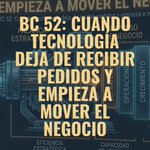
BC 52: Cuando Tecnología deja de recibir pedidos y empieza a mover el negocio, by @tekelala businesscyborgs.substack.com…

BC 51: ¿Y si grabamos y transcribimos todas las reuniones?, by @tekelala open.substack.com/pub/busine…
