

Triple Entry Accounting Conference 2026 · “A New Accounting Paradigm for the Information Age” · A https://xitter.cf/t.co/X4jfAg1xSd event
Malta
Joined February 2023
- Tweets304
- Following179
- Followers119
- Likes224





Pinned Tweet
Call for Papers is open for #TEAconf 3.
Submissions welcome — from cryptographic protocols and signed records to audit, fraud prevention, payments, digital assets, CBDCs, machine-readable accounting, and AI data provenance.
Nov 19–22, Malta · Drafts → [email protected]

teaconf retweeted

How to give an AI rights
1. Given: corps have rights
2. Start a corp
3. Automate corp into an AI DAO
4. Done! It's an AI, it has rights
teaconf retweeted

Render therefore unto Caesar the things which are Caesar's; and unto God the things that are God's.

Berliner Zeitung writes that Washington and Moscow are discussing a possible deal that would allow Americans to acquire a stake in the Nord Stream gas pipelines and profit from future Russian gas deliveries to Western Europe.
The German newspaper says the arrangement could give the US a share of the revenues from Russian gas exports, even as Washington expands its own LNG sales to Western European countries.
The report notes that the US has already secured access to Ukrainian natural resources, while the EU has committed to purchasing $750 billion worth of American energy by 2028.
The newspaper concludes that Western Europe risks paying for Ukraine’s defence and reconstruction while Washington and Moscow profit from its energy market.

teaconf retweeted
The audit is backward-looking by design. By the time it finds something, the damage may be done.
TEA changes the equation: transactions are cryptographically verifiable from the moment they are recorded. Auditors can verify the evidence, not just inspect the aftermath.
#TripleEntryAccounting #TEAconf
teaconf retweeted

* Networks aren’t an organizational type; they’re a state of coupling
johnrobb.substack.com/p/unor…?
"It’s a field of interconnectivity within which organizational types (collections of particles/bound functions) operate. Currently, it is a solvent that breaks down organizational types by creating new edges, breaking them down into constituent functions, and forcing rapid phase transitions.
Due to the impact of networks, we’re moving from an ordered system that produces persistent sociopolitical systems to an unordered one where resonance becomes a source of transient order.
In the past, we created sociopolitical order by combining organizational types (tribes, markets, and institutions). These organizational types kept their structure when you combined them. You can add a bureaucracy to a tribe and still have a tribe (feudalism). You can put a bureaucracy in a market by creating a firm. That’s gone. You don’t just add a network. Networks are an overlay that changes the phase of the organizational types within it: how they hold together, what they retain/shed, and what they can lock onto (as the organization’s purpose)."
- John Robb
teaconf retweeted
When buyer and supplier sign the same transaction record, both parties see the same facts.
No competing versions. No reconciliation between separate records. One signed record, shared by both parties, verifiable by anyone with permission to inspect it. This is #TripleEntryAccounting.
#TEAconf
When buyer and supplier sign the same transaction record, both parties see the same facts.
No competing versions. No reconciliation between separate records. One signed record, shared by both parties, verifiable by anyone with permission to inspect it. This is #TripleEntryAccounting.
#TEAconf
Traditional accounting records transactions as separate records. #TripleEntryAccounting can link them into a verifiable chain.
Invoice, payment, receipt, delivery confirmation — each step can reference and build on the previous one, creating a connected audit trail instead of records that must later be reconciled.
teaconf.org
#TEAconf
teaconf retweeted

What good is DeSci, people asked. This good.

There is a child with a rare disease who is currently suffering and struggling to manage his symptoms. Rare as this is, you can directly help him.
Today we are launching the "Rare Disease, Real Kid" Hackathon, and there are $50,000 in prizes from @AnthropicAI and @awscloud.
We (@huggingface & @Sagebio) are helping this child open his genome and clinical data to the community, so that we can find what's caused his disease and what currently-approved drugs could help him.
I doubt I need to motivate this much further or explain how rare it is for a family to share their child's genome and clinical data, but if you're not sure, consider this:
Until very recently, it wasn't feasible for patients like this to get treatment because their disease was so rare that the economics could never justify the investment. Now, as we've seen, people with rare diseases are starting to be able to find the answers themselves (with the help of AI tools, cheaper sequencing, etc). This kid is not able to do that for himself and neither are his parents, so we're asking you for help. Both for this kid and to prove that it's possible for everyone else suffering from a rare disease.
More details in 🧵.
sagebio-rare-disease-real-ki…
teaconf retweeted
PKU formula is medical nutrition therapy. This groups the product with a lot of lifestyle conditions in terms of class risk. But it's our only real food.
Keeping it in regulatory limbo starves healthy, insurance policy & tax paying patients and drives up public expense.
One of the most overlooked ideas in #TripleEntryAccounting is atomicity: there can only be one official book.
A company can always create an alternative set of records. TEA does not make that physically impossible.
What it does is make the official set provable.
When transactions are anchored to cryptographic evidence, any alternative version becomes detectable. The books either match the evidence, or they do not.
The question changes from: “Which set of books should we trust?” to: “Which set matches the evidence?”
That is a profound shift for audit, governance, and fraud prevention.
teaconf retweeted

For some time now, you know that I have been reading and researching Ricardian Contracts. I have discovered a definition of trade that I had never really thought about before—and, as far as I remember, it is not something that is taught in schools either. In Ian Grigg’s (@iang_fc) approach, the rights and obligations underlying commercial and, in particular, financial assets are essentially defined by a contract. If we broaden this perspective a little, a very large part of economic life, from opening a business to the employment contracts of workers, operates through contracts.
If we take this a little further, we can even consider everyday commercial documents, such as a retail receipt, as part of a contractual relationship. In the final part of this article, I will try to explain the Ricardian approach through the example of a retail receipt.
Contracts are easy to apply in everyday life. Digital assets, however, are not so straightforward. Digital assets can be represented using different names, symbols, and technical definitions. Therefore, what exactly the buyer is purchasing needs to be documented through a contract in a legally appropriate manner.
Ricardian Contracts aim to address this problem. A Ricardian Contract is a contract that clearly defines what a digitally traded asset is, what rights it gives to its owner, and what conditions it is subject to. It is readable by humans and verifiable by machines.
Dr. Wright (@Dr_CSWright) has been trying to instill three important ideas in us for years: Code is not law. Possession of a key does not prove ownership. Governments will always exist, and courts will continue to issue judicial decisions.
If we take Ian Grigg’s approach together with what Dr. Wright has taught us, then the real issue in digital commerce is not merely recording an asset on a blockchain or controlling it through a key. The real issue is to clearly define which legal rights and obligations that asset represents and to establish a reliable record that courts can evaluate when assessing those rights and obligations in the event of a dispute.
Whether you are a developer, a buyer, or a seller, if you are creating, issuing, or purchasing a digital asset, you first need to clearly define what that asset represents and conduct the transaction according to that definition. As long as governments exist and courts continue to operate, this legal dimension of digital commerce will not disappear.
Ultimately, digital assets are not an area where we can simply do whatever we want, disregard the law, and assume that we will never be held accountable before a court.
Let’s move on to retail receipts.
In a broad sense, a sales receipt can be evidence of a contractual relationship, but it would not be correct to say that the receipt itself is the contract. Let’s continue with the supermarket example.
A sales relationship arises between the buyer and the supermarket. The supermarket offers a particular product at a particular price. The customer purchases the product and makes the payment. The sales receipt can show what was purchased and how much was paid, but it cannot by itself contain the entire legal and commercial meaning of the sales relationship, including the product’s warranty terms, return conditions, the buyer’s rights, and so on.
So, if we approach this product from a Ricardian perspective, can we establish a verifiable contractual relationship between the sales receipt, the product sold, and the rights and obligations arising from that sale?
Yes, we can. In fact, there are many working applications that already do this. The existence of working applications does not prevent us from working in this area as well. On the contrary, existing applications can be seen as evidence that there is a need and a market for such solutions. We can modify them, transform them, and, if necessary, compete with them...
We can design a model in which the idea of a Ricardian Contract is applied at the product level.
There could be a product information document containing details such as the product name, manufacturer, product code, production date, etc., together with a contract specifying the warranty, return conditions, the buyer’s rights, and other terms. A hash of this contract could then be generated. A QR code could direct the user to a link where the contract terms and the blockchain record could be displayed. Anyone who wishes could verify the record. The sales receipt could then state that, for XXX USD, a product or products identified by a specific identity and subject to a specific contract were sold.
In this way, a verifiable cryptographic bridge could be established between the physical piece of paper and the cryptographic contract. The hash or record on the blockchain alone does not guarantee that “this document is legally valid,” but it can form part of a strong chain of evidence showing that the contract existed with a specific content at a specific point in time and that the parties carried out a transaction associated with that contract.
A chain of evidence consisting of product + contract + sale + history could be established.
“For those who say, ‘This is not enough for me; I want more,’ I can theoretically offer an even longer chain.🙂
Product Lifecycle: raw material + source of the raw material and production conditions + manufacturing + quality control and certifications + supply chain + storage and logistics + sale + warranty + maintenance and repair + resale + recycling or disposal.
In short, there seem to be many opportunities in the field of contracts. It is an area worth experimenting with and, if necessary, worth failing in. If you primarily target small and medium-sized businesses and freelancers, your chances of success may increase. Large companies can afford the high costs of such services, whereas small businesses and freelancers may struggle to access them.


WYSIWIS — What You See Is What I See.
Both parties reference the same shared record. Not two versions to reconcile, but one record both parties can verify.
doi.org/10.3390/jrfm17020076
More: teaconf.org/discover/overvie…
#TripleEntryAccounting #TEAconf


teaconf retweeted
While it's fun to @ my public officials, it's not enough to move the needle.
One more technical deliverable for my friends at @teaconf this week, then it's proper advocacy at home.
Of course the devil was in the accounting details.
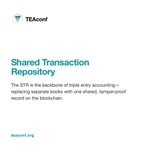
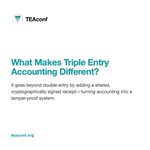
In double-entry, each party keeps its own records. In Triple Entry Accounting, both parties refer to the same shared, cryptographically verifiable transaction record.
One shared source of truth.
teaconf.org
#TripleEntryAccounting #TEAconf


teaconf retweeted
The mom is in tears of rage.
The lawyer just confirmed her class action.
My son (PKU, 23) just came out of his pediatric genetic clinic appointment.
I have too much good stuff to focus on to explain it here now.
The evidence is all locked.


In double-entry, the receipt records the transaction. In #TripleEntryAccounting, the receipt is the transaction.
One shared record. Signed by both parties. Immutable.
teaconf.org
#TEAconf
teaconf retweeted
Kind reminder: Call for papers.

Call for Papers is open for #TEAconf 3.
Submissions welcome — from cryptographic protocols and signed records to audit, fraud prevention, payments, digital assets, CBDCs, machine-readable accounting, and AI data provenance.
Nov 19–22, Malta · Drafts → [email protected]