




LaSer retweeted

@Alice_Weidel are un salariu de 24.000 de euro, plătit și de sute de mii de contribuabili români din Germania. Familia ei trăiește în Elveția. Dar problema ei sunt românii care, cică, trăiesc “regește” din alocații pentru copii despre care, de fapt, “nimeni nu știe dacă există”.
Și vrea să “remigreze” românii care lucrează în Germania. M-am dus la Bundestag și i-am spus vreo două. Încă aștept să-și ceară scuze.
Dă mai departe video-ul dacă aștepți și tu scuzele ei.
LaSer retweeted

Wo ein Muskel entspringt, wo er ansetzt und wie er sich zusammenzieht. Mit bewegten Tafeln verstehst du es auf Anhieb.
Die Anatomie-Bibliothek von AnatoBase zeigt jeden Muskel und Knochen einzeln, mit Ansatzstellen und Funktion.



LaSer retweeted

NVIDIA released a new looped transformer:
Instead of stacking more layers, it runs the same layers multiple times so a 4B model can think like a 9B one.
Here's how it works:
In a standard transformer, every token passes through a stack of decoder blocks once, and each block has its own weights.
So if you want a deeper model, you add more blocks, and the parameter count grows with the depth.
NVIDIA's Dory1.0-4B decouples the two by reusing a chunk of its layers.
The model is split into three parts:
> An input block of 8 blocks runs once and turns the tokens into a hidden state x.
> A recurrent block of 20 shared blocks runs k times, where k can be anywhere from 1 to 4.
> An output block of 8 blocks runs once on the final state, followed by the LM head.
Before every pass through the recurrent block, x is added back to the current state and the sum is L2-normalized.
This keeps the original token representation in view on every pass, instead of each pass only seeing what the previous one produced.
Both models in the diagram below store 36 blocks of weights.
The standard transformer applies each block once, while Dory applies 36 blocks at k=1, 56 at k=2, and 96 at k=4, i.e., 72, 112, and 192 physical layers from the same checkpoint.
The extra depth is actually helpful on reasoning and agentic tasks:
> SWE-bench Verified:
- at 1 loop → 50.3
- at 2 loops → 59.5
- at 4 loops → 61.8
> 12-benchmark average:
- at 1 loop → 35.17
- at 2 loops → 39.67
- at 4 loops → 40.60
- and with 2 or more loops, it beats Qwen3.5-9B, Gemma 4 12B, and Gemma 4 26B-A4B.
More loops implies more compute per token, but the 4-loop model also writes 1.3x to 2.5x fewer output tokens on agentic tasks.
So 2 loops end up costing only 1.03x to 1.25x the compute of 1 loop end to end, which is why NVIDIA recommends 2 as the default.
By default, Dory keeps a separate KV cache for every loop, so at 4 loops the recurrent layers store 4x the cache.
To avoid this, it can keep only the cache from the last loop, which uses the same KV memory as a normal model with only a small change in accuracy.
One thing to note here is that looping helps the model reason over what it already knows, but it does not add knowledge.
For instance, on tasks like AA-Omniscience, accuracy stays at 10.0 whether you run 1 loop or 4, and on knowledge-heavy tasks like GPQA, Dory still trails Qwen3.5-4B.
Here's the paper: arxiv.org/abs/2611.03998
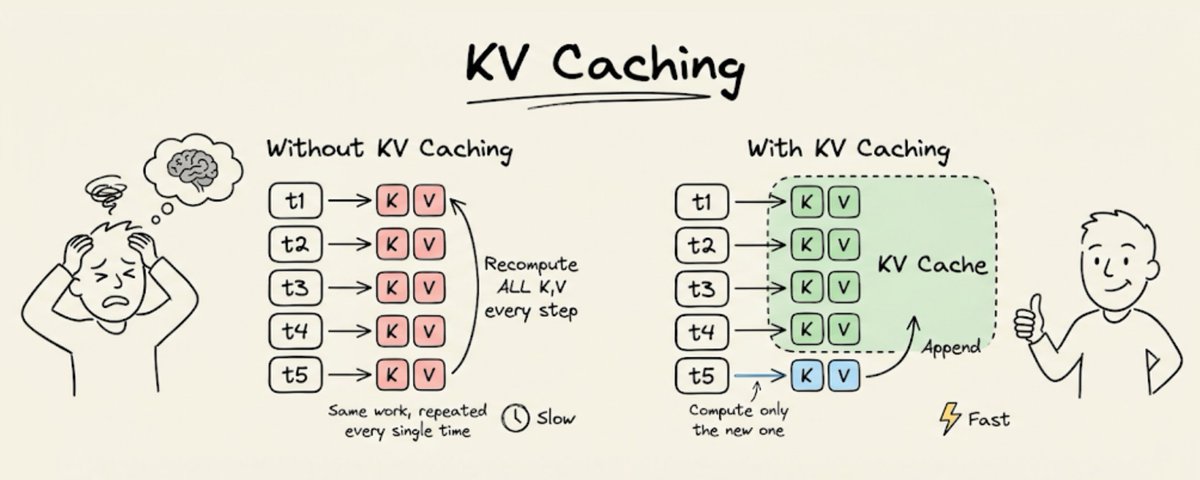
That said, how much memory looping costs comes down to how the KV cache is handled, so I wrote a full breakdown of how KV caching works.
It covers what gets cached during prefill, how the cache grows during decoding, and why it becomes the main memory bottleneck at long context.
Read it below.

LaSer retweeted

Doar 7000 de patrioți au reușit să aducă AUR la protestul pro-Georgescu. Cam cât face Sfânta Parascheva în 10-15 minute:
rasboiul.ro/doar-7000-de-pat…


LaSer retweeted

Say what you want, but this is what leadership looks like. No mincing words, no empty rhetoric, no bullshit. Just history, data, facts, and a clear understanding of the world.
Mark Carney has emerged as a leading voice among liberal Western democracies. And the world is taking notice.

LaSer retweeted

Russia's return to big-time hockey is over before it even began.
Canada, the host of the upcoming championship, simply refused to issue visas to Russians.
🇨🇦👏

LaSer retweeted

This is *absolutely* how to handle him. Stay on script. Insist on facts. Give him hell. 👏🏾
LaSer retweeted

Looking for the ultimate autumn escape? Discover Șimon, a peaceful mountain village in Romania, where rustic architecture meets breathtaking fall colors. #RomaniaIsBeautiful 🇷🇴🇪🇺. 🍂🏡📸Mihai Orboiu

LaSer retweeted
Peak autumn magic in Prahova! 🍂The contrast between the evergreen pine trees and the fiery red beech forests between Mâneciu, Cheia & the Ciucaș Mountains ⛰️ is absolutely breathtaking right now. #RomaniaIsBeautiful 🇷🇴🇪🇺. 🍁📸Tiplea Daniel


LaSer retweeted

Chip packaging is moving so fast it's hard to keep up. @jwt0625 built an online tool that tracks all of it, the first of its kind. It's hugely useful for both technical and market analysis.

[Advanced Packaging Atlas](o5s.org/advanced-packaging-a…)
soundtrack: Baccano! Original Soundtrack - 08 In the Speak Easy
LaSer retweeted

Tomorrow, we unveil something years in the making. A place where the semiconductor industry's brightest will come together to solve the toughest technology challenges. A place built to accelerate the future of computing. The countdown is on. Come back tomorrow to follow the excitement.


LaSer retweeted

SemiAnalysis on Intel 18A Density: A real banger!?
"Our measurements put Panther Lake’s 18A compute logic and TSMC N3E GPU logic at similar logic density. However, 18A does not lead TSMC N3P, N2 or Samsung SF2 in peak density."
First, Panther Lake CPU tile uses Intel 18A HP library. Whereas, Panther Lake iGPU uses the 2-2 HD library. Their statement comparing 18A & N3E is incorrect cos one is HP & the other is HD.
Second, they don't use Cell Utilization when comparing FSPDN/BSPDN nodes. Again, that's incorrect.
Lunar Lake CPU tile is 105 mm2 (without iGPU). Whereas, PTL-U 338H (4+0+4) CPU tile is only 91 mm2 (without iGPU). This is in spite of PTL-U 338H having extra 4MB L2 + 6 MB L3 cache. This size difference between the LNL & PTL CPU Tile is around 15%. If we remove this extra 10MB of cache from PTL-U and compare apples to apples, the difference is around 20%.
How is 18A able to pack more in significantly less area?
This is because of 18A higher "Cell Utilization". This puts 18A clearly ahead of *all* 3nm class nodes. 18A is close to N2 & 18A-P is closer to N2P.
The key purpose of BSPDN is to move the power rails, metals, grid, bumps to the backside, freeing up area in the front side. This freed up area in the frontside can accommodate more logic/sram. In a theoretical 100 mm2 pure FSPDN logic die (like TSMC N2P), only up to 75 mm2 can be used for pure logic. Whereas, in a theoretical 100 mm2 pure BSPDN logic die (like Intel 18A-P), over 90 mm2 can be used for pure logic according to Intel. This gives BSPDN nodes like 18A a solid edge in overall logic density. (Note: All density comparisons are theoretical peaks and not to be taken literally.)
So, w.r.t to my previous post, comparing densities of a FSPDN nodes like N2/N3 with a BSPDN nodes like 18A/18A-P without using Cell Utilization is a big mistake. Guaranteed to give wrong results.
Image Source: Semi Analysis
Link: newsletter.semianalysis.com/…
(For more details, see my previous post on this.)
Share your thoughts. Follow/Repost if you like. 👍
