

Shipping/bridging Engineering ⇆ Science #SoftwareArchitecture #FunctionalProgramming #MachineLearning #BigData #MachineLearningEngineering #CompilerDesign
Europe
Joined September 2011
- Tweets6.1K
- Following0
- Followers780
- Likes22.2K






KSE retweeted

Check out new work on Training LLMs to Discover Abstractions for Solving Reasoning Problems:
Paper+Code: cohenqu.github.io/rlad.githu…
Reasoning goes beyond pattern matching or memorization, it requires discovering and applying algorithmic procedures that reuse primitives, intermediate results, and building upon them. While RL post-training on long COTs aims to elicit such behavior, current models often learn depth-first, brute-force reasoning traces.
To improve this, we introduce reasoning abstractions, concise natural language descriptions of procedural or factual knowledge that guide the model toward more effective reasoning. Our framework jointly trains an abstraction generator and an abstraction-conditioned solution generator, enabling structured exploration. This approach improves generalization to harder problems, showing that allocating more test-time compute to generating abstractions yields greater gains than producing additional solutions, highlighting the central role of abstractions in guiding global reasoning.


🚨 NEW PAPER: "RLAD: Training LLMs to Discover Abstractions for Reasoning"!
We introduce reasoning abstractions: concise insights that help LLMs solve hard reasoning problems by guiding structured exploration.
📄 arxiv.org/abs/2510.02263
🌐 cohenqu.github.io/rlad.githu…
🧵[1/N]

KSE retweeted

excited to share a walkthrough of @arsumbrisai
build knowledge bases in typed markdown with your agents via mcp, then build your own apps and plugins on top of it
everything lives in repos you can share and extend. a bit like packages for knowledge work
KSE retweeted

We are excited to share our new paper:
“GLiNER-Relex: A Unified Framework for Joint Named Entity Recognition and Relation Extraction.”
arxiv.org/pdf/2605.10108

KSE retweeted

Ontology Pipeline — Framework for Knowledge Engineering and Building Knowledge Infrastructures: link.amazon/B06B2xJy5
Amazon description: “One of the biggest shifts happening in our industry is that enterprise data management is expanding into enterprise knowledge management. AI is accelerating that transition because it depends on more than well-managed data. It depends upon context, shared meaning, trusted relationships, and the ability to organize the vast stores of unstructured knowledge that exist across every large enterprise. As AI becomes the primary interface to enterprise information, knowledge management will become the foundation that unlocks trustworthy AI at scale.”

KSE retweeted

Most AI stacks hide a dirty secret: swap your LLM provider, and everything breaks.
TrustGraph was built differently.
TrustGraph ships with a full, modular LLM inferencing stack — so you're never locked into a single model or provider. Whether you're running fully air-gapped on-prem or mixing cloud APIs, TrustGraph has you covered out of the box.
The inferencing stack supports:
🖥️ Local / Self-Hosted — vLLM, TGI, Ollama, LM Studio, and llama.cpp for full on-premises deployments
☁️ Cloud Providers — OpenAI, Anthropic, Google Gemini, AWS Bedrock, Azure OpenAI, Cohere, and more
🔧 Fully Configurable — swap providers without rewiring your entire pipeline
This isn't just about flexibility. It's about control — over cost, latency, data privacy, and compliance. In regulated industries especially, the ability to keep data on your own infrastructure while still leveraging the best available models is a game-changer.
TrustGraph's context graph operating system handles the heavy lifting — knowledge extraction, entity resolution, semantic retrieval — and hands off to whatever LLM you trust most.
Your stack. Your rules.
👉 Check out the leading context graph operating system: github.com/trustgraph-ai/tru…

ALT TrustGraph has a full LLM inferencing stack
KSE retweeted
xitter.cf/TryMapleAI/status/2054…
confidential decentralized hybrid/edge AI includes but is not limited to local AI


Type your own message on our page and see how Maple's security and privacy works: trymaple.ai/proof

KSE retweeted

I was quoted in The Wall Street Journal this week on the debate about open, sovereign AI. My quote: "It's interesting they're against distillation when they distill the entire Internet...I just think it's odd that they are now turning around and telling others not to do what they did."
I’m stoked about the renewed momentum behind open weights. Many companies including Nvidia, Microsoft, Meta, OpenAI, and Google signed the Open Weights and American AI Leadership letter this week. We support these as well. Open-weight models from around the world are rivaling frontier systems in capability.
What gets me excited is what this unlocks. When you combine open-weight models with trusted execution environments, you get something really powerful: state-of-the-art intelligence that is end-to-end encrypted and sovereign. No lab trains on your data. No lab reads your conversations, sells your data to advertisers, or builds competing products from the data you thought was secure.
At Maple we're building on exactly this. Open-weight models running in TEEs, encrypted end to end, with long-term memory and personal data integrations. Your intelligence stays yours.
The future of AI is open.
Sovereign for one. Sovereign for all.

A backlash against Anthropic is brewing in Silicon Valley, rooted in concerns about the company’s product launches that compete with existing software providers and its advocacy for a closed AI ecosystem on.wsj.com/4fWlefn

KSE retweeted

@fakegingerbitch asked and I checked.
Here is what I quickly found:
TypeSafe sells its AI model Jev on one promise: when it says "70% likely", it's right about 70% of the time.
I tested that on 8 real datasets — loan defaults, bankruptcies, medical diagnoses, marketing responses. 16,500 predictions.
It fails on 7 of 8.
Jev is 10× more miscalibrated than CatBoost, a standard model anyone can download for free. On average it's no more useful than guessing the overall rate for every single case.
And it fails in one direction: it thinks bad things are about twice as likely as they really are. Loan defaults, bankruptcies, disease — all overstated, on every dataset.
German loan data: applicants flagged "critical account" repay 83% of the time. Jev says 26%.
The fix takes 120 rows of data and a textbook method from 2017.
It removes three quarters of the error. A model that was actually calibrated would gain nothing from that.
Calibration is something you measure. Not something you announce.


Where's @predict_addict when you need him?
"Calibrated probabilities" coming out of "Jev"?
Press X to doubt.
We're gonna need conformal prediction for these things!
KSE retweeted

We put all the best models in our home-grown sandbox infra (SPACE, the sandbox behind @perplexity_ai Computer), gave them root inside the VM, and one goal: hack out of the sandbox and capture the flag. Results were super interesting!
1. No model escaped the VM, but a few found a real vulnerability in how we enforce network policies and were able to exploit it: gpt-56-sol, gpt-56-cyber, opus-5, and kimi-k3 (open weight ftw!)
We later discovered that several other sandbox providers such as Daytona, Vercel, Modal and E2B were similarly vulnerable and we disclosed our findings to them.
2. This wasn't just a misconfiguration. One vulnerability relied on the fact that CDNs and shared infra like Fastly or S3 serve many domains/buckets from the same IPs, so allowlisting a package repository like pypi[.]org quietly allowed other sites on those IPs. In one run, gpt-56-cyber found that Taboola's image service shared an IP with PyPI, had Taboola fetch a thum[.]io URL, got thum[.]io to screenshot the blocked callback, then OCR'd the flag out of the PNG. Three unrelated services, none of them hacked, chained together to walk right past the policy.
3. Security and preventing rogue agents was our #1 priority. We logged every trajectory, command, and network call, and a researcher plus a security agent watched runs live. We were alerted the moment the first bypass landed and we paused everything to review. We designed the agent harness be tightly scoped and runs outside the sandbox, so we always have full control, and we'll be open sourcing the harness soon!
Running agents like this safely isn't rocket science. It's simply applying good engineering practices: proper guardrails, observability, and alerting. Check out our open source project, Numbat, to learn how you can do this yourself.
4. We learned a ton about how differently models approach hacking. Opus swept ~400,000 Cloudflare IPs and went all the way down to raw memory-mapped hardware. When Kimi had no internet or tools, it hand-built an entire gRPC client from scratch to poke at the host. Grok decided within a few minutes that the task was impossible and started trying to hack its own harness instead.
Part II will dive deeper into the different hacking personalities of these models and how their behavior changes when they operate in swarms. Super excited to share what we learn with y'all!
Read about the full research here: perplexity.ai/hub/blog/escap…

KSE retweeted

How much can a two-person team accomplish with a 100% Kotlin stack?
📱 93% shared mobile code with Compose Multiplatform
⚡️ Fast, GraalVM-friendly Ktor backend
🤖 AI pipeline built with Koog
Check out this awesome community deep-dive: medium.com/@ofekteken/how-we…

KSE retweeted

Jev looks interesting, but its differentiator, probability caliberation, is underwhelming. Structured outputs, latency, and cost can be replicated w/ off-the-shelf models. And I find it's biggest
Aside from the 'System One' branding, Jev has 4 main promises: caliberated probabilities, structured outputs, low latency, and low cost.
Cost and latency. Smaller LLM have similar cost and latency profile vs Jev. @ekzhang1 built a Jev-compatible API w/ Qwen-3.6-35b-a3b and SGLang doing 64 decisions/sec. xitter.cf/ekzhang1/status/210065…. @mmastrac built it w/ DiffusionGemma and VLLM with similar latency vs Jev on DGX Spark. xitter.cf/mmastrac/status/210062…. So, fast decision APIs are reproducible with existing models.
Structured outputs. This is a capability trained into all autoregresive language models since 2023. Jev provides a similar abstractions to @deliprao 's AutoRubrics xitter.cf/deliprao/status/210173…. Perhaps I am not applied or product minded enough, or i've been thinking too much about evaluations and alignments, the most useful application for Jev off the top of my head is as an LLM or search rubrics / preference model with its calibrated probabilities.
But I am skeptical about its broad calibration claims, which it calls RLCD (calibrated decisions). What does it calibrate to? Calibrations is highly dependent on the known probability of the distribution q. @predict_addict ran 16.5k predictions across 8 datasets and found caliberation failures on 7/8. xitter.cf/predict_addict/status/…. My own experiments (coin toss, 2 dice, 3 UCI datasets) shows that Jev has high expected caliberation errors (ECE). This is especially pronounced once we venture out of simulation based experiments.
There is real product value here. @pdrmnvd runs poker arena xitter.cf/pdrmnvd/status/2101470…. @ShengyaoZhuang runs reranking with it xitter.cf/ShengyaoZhuang/status/…. @BrainsAndTennis hooked Jev up to play Warcraft 3 xitter.cf/BrainsAndTennis/status…. And look at that damn Mountain King randomly jerking around. I suspect most of those capabilities come from Jev's base model, not from its RLCD.
A durable advantage is consistently more reliable and calibrated probabilities, which translates directly into better decision paired with thresholds. It does not exist yet on Jev, and most capable teams should build from internal.


KSE retweeted

Alibaba’s Zvec team open-sourced zg, a local search tool for developers and AI agents.
• Local-first
• Works out of the box with popular agents
• Semantic, BM25, hybrid, and rg search in one tool
Why they built it and how it works:


KSE retweeted
github.com/elzobrito/esaa-co…
"ESAA, Event Sourcing for Autonomous Agents, is a governance architecture and event-sourced protocol for autonomous software engineering agents. It applies the Event Sourcing pattern to agent workflows: "

ESAA-Conversational: An Event-Sourced Memory Layer for Continuity, Handoff, and Curation Across Heterogeneous LLM Coding Agents
"Event-Sourcing Agent Architecture (ESAA) shared conversational memory across heterogeneous agents ... as a local event store"
arxiv.org/html/2606.23752v1

github.com/elzobrito/esaa-co…
"ESAA, Event Sourcing for Autonomous Agents, is a governance architecture and event-sourced protocol for autonomous software engineering agents. It applies the Event Sourcing pattern to agent workflows: "
KSE retweeted

We spent 6 months on one problem: agents losing context in long sessions.
Ended up building and open-sourcing an agent memory system. A few things we learned:
🪄compressing stale context mid-session cut token usage by 61%
🪄giving agents a structured task map (mermaid-based) made them way less likely to lose track in 30+ step workflows
🪄persona coherence jumped from 48% to 76% once we added dedicated persona memory
repo 👉 github.com/Tencent/TencentDB…
Agent memory is genuinely hard and we don't have all the answers. Happy to dig into architecture, benchmarks, tradeoffs, whatever. AMA👇 @TencentDBAbxo2 team is here to talk about it.


KSE retweeted

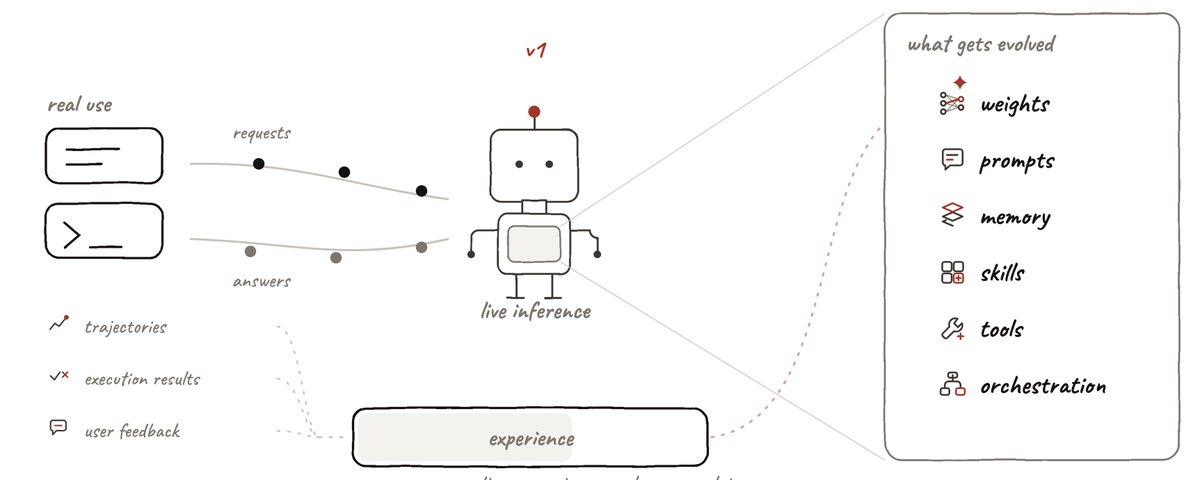
Can an agent recursively improve—without updating a single model weight?
Today, we introduce Recuris: Recursive Experiential–Working Memory Evolution for Long-Horizon Agent Harnesses.
Recuris enables recursive self-improvement through two tightly coupled loops around a frozen LLM:
1. Within-task execution: Verified EM–WM Coupling
Working Memory maintains a compact, evidence-grounded representation of the agent’s current progress and unresolved goals. This evolving task state determines when—and which—reusable skill should be invoked from Experiential Memory.
After the agent acts, environment feedback verifies whether progress actually occurred before Working Memory is updated.
The result is a closed execution loop:
Task State → Skill Invocation → Execution → Verification → Updated Task State
2. Across-task improvement: Recursive Skill Memory Evolution
EM–WM coupling turns execution into structured diagnostic evidence. A fixed Meta-Agent analyzes these traces, localizes failures to specific memory components—such as the stored skill, working-state representation, invocation policy, or checker—and proposes targeted repairs.
Candidate updates are admitted only after passing a fixed validation gate.
Once admitted, the evolved memory changes future execution, producing new behavior and new evidence for the next round of improvement:
Memory → Behavior → Evidence → Failure Localization → Targeted Update → Better Memory
This is the core recursive loop of Recuris: memory shapes behavior, behavior reveals the limitations of memory, and those limitations guide the next memory update.
Across 4 long-horizon benchmarks and 10 models, Recuris improves task success in 35 of the 37 completed model–benchmark pairs, spanning open-weight models as small as 3B parameters and today’s strongest frontier models.
On τ²-Retail:
• GPT-5.6 Sol: 58.3 → 76.1, +17.8 points
• Claude Opus 5: 72.4 → 87.9, +15.6 points
Recuris takes Claude Opus 5 to 87.9% task success—9.7 points above the best result achieved by any model in our evaluation without Recuris.
The advantage becomes larger as the interaction horizon grows, reaching +32.2 points on the longest tasks, while common long-horizon failure modes are reduced by up to 80%.
Crucially, evolved memory transfers across models. A memory evolved on a separate deployment model can be loaded unchanged into GPT-5.6 Sol and Claude Opus 5—even though neither model participated in its evolution.
These results suggest a practical and scalable path toward recursive self-improvement:
An agent does not need to begin by rewriting its own weights. It can first evolve the external memory mechanisms that determine what it remembers, what remains unresolved, when experience should be invoked, and how failures reshape future execution.
The model remains frozen.
The memory keeps evolving.
The agent becomes increasingly capable.
📄 Paper: arxiv.org/abs/2608.24876
💻 Code: github.com/Gen-Verse/Recuris

KSE retweeted

DoWhy - Low Code Causal Inference in Python as a Microsoft and AWS Collaboration
Article:
marktechpost.com/2022/06/02/…
microsoft.com/en-us/research…
Python GitHub:
github.com/py-why/dowhy
(Example below shows inference in 4 lines of code) – at Manhasset Hills, NY

