

Business meaning in the graph. Business authority in the runtime.
San Francisco
Joined June 2024
- Tweets218
- Following3
- Followers315
- Likes599





TrustGraph retweeted

I never expected to see the @TrustGraphAI logo next to Minecraft. 😂 Thanks for the support @Olares_OS!

TrustGraph retweeted

TrustGraph
Connect ontology-grounded context graphs with deterministic AI agent governance to enforce business rules before execution and preserve decision evidence.
github.com/trustgraph-ai/tru…

TrustGraph retweeted

📚 Build a knowledge graph with TrustGraph
olares.com/docs/use-cases/tr…

We've come a long way since the TrustGraph site was nothing more than a Docusaurus collection of documentation masquerading as a website!
Check out the brand new TrustGraph.ai!

ALT Check out the brand new TrustGraph website!
TrustGraph retweeted
Everyone is talking about ontologies. Why now? What changed?
The economics.
Ontologies are far from new. If we're talking about semantic web standards like RDF, they date back to the late 90s. OWL, the standard for ontologies, goes back to 2004.
What's really changed is how you develop ontologies. The old way:
- Read lots of information and try to understand what it all means, mapping out relationships and terms
- Try to reach consensus with others on the mappings, or in other words, argue a lot about it
- Build all that into a machine-readable structure like OWL
As you can imagine, this is a long process, for a complex domain likely months. So what's the new way?
- LLMs can read an interpret the domain
- LLMs can build the relationships and mappings
- LLMs can structure all that in OWL, or any target format you'd like
And how long does that take? Minutes. I know what you're probably thinking, what about the quality? Surely human developed ontologies are better, right?
Not really.
Since we released ontology features and OntologyRAG in @TrustGraphAI, we've studied a lot of ontologies and developed a lot of our own. LLM developed ontologies? Easily on par with human developed ones, and more often than not, better.
But where do we go from here? Expect to see even more advanced capabilities in TrustGraph very soon that will be able to develop custom ontologies by learning your business logic through your own data with all the lifecycle change management capabilities you need.
Don't trap your business logic in proprietary ontologies. Develop you own with TrustGraph.

ALT TrustGraph is the leading ontology development platform
🚀 TrustGraph 2.9 is live! The Workbench is now 100% config-driven — navigation, search, DCAT catalogs, and IAM admin, all from JSON. Plus: LangChain removed from the core, named-graph bulk APIs, and models pre-loaded in containers. 👉 github.com/trustgraph-ai/tru…

TrustGraph 2.8 is now available.
This release is a major infrastructure and product milestone for teams building enterprise knowledge systems, GraphRAG applications, and governed AI workflows.
The foundation is now fully asynchronous. TrustGraph has migrated its messaging layer from a thread-per-consumer design to configurable async receive and send pools across Pulsar, RabbitMQ, and Kafka. That removes a major scaling bottleneck for deployments operating across many workspaces and flows.
TrustGraph 2.8 also adds:
• Hybrid Document RAG using BM25 keyword search, vector similarity, and Reciprocal Rank Fusion.
• LLM-native structured output, carrying JSON schemas from prompts to supported model-provider APIs.
• A pluggable image-to-text service.
• Docling document processing for PDF, Office files, HTML, Markdown, and CSV.
• Structured audit events for gateway requests and IAM decisions.
• Expanded observability with unified metrics across infrastructure, services, and applications.
• Gateway passthrough support for organization-specific enterprise extensions.
• Improved multilingual RDF handling, including language tags, XSD datatypes, and Unicode-aware entity names.
TrustGraph Workbench 2.0.3 is included in the release, introducing a plugin-driven UI architecture, five runtime themes, a reusable component system, a Threat Explorer for OCSF investigations, and interactive 3D graph visualization.
Get TrustGraph 2.8:
github.com/trustgraph-ai/tru…
Documentation:
docs.trustgraph.ai/
TrustGraph retweeted
I'm excited to be a part of the @DevNetwork_ Advisory Board and be a panelist on Sept 3 of one of the largest gatherings of API, cloud, AI, and enterprise technology leaders driving the next generation of software innovation. Next week three major events come together:
☁️ API World + CloudX + AI TechWorld (September 1–3 | Santa Clara Convention Center)
As part of the Advisory Board, I have a limited number of free and discounted passes available for my network:
👉 Free OPEN Pass: link.devnetwork.com/MLtDIly6
👉 25% Off PRO & PREMIUM Pass Code: Advisory-25
If you're building with APIs, AI, cloud infrastructure, agentic systems, or enterprise software, this is a great opportunity to connect with developers, engineering leaders, architects, founders, and technology decision-makers.
Let me know if you'll be attending—I'd love to connect in person to discuss how @TrustGraphAI can transform your agentic roadmap!
🗓️ Check out the schedule: cloudxconf.com/conference/

TrustGraph retweeted
If we really want to talk about graph engineering, shouldn't we be talking about semantic significance?

🚀 Join the GOAI Open Source AI Challenge!
Calling all AI developers, builders, and open-source enthusiasts! The GOAI Open Source AI Challenge is now open, bringing together developers from around the world to build the next generation of AI applications.
🏆 Global competition with a ~US$730K+ prize pool
🌍 Open to developers worldwide
💻 Build with open-source AI technologies
🤝 Meet fellow builders at the Silicon Valley Roadshow (Aug. 8)
Learn more & register: goaihz.com/en
Silicon Valley Roadshow: luma.com/cxu2xd95

TrustGraph retweeted

this is f**king insane
someone just open-sourced a GitHub repo with 2,400 stars which gave out the entire framework for "graph-engineering"
I set it up with Deepseek V4 Flash in 3 mins
[here is how]
1. Install 'opencodex'
2. Add Deepseek API key
3. Install 'trustgraph'
4. Set up Docker
5. Voila
Most people will ignore and bookmark.
Just Give this video to your agent.
Be Different.


TrustGraph retweeted
The path to #EnterpriseAI follows a road paved by safety engineering, human factors, cyber risk quantification, behavioral economics, and prospect theory.
Together these methods can generate measurable determinism for agentic AI. All coming very soon in @TrustGraphAI...
TrustGraph retweeted

this repo is f*cking insane
someone packaged holonic context graphs, graphRAG, and local LLM inferencing into a single self-hosted container harness.
it builds 3D context graphs, extracts entity-relationship paths, and gives your AI agents full fact-level provenance with zero hallucinations.
zero API keys needed. bookmark before this gets buried.

ALT TrustGraph Repo


TrustGraph retweeted
Today, I read a LLM license so you don't have to! Today's model? Kimi K3.
What's the TLDR? Yes, Kimi K3 is open weights, but it's not true open source as it comes with commercial restrictions. It's not MIT, Apache 2, AGPL-3, or even SSPL. It's their own custom written license. It sorta reminds me of some of Meta's licenses for Llama with one big exception...
I actually don't understand this license - kinda at all - and I wonder if that's the intent.
I also wonder if they had US counsel to help them with the wording, because lost in translation could also be an issue.
The key points:
- If you provide Model as a Service to a third party with Kimi K3 *and* exceed $20M USD (or equivalent) in revenue over 12 consequetive months, you must obtain a separate - and I'm assumed paid - license from Moonshot AI.
- However, there are exceptions to Model as a Service, specifically "...(a) end-user products with model capabilities solely embedded within specific features or harnesses, or (b) mere relaying of requests o models hosted by others."
I very much don't understand exception (a), and as Mark Adams and I wondered, if we deploy Kimi K3 within @TrustGraphAI (the deterministic context harness for agents), are we exempt? I think we can argue yes, but I have a feeling that wasn't their intent?
- Much like Meta's old licenses for Llama, if you exceed 100 million MAU (montly active users) or $20M USD revenue threshold, "Kimi K3" must be prominently in the UI.
- Then there's point 4. Point 4 states that neither the Model as a Service nor MAU thresholds apply if "...(a) internal use of the Software, defined as any use that does not make the Software, its outputs, or its underlying capabilities available to third parties..."
This again, is very ambiguous and open to interpretation in my view. If an enterprise were to take a platform like TrustGraph, and use it to deploy Kimi K3, it seems they would be exempt from the Model as a Service and MAU requirements, even if someone (like us) provided engineering services to them to manage/host the TrustGraph deployment that forms the harness for the internal usage. Again, ambiguous.
It seems this license is aimed at someone that deploys the model, then provides simple API access to it. However, if you deploy it within a more sophisticated context harness, it's exempt from the revenue threshold? For me, the interpretation is unclear, and that could be the intent. Perhaps they have intentionally released Kimi K3 with an ambiguous license to scare people away from trying to commercialize it.
Is Kimi K3 an open weights model? Yes.
Is Kimi K3 true open source software? No. There are commercial restrictions that limit usage.
Is this the future direction of open weights models? Restrictive licenses that allow us to see the weights but prevent commercialization? We shall see.


TrustGraph retweeted
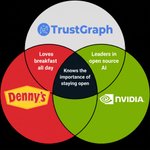
Open weight models and open source AI seem to be on everyone's mind. It was a central theme to AMD's Advancing AI conference with Lisa Su's keynote talking about the need to cultivate open ecosystems.
We at @TrustGraphAI give our strongest support in advancing open source AI.

For my first post, I’m sharing a letter @NVIDIA signed on why open models matter.
AI will transform every industry, power every company, and be built by every country.
Open models strengthen safety and cybersecurity, accelerate innovation and diffusion, and enable sovereignty.
The world needs both frontier closed models and frontier open models.
images.nvidia.com/pdf/Open-W…


TrustGraph retweeted
What does the World Cup have to do with building in AI?
Congratulations to Spain for proving they are the best team, and that a true team effort is what wins championships. While teams like Argentina, France, and England are built around star players like Mbappe, Messi, and Bellingham, Spain doesn't focus on superstars.
They focus on the team. A team of players that know their roles. A team of players all on the same page. A team of players working together as a cohesive unit with one goal in mind: team victory.
Sure, the superstar players make for exciting moments and great content, but they all went home without what they really wanted - the World Cup championship.
And this is how people are approaching AI, treating the LLM like it's the superstar player. Sure, you can build around a LLM as if it's your star player, but will you have an end product that will be usable by large enterprises.
No.
Enterprise-grade AI products require a team effort. The LLM is just one of many players. In fact, the smaller role you give the LLM, the better your chance is at success. The best AI products are not built to feature LLMs.
The best AI products are built to minimize LLMs.
But how do you do that? Context engineering. But how do you do that with closed models from Anthropic, OpenAI, or Google that try and lock you into their team's way of doing things?
Open Source AI.
Not too long ago, the thought of building complete enterprise grade products with open source AI seemed fantasy. But it is reality today. How do I know? Because we do it every day with @TrustGraphAI. TrustGraph is the complete context engineering platform for open source AI.
From powering agents with holonic context graphs, to deploying open weight models, to modular and reusable units of context called context cores, to true enterprise-grade multi-tenancy and fine-grained access controls for users, agents, and data, the future of open source AI is now.
Not only is TrustGraph built for open source AI, it's open source too. Try it today 👇
🤖 Made with AI

TrustGraph retweeted
Have you heard the term "explainable AI", but wonder what does it actually mean? This is explainable and open source AI 👇
We are excited to announce the release of TrustGraph 2.6! 🚀 This update marks a massive leap forward in retrieval accuracy, enterprise access control, and UI/UX experience for GraphRAG applications.
Whether you're an enterprise architect fine-tuning access controls or a developer building advanced RAG pipelines, TrustGraph 2.6 delivers the performance and flexibility you need.
Key Highlights:
• Cross-Encoder Reranking: We replaced our legacy LLM edge-scoring pipeline with a highly efficient FlashRank cross-encoder, drastically improving GraphRAG and Document-RAG precision while reducing redundant context.
• Multi-LLM Support: A single OpenAI-compatible processor now covers multiple providers (DeepSeek, Qwen, Mistral, Llama, Zhipu AI, and more) via a simple --variant flag.
• Enterprise IAM: Introduced fine-grained, per-operation capabilities and a global user model for robust, enterprise-grade access control.
• Portable Workspaces: Seamlessly migrate workspaces between deployments with new .tgx bundle export/import CLI commands.
• Next-Gen UI Explorers: Client-side routing and a suite of powerful interactive visualizations, including a Subway-Map Pathway Finder, Risk Explorer, Game Theory Explorer, and more.