





Cool. But a thought: amid breathless reports and photo gawks of #ArtemisII: the mission will break the furthest-from-earth human travel record set in 1970 by 4,000 miles. On a miles per hour basis, that’s 8/thousandths of a mile per hour (0.008 MPH). 43 ft! < 1 ft/hour! Worth it?

Artemis II has reached its maximum distance from Earth.
On the far side of the Moon, 252,756 miles away, Reid, Victor, Christina, and Jeremy have now traveled farther from Earth than any humans in history and now begin their journey home. Before they left, they said they hoped this mission would be forgotten, but it will be remembered as the moment people started to believe that America can once again do the near-impossible and change the world.
Congratulations to this incredible crew and the entire NASA team, our international and commercial partners, but this mission isn’t over until they’re under safe parachutes, splashing down into the Pacific.
Here’s a thought, amid breathless reports and photo gawks of #ArtemisII: the mission will break the furthest-from-earth human travel record set in 1970 by 4,000 miles. On a miles per hour basis, that’s 8/thousandths of a mile per hour (0.008 MPH). 43 ft! < 1 ft/hour! Worth it?

Sean Carroll retweeted

Why anti-Zionism can't properly be treated as antisemitism for purposes of federal civil rights law, in ~ 2 minutes
(Full hearing: youtu.be/uJ_k0v_jmZ8?t=2645)
Sean Carroll retweeted

Within the week, our team has distributed a total of 153,220 gallons (580 cubic meters) of potable water to displaced families in southern Gaza, reaching an estimated 193,333 individuals.
In Gaza City, we delivered 250 fresh vegetable parcels to displaced families. Each 35-pound (16.05 kilograms) parcel provides enough produce to support a family for about one week.
And we continued distributing hot meals, including 60 pots of rice in the Middle Area camps, and another 60 pots in Khan Younis, collectively serving hot food to 18,000 displaced people.
Thank you to our supporters for making all of this possible.


Sean Carroll retweeted
Step inside one of Anera's clinics in Gaza and meet Ahmad Najjar, our medical donations program coordinator. Our medical team has faced immense hurdles, but through determination, they’ve found innovative ways to care for those in need. “We build these spaces because healing begins here. Even now, life insists on itself,” says Ahmad. These clinics, supported by Anera’s partners and donors, are not just facilities; they are lifelines.
Our emergency response in Gaza is ongoing. Your support will cover clinic costs, including medicine, provide meals, and much more. Donate at give.anera.org/gaza-response.
Sean Carroll retweeted

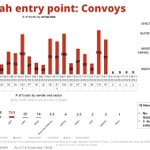
The incredible reporting in Haaretz gives an overview of all the obstacles Israel creates to the delivery of aid in Gaza.
1) Strict Registration Requirements:
Many humanitarian organizations are denied registration or have their applications delayed, especially if any of their staff have criticized Israel or if they refuse to provide lists of Palestinian employees—which can violate their home countries’ laws.
2) Rejection of Dozens of Aid Organizations:
The Israeli Welfare Ministry, especially under Minister Shikli, has rejected dozens of organizations seeking to send aid, citing new, more restrictive procedures.
3) Bureaucratic Delays and Permit Issues:
Aid convoys face complex and frequently changing bureaucratic processes for approvals, which delay the movement of trucks and increase costs.
4) Police Escort Requirement (and Delays):
Israel now demands police escorts for every aid convoy from Jordan, but police often fail to show up, causing further delays or cancellations.
5) Military Delays and Logistics at Kerem Shalom Crossing:
The Israeli military accelerates loading but then delays trucks for hours at the crossing, limits loading and tying time, and sometimes sends them on dangerous routes.
6) Limited and Unpredictable Crossing Access:
Crossings like Kerem Shalom and Be’eri are often closed on Fridays and Saturdays, and there’s no simultaneous passage for aid teams and trucks.
7) Physical Barriers and Checkpoints:
Additional checkpoints and physical barriers block or slow convoys, often trapping trucks for hours or even days.
8) Restrictions on Allowed Goods:
Israel restricts or bans certain food items (e.g., dates, potatoes), medical supplies, generators, solar panels, and even prefab clinics, often with unclear or shifting justifications.
9) Forcing Use of Vulnerable Routes:
The army directs convoys through dangerous, looted routes, sometimes suspected of encouraging theft to show the UN as “ineffective.”
10) No Military Escort for Convoys in Gaza:
Convoys aren’t accompanied by military or police once inside Gaza, leaving them exposed to looting and attacks.
11) Collapse of Social Order:
Israel’s attacks on Gaza police and governance have led to chaos, making it even harder to distribute aid safely.
12) Crippling UNRWA and Humanitarian Agencies:
Israel has expelled international UNRWA staff, barred them from coordinating with Israeli authorities, and made it nearly impossible for the agency to function.
13) Targeting the UN Humanitarian Office (OCHA):
The Israeli government has taken steps against OCHA staff, including revoking the visa of the Gaza office chief, further hampering coordination.
14) No Time to Secure Loads:
Aid organizations aren’t given enough time to safely tie down food on trucks, causing food to spill or be stolen before reaching those in need.
15) Delays in Final Distribution:
Even after entering Gaza, aid is often stuck at logistics areas near the crossings, with organizations barred from freely collecting and distributing supplies, which limits how much food actually gets to people.
Remember that list of obstacles Israel creates the next time someone blames the UN or Hamas for hunger in Gaza. This is an intentional policy of making it seem like Israel iss providing aid without actually providing it.

Sean Carroll retweeted
What is happening in Gaza is not just a logistical challenge. It is the unraveling of a lifeline. Anera’s staff continue to show courage in the face of immense personal loss, displacement, and danger.
One staff member put it plainly: “Day by day, we are losing the ability to offer any hope.”

Sean Carroll retweeted
UN Secretary-General António Guterres says Gaza is enduring “the cruelest phase of this cruel conflict,” with Israel blocking aid for nearly 80 days. “What’s been allowed in is a teaspoon when a flood is needed.”

Sean Carroll retweeted

We don’t need any other new for profit organization…the Food relief is already in place! We just need food and humanitarian relief open again…@WFP @WCKitchen @AneraOrg and many other local organizations can do it….we just need food…why something new when already Palestinians are feeding Palestinians? please @realDonaldTrump make it happen….

Axios :"Scoop: Former UN food program director in talks to lead new Gaza aid foundation."
This scoop should refer to David Beasley as the senior advisor to Fogbow who were partly responsible for the Gaza maritime relief effort using a floating pier which was a $232m total failure
Sean Carroll retweeted

Families in Gaza are starving while the food they need is sitting at the border. But @WFP hasn't been able to get new aid in since 2 March.
If we wait for famine to be officially confirmed, it will be TOO LATE.
We need access.
We need a ceasefire.
We need to move NOW.
Sean Carroll retweeted

Everyone in Gaza is hungry.
As supplies dwindled over the past two months, access to food is becoming increasingly difficult.
A new assessment shows nearly a quarter of people in Gaza could be pushed into famine without immediate action.
⏩Swipe to get the facts⏩
Sean Carroll retweeted

After two months of devastating blockade and starvation of Gaza, Israeli officials demand that we shut down the universal aid distribution system run by the UN and NGOs like NRC. They want to manipulate and militarize all aid to civilians, forcing us to deliver supplies through hubs designed by the Israeli military, once the government agrees to re-open crossings.
NRC will stand by our humanitarian principles and will, with all our peers, refuse to take part in this new scheme. We urge donors to do the same.
ochaopt.org/content/statemen…

Sean Carroll retweeted

This 👇 is extremely rare, the German business community demonstrating greater moral courage than their political counterparts.
BWA—the powerful German Federal Association for Economic Development and Foreign Trade—just issued this statement by its chairman Michael Schumman on Palestine, calling out the stunning hypocrisy and injustice at play:
"When rockets fall on Sumy, when children perish and families are obliterated, a chorus of outrage rises swiftly across the capitals of Europe - amplified by headlines, commentary, and statesmanlike pronouncements. But when similar horrors occur in Gaza - with a regularity that numbs the conscience and perpetrated by leaders of nations we call friends or partners - those same voices fall silent, or at best, retreat into the hushed murmur of diplomatic platitudes....
What reveals itself here - and it is a phenomenon of deeply troubling significance - is a distortion of perception, both in the media and society at large: a quiet, creeping hierarchy of human suffering, which leads us to distinguish between victims of the first and those of the second order. This, I fear, will not go without consequence. For once justice is made relative, it tends to recede - and the accusation against us, who have relativized it, will one day return with doubled force, like all that has been suppressed, and come and haunt us at a high cost."

On the Inequality of Compassion - Statement of our Chairman Michael Schumann after his return from Antalya Diplomacy Forum:
”Let it be said at the outset - every loss of human life that occurs under the shadow of war, whether amid the thunder of artillery or the quieter horror of so-called “precision strikes“, is an event of relentless tragedy, a rupture in the fabric of humanity that no rhetorical balm can mend. The grief of the bereaved, like the guilt borne by those who, whether by command or complicit silence, have helped bring it about, runs so deep that it weighs heavily on the souls of all involved - often across generations.
And yet, how strangely varied are the responses these tragedies evoke in our collective consciousness! When rockets fall on Sumy, when children perish and families are obliterated, a chorus of outrage rises swiftly across the capitals of Europe - amplified by headlines, commentary, and statesmanlike pronouncements. But when similar horrors occur in Gaza - with a regularity that numbs the conscience and perpetrated by leaders of nations we call friends or partners - those same voices fall silent, or at best, retreat into the hushed murmur of diplomatic platitudes, as though the unspeakable might be rendered tolerable through polite evasion.
I have just returned from a conference in Türkiye, attended by numerous representatives of Arab nations - cultivated, clear-eyed individuals whose questions were born not of resentment, but of a sincere longing for moral coherence. They asked, not without bitterness, yet with just cause: Where is Europe’s outrage in the face of the suffering in their part of the world?
What reveals itself here - and it is a phenomenon of deeply troubling significance - is a distortion of perception, both in the media and society at large: a quiet, creeping hierarchy of human suffering, which leads us to distinguish between victims of the first and those of the second order. This, I fear, will not go without consequence. For once justice is made relative, it tends to recede - and the accusation against us, who have relativized it, will one day return with doubled force, like all that has been suppressed, and come and haunt us at a high cost.“
#ADF2025 #MEET4DIPLOMACY #Humanity #Justice #Suffering #Europe #Russia #Ukraine #Israel #Gaza

Sean Carroll retweeted
Photos taken March 29, 2025: This is a grocery store in Gaza. As you can see, they are nearly bare, with only a few cans, some packs of water, and a few other items.
While much of the world gathered to celebrate Eid this weekend, Gaza was left with almost nothing. Despite the outpour of support, the borders remained closed this month, meaning additional aid could not reach those in need.
Thanks to our supporters, we were able to distribute thousands of essential items to families across Jordan, Lebanon, and the West Bank. However, in Gaza, Ramadan was marked not by abundance or peace, but by suffering and a lack of humanity.


Sean Carroll retweeted
Anera received a new shipment of life-saving medications donated by @directrelief in Jordan, bringing hope to patients with chronic illnesses. These treatments will support individuals managing kidney disease, rheumatoid arthritis, and other autoimmune conditions, ensuring they receive the care they need. 🧡📦

