

sociologist/criminologist AP @HamlineU. PhD @UMNsociology. Crime, punishment, inequality, quant.
Minneapolis
Joined February 2011
- Tweets1.2K
- Following490
- Followers387
- Likes2.1K
Not only are the packaging effects conditioned by sentencing context, but so is the racialization in sentencing - we see more robust race effects among non-presumptive prison cases for both probation and LFOs.


How does this change the picture of the race effects? For LFOs, the IV race effects are substantively similar, but probation for Black and Native American defendants is higher as compared to White (~7.4% and 66%) - highlighting how packaging can mask important racial disparities.

We find that a 1% increase in instrumented incarceration results in a 0.27% decrease in LFOs and a 2.3% decrease in probation. Importantly, sentencing context moderates these effects - with more packaging malleability at lower levels of sentencing (i.e., non-presumptive prison).

We model the interdependency of incarceration and probation/LFOs using IV models leveraging county jail capacity as an instrument. In the first stage, capacity interacts with sentencing context - pushing felony towards prison and GM to lower confinement to reduce overcrowding.

These "extra-legal" race effects hold up in standard multivariate models that adjust for legal, defendant, and case factors, with BIPOC defendants associated with 13-39% more incarceration, 19-29% lower probation, and 7-46% lower LFOs compared to white defendants.

First we descriptively show that the overall racialized pattern in sentenced punishment reveals a bifurcation along the lines of race, with White defendants receiving longer community surveillance and larger monetary punishments, and BIPOC defendants receiving
longer confinement.

Fourth, we observe a decrease in MPD stops after the murder, and reduced proactive policing explains a meaningful portion (~25%) of the post-murder increase in homicide, suggesting that both de-policing and broader social and institutional mechanisms were also at work. 5/n

Third, the the post-murder homicide surge locally was spatially uneven and disproportionately concentrated in structurally disadvantaged neighborhoods. 4/n

Second, we show that not only did the quantity of homicide changed, but so did the quality. We observe argument and felony crime incidents among adults driving the overall increase. 3/n


First, homicide rates rose from an average of 0.11 to 0.28 per 100,000 (about 2.5x). Net of pandemic outcomes, policy, and movement and seasonality we identify an effect of + 0.28 homicides per 100,000 - equivalent to ~ 183 excess homicides in the period. 2/n


Fresh online in JQC (@SpringerCrim) w/ @jillkpeterson, @chrisuggen, and others! We use an ITS design to examine the changes in the Twin Cities in relation to the pandemic and the police murder of George Floyd. Finding summaries below!
Link here: link.springer.com/article/10…
1/n

There are many signs of the fear and distress people are feeling in my home town of Minneapolis. One signal of elevated strain is the rise in 911 calls for help — up about 9% daily in the new year relative to previous daily averages across 2020-2024.

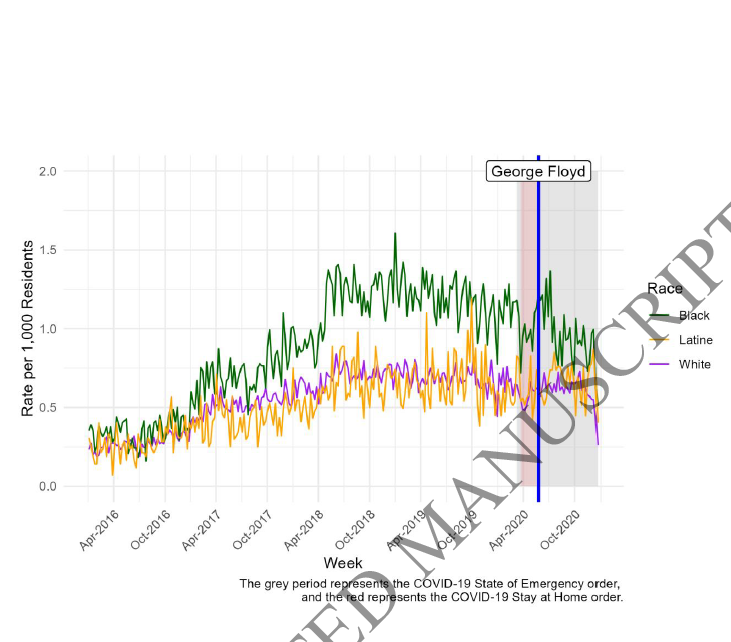
Fresh out in @AmJEpi ! Using an ITS design, we find that mental health diagnoses rose for Black Minneapolitans post-murder of George Floyd (~+2.9/1,000 at ZCTA-level). This increase was spatially global across an index of concentrated disadvantage.
academic.oup.com/aje/advance…


New: Our study of Minnesota hospital data shows a broad increase in mental health diagnoses among Black (but not White or Latine) Minneapolitans after the murder of George Floyd. With Jeanie Santaularia, @ryanplarson, & @ChrisERobertson in @AmJEpi. academic.oup.com/aje/advance…

We also find significant spatial heterogeneity in the increase in gun injury. Disadvantaged, historically Black neighborhoods experienced the greatest brunt of the increase of gun assault injury incidence in Minneapolis.
3/4

Using an interrupted time series design we find ~1.78/100,000 increase in gun assault injury in Minneapolis after the police murder of George Floyd. Our models indicate that this increase was not a simple byproduct of changes in policing, COVID-19 policy, or seasonality.
2/4

Presenting some collaborative research w/ @hoosierbluesman looking at the patterns of support in Minneapolis' city charter amendment vote along the lines of demographics, politics, and police violence/crime this morning @MidwestSoc! Room FJORD 4


