

Law professor @NYlawschool, former Manhattan ADA. What I love: legal ethics, criminal justice, free speech, due process rights, my kids, not in that order.
New York
Joined July 2009
- Tweets2.1K
- Following912
- Followers3.7K
- Likes5.9K
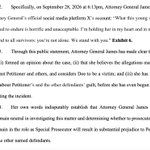


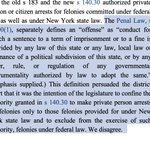
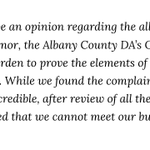
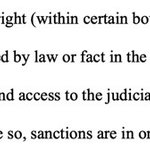


Disqualification of a prosecutor, unlike a private lawyer, can be based on an appearance of impropriety. James' statements create that appearance and if NY had a rule like MR 3.8(f) would also violate that rule.


NEW: Cornell Seven Case Takes Wild Turn as Defendant Challenges Letitia James
Gillio Lopes is fighting to remove Letitia James as special prosecutor; his attorney, Andrew Miltenberg, tells @LAmag why he believes James should step aside and what happens if a judge disagrees. I also spoke with New York criminal defense attorney @Bederowlaw to get his perspective on the latest developments.
lamag.com/crimeinla/cornell-…
Rebecca Roiphe retweeted

3 of the Nation's leading First Amendment Scholars - former ACLU President Nadine Strossen, Rebecca Roiphe @rroiphe, and Eugene Volokh @VolokhC - have just filed an amicus brief in support of my Cal Bar cert petition. Well worth a read. Thank you all. supremecourt.gov/DocketPDF/2…
Bruce Green and I just posted this article arguing that the Supreme Court did not bless the President's control over individual prosecutions in Trump v. US and the President actually has a constitutional obligation to preserve prosecutorial independence. papers.ssrn.com/sol3/papers.…
Of course this is true and when Congress tried to prevent lawyers who receive federal funds from challenging laws that hurt they clients, SCOTUS found that it violated the first amendment. supreme.justia.com/cases/fed…


I was on this committee. I think maybe 1/4 of the members were Jewish.
This quoted post is unavailable.
The Florida federal judge states that Trump can't claim full control over DOJ then say it's a separate party. The judge also insists that "the DOJ is tasked with zealously representing the United States' interests...and is trusted to remain insulated from political influence. "

In criticizing the IRS/Trump anti-Weaponization fund, the federal judge in Florida did exactly what Bruce Green and I suggested in this Lawfare piece -- findings of fact and conclusions about the professional lapses of government lawyers. lawfaremedia.org/article/the…

Rebecca Roiphe retweeted

After the US Supreme Court issued major decisions this morning, @NYLawSchool 's Prof @rroiphe provided key insights to @CBSNews on the ruling over the President's ability to fire members of certain types of federal agencies

The Supreme Court has ruled that removal protections for members of the Federal Trade Commission are unconstitutional and overturned a 90-year-old decision that allowed Congress to shield members of certain independent agencies from being fired by the president at will. However, the high court allowed Lisa Cook to continue in her post as a member of the Federal Reserve Board of Governors while legal proceedings over President Trump's attempt to fire her continue.
CBS News legal contributor @rroiphe has more on these two cases.
Rebecca Roiphe retweeted

A Lawfare study found that 97 of the more than 1,500 January 6th rioters pardoned by President Trump have faced other charges after being granted clemency.
@KDilanianMSNOW has more details. @sbg1, @rroiphe and @LACaldwellDC join @KatyTurNBC to discuss.
ms.now/katy-tur/watch/study-…

Rebecca Roiphe retweeted
This AM, @NYLawSchool’s @rroiphe appeared on @MSNOWNews to discuss w/ @AnaCabrera the implications of the appointment of the new Acting DNI as well as the weaponization fund
🔗 shorturl.at/efKKC

When should prosecutors be disqualified for political bias? Bruce Green discuss after a California court disqualified Jeff Rosen from prosecuting pro-Palestinian protesters reason.com/volokh/2026/05/15…
Rebecca Roiphe retweeted

Guest Post: State Prosecutors, Protests, and Politics as Usual? Professors Bruce A. Green and Rebecca Roiphe opine on the disqualification of a Santa Clara County prosecutor. reason.com/volokh/2026/05/15…
Rebecca Roiphe retweeted

Niche tweet, but there's a lot of discussion of "viewpoint diversity" in academic hiring, and what it means, and whether it's an affirmative good.
In law schools, at least, I think it's a good thing and important. I thought I would say what I think viewpoint diversity is, and why I think it's good and important in academia—focused, at least for now, on scholarship. (As I said, it's a niche tweet—feel free to skip.)
I'll start with an observation. One of the things you realize when you start law school is that legal argument is a cultural practice and a language, not a science governed purely by logic. As a result, whether a particular legal argument is deemed persuasive often depends on the legal culture that the judge who is to be persuaded is steeped in, and how the lawyer has framed the issue in light of that legal culture.
There are some parts of the legal culture that are broadly shared by essentially all lawyers. But the legal culture splinters, too. On a lot of topics, there is no one prevailing legal culture, but rather two or more different legal cultures.
To pick an accessible example, you may have one group that sees a close reading of text as the important part and policy and purpose as sideshows, while another group sees policy and purpose as the focus while the details of text are side shows.
Often, these different legal cultures emerge organically from different political or ideological perspectives, which themselves change over time. It's human nature, I think. People are naturally enthusiastic about the modes of legal thinking that tend to deliver results they like. Over time, they gravitate to modes of thinking that have tended to lead to those results.
People won't see themselves as result-oriented in coming to those views. Rather, they will just notice (being insightful people) that certain modes of thinking usually lead to pretty inherently attractive outcomes, and the principled arguments for those modes of thinking will be more present in their minds than the principled arguments against them.
Attitudes towards the different schools of thought tend to follow. Every approach has its principled arguments for and against—no approach is perfect. But people will naturally focus on the principled arguments in favor of viewpoints that lead to results they see as fundamentally heartwarming, positive, or great. And on the flip side, they will naturally focus on the the principled arguments against viewpoints that tend to lead to results they see as fundamentally troubling or terrible.
What does this have to do with viewpoint diversity in academic hiring?
A lot, I think.
First, when it comes to evaluating the merit of scholarship during the hiring process, professors naturally tend to put a thumb on the scale of work within their subcultures. Scholarship speaking from within their legal subculture will resonate with them more than scholarship speaking from a different subculture. It's enough of a difference that, if they're not paying attention to the dynamic, what they casually perceive as just trying to hire the best people will often mean trying to hire the best people among those within their particular legal subculture.
As I see it, the importance of "viewpoint diversity" starts with just being aware of this limit to our own perceptions and the need to overcome our own biases. In law, at least, you tend to hire the best people only when you're aware that good ideas don't only come from the particular legal subculture that you personally live in, and that you need to try to step outside yourself to see that people with other views and assumptions have good ideas, too.
So that's the start, and it's basically just about overcoming our own biases as we try to measure merit.
The next part of it is the belief, based on experience, that a clash of ideas tends to sharpen them. Scholarly ideas are like a muscle. They need to be stressed to become strong. I can't be sure if I'm right unless I encounter someone who disagrees with me and who challenges me, and who forces me either to defend my view or change it. Ideally, the challenge is not just on a minor point, like how best to express an idea, but on a more fundamental issue like whether the basic premises of the argument are right or wrong.
A big benefit of viewpoint diversity is that it tends make that clash of ideas a lot more likely. If everyone basically thinks the same way, there are less likely to challenge basic premises. They won't think of basic critiques as readily, and they won''t be as willing to raise them, as those outside their subcultures would be. So to make your own work stronger, it's far more valuable to get feedback from those who don't share your basic premises than those who do. Having viewpoint diversity on a faculty creates an environment that makes it more likely to strengthen scholarship among those in the majority group.
This second value of viewpoint diversity doesn't have an obvious normative "to do" in response. Different people will have different senses of what it should lead to. Maybe it simply emphasizes the importance of the de-biasing discussed above. And it doesn't mean just (roughly) left and right, or left and center, or political ideology: Different subcultures can be different methodologies, PhD disciplines, and different subject areas, too. But I think that clash of ideas based on different views of the law is a key way to improve legal scholarship, and that having viewpoint diversity makes that clash more likely to happen.
There are other benefits to viewpoint diversity, I think. I haven't addressed those to students in class, who get to learn different worldviews in their courses that can help them persuade judges from different worldviews, too. But this tweet was long enough.
The court should make a factual finding regarding these alleged lies and if it finds they were in fact lied make a referral to state disciplinary authorities, as Bruce Green and I argue here lawfaremedia.org/article/the…

Responding to the Trump-written motion to dismiss in the Ballroom case, plaintiffs say it makes multiple statements govt attys know to be false, is “utterly unprofessional,” & is signed by 3 top DOJ attys who had never previously appeared in the case....
1/2
storage.courtlistener.com/re…


Rebecca Roiphe retweeted
Secretary of Commerce Howard Lutnick is facing questioning by the House Oversight Committee today over his relationship with Jeffrey Epstein.
@mychaelschnell has the latest from Capitol Hill. @lawofruby and @rroiphe join @AnaCabrera with legal analysis.
ms.now/ana-cabrera-reports/w…

I agree and it’s a little bit gallows humor. See my article on the disciplinary case against John Eastman. larc.cardozo.yu.edu/clr/vol4…
This quoted post is unavailable.
I don’t agree. I think just as FBI agents who happen to be lawyers are allowed to use lawful deceit to gain evidence so too are journalists who happen to be lawyers allowed to follow the norms and practices of their profession. The rules should be interpreted with the 1A in mind

Whatever one makes of these memos, whoever leaked them breached the trust that allows courts to do their jobs.
One of the article's coauthors, a licensed atty in NY, may have also violated the state's ethics rules and be subject to discipline.
1/
reason.com/volokh/2026/04/20…

Rebecca Roiphe retweeted

SCOTUS is likely to grant cert. if @DrJohnEastman files a petition based on many of the arguments by @rroiphe in her attached article.
larc.cardozo.yu.edu/cgi/view…

"Denied; disbarred." With that cursory ruling, the Cal. S.Ct declined to take my case despite clear First Amendment violations. So Bar Court disbarment recommendation now takes effect. We will appeal to U.S. S.Ct. Costly, but important. Please help here. givesendgo.com/Eastman

Bruce Green and I wrote this piece on the DOJ's proposed rule that would require states to defer to DOJ itself before disciplining federal government lawyers. lawfaremedia.org/article/the…
