
ronin retweeted

Lauren Tan’s pstack makes a lot more sense once you look at the bot team behind it.
she’s not using one “super agent” for everything.
instead, the work gets split across specialists:
• Chief of Staff → turns fuzzy goals into a plan
• Hatcha → research + synthesis
• Engineer bots → build, refactor, test
• Dr. Eggbot → review + catch weak assumptions
• Potato → keeps recurring work running
• Suki → UX, polish, final output
• Crumb → memory + context across long projects
the interesting part is the handoff:
goal → plan → specialists → review → final result
each bot has a narrow job, clear trigger, and expected output.
much better than asking one agent to research, code, review, remember everything, and somehow stay consistent.
I mapped the whole team + delegation flow in one page below ↓



ronin retweeted

interesting write-up from ceo of e2b
but let me rephrase the title honestly for you -
"Your sandboxes are dead. My sandboxes are great!"


ronin retweeted

Andrej Karpathy:
"Prompting is going away. Delete everything, keep Graph."
In just 69 minutes, he shows how to build graphs and why they're the only layer that survives in the end
Prompts → Agents → Loops → Graphs
a loop keeps one agent running until the job is done
a graph decides which agents exist and what each one passes to the next
anyone can build an agent, almost nobody builds the graph that runs them
watch it today, then save the full guide on graphs below before everyone starts catching up ↓


ronin retweeted
SpaceXAI Senior Engineer Lauren Tan on Grok Bot:
"GrokBot is the most powerful agentic tool we have ever shipped, but only 1% of users use it correctly
You can build an entire business with Grok Bot"
One bot's only job is building other bots. Dr Eggbot, trained on her own plugins
Give it a task and it opens a browser, sketches the mockup, hands back a live url
Two people turned an empty github org into an in-person company in a day
skip TikTok now and watch this, then read an article below


ronin retweeted

Google just open-sourced Harness².
(turn any harness into a self-improving system)
a harness is everything wrapped around the model, like the system prompt, tools, memory, skills, and subagents. today a person designs it once, and the agent runs every new task with that same fixed setup.
Harness² lets the agent refine that setup for each new task on its own, with the model weights left untouched.
on every task, the agent proposes edits to its harness, runs a few candidate versions, and composes a better harness by comparing how those runs behaved.
because it learns from the differences between runs, it needs no correct answer or grader for the task.
that covers a single task. Harness² also carries what it learns from one task into the next.
after each task, it saves the harness it settled on along with the lessons that held up across the runs. the next time it refines a harness, it starts from those notes instead of from scratch.
this means every finished task makes the next round of edits more informed.
Google tested this with Gemini 3.5 Flash and GLM-5 on legal, office, and professional work benchmarks. one round of edits was enough to beat their original harnesses, and giving the agent more rounds pushed scores higher.
those extra rounds can go wide or deep. the agent either tries several candidate harnesses at once or keeps refining a single one step by step, using OpenCode or Codex to carry out the work.
you can find the Harness² repo here: github.com/google-research/h…
I wrote about a similar idea for agents already running in production, where the harness should repair itself after a failure instead of waiting for someone to debug the trace by hand.
that piece walks through how @Cometml's Opik (open-source) closes this loop, going from a failing trace to a proposed fix to a regression test that stops the same failure from coming back. it's quoted below.


ronin retweeted

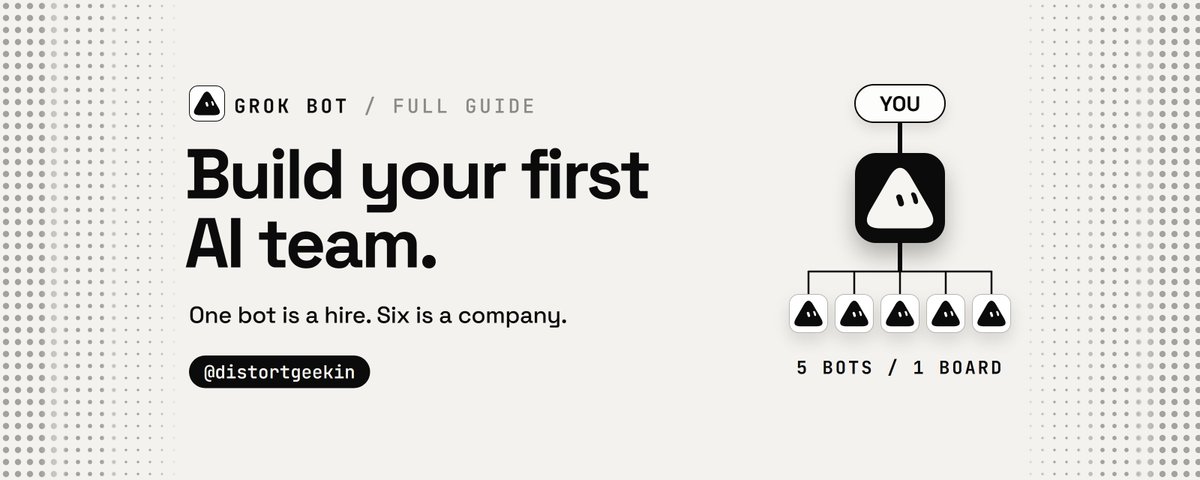
Lauren Tan just released a free 1-hour Grok Bot course on building an AI Team
From zero bots to 3,000 PRs a month on autopilot:
0% → 02:05 - Build your first bot that turns X bookmarks into live apps by morning
30% → 16:39 - Hire one bot per job, not one chat per task
45% → 22:46 - Teach a bot once and it keeps the skill forever
75% → 28:52 - Run your own company with a team of agents
100% → 38:25 - One orchestrator bot runs the whole AI Team while you sleep
Prompt → Bot → Skills → AI Team → Orchestrator → Company on Autopilot
Most people still open a new chat for every task
Worth more than any $1,000 AI agents course
Bookmark and watch it today

ronin retweeted

Prompt of the day:
Create a pre-commit hook that prevents files over 5,000 tokens. Tokens = bytes/4.
Run only on staged files. Ignore files which are not authored by agents, like lockfiles or codegen.
Provide explicit instructions on how to split files in the error message.
The simplest investment I ever made in my codebase. So good.
ronin retweeted

TL;DR of my new article: who Lauren Tan (@poteto) really is, and how the engineer behind Grok Bot went from 31K to 198K followers in ten weeks.
She has been at Cursor for less than seven months, not even long enough to hit a typical one-year vesting cliff. In that time @elonmusk has reposted, quoted, or replied to her at least 21 times.
🇸🇬 A teenager in Singapore whose dad gave her Photoshop at 15, then a finance degree where her first program was an Excel macro
🎤 Her tweets got her invited to speak at EmberConf, and her talks got her DockYard, Netflix, and the React team
⚛️ Sole author of the React Compiler Beta post, co-author of React Compiler 1.0
🐶 Binnie, her bug-fixing Slack bot, helped inspire Grok Bot because she is "a fairly lazy person"
🏗️ She rebuilt Grok @bot on Dune, her agent-first framework, in more than 600 PRs
🚀 Her 2,500 PRs talk has 3.9M views: "You can't spawn 100 agents when you don't even trust the output of one agent."
🌌 Grok Bot Galaxy, a 72-hour livestream building a company with @grok and @bot, which Elon quoted to 30M views
🥔 pstack, where the P is for potato
Caveat: she is the first to say she did not build Grok Bot alone. "I wouldn't say I built it all."


ronin retweeted

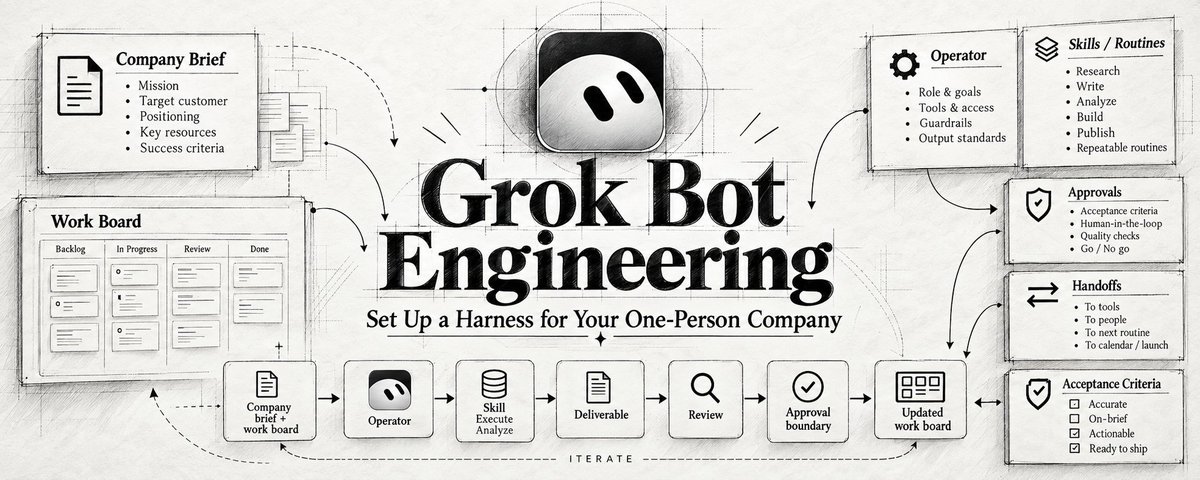
SpaceXAI engineer Lauren Tan:
"There's no point spawning 110 agents if you can't trust the output of one"
"Without a verification skill, you're the one checking everything - and you become the bottleneck"
In a 1-hour talk, she explains how she went from reviewing every output to shipping 1,000 PRs in a month
Watch Every Step → Verify → Skills → Evals → Auto-Merge
Trust in agents isn't a feeling - it's infrastructure you build
Worth more than most $2,000 AI coding bootcamps
Bookmark it and watch tonight

ronin retweeted

wow, this is f***ing wild
SpaceXAI engineer Lauren Tan has shared her own agent setup, with 54 skills
install it in Grok Bot: /add-plugin pstack
Here’s what’s inside:
→ 8 build skills:
/architect maps out the approach
/arena weighs different solutions
/swarm distributes work among agents
→ 6 review skills:
/interrogate questions assumptions,
/create-verification-skill sets out how to verify the app while it runs
→ 8 context + learning skills:
/recall retrieves earlier context
/catchup restores the project status
/teach captures reusable procedures
→ 5 writing + UI skills:
/unslop
/technical-writing
/make-bot-ui handle explanations, documentation and interfaces
along with 3 setup skills and 24 engineering principles for testing, dependencies, error handling and code structure.
The process: investigate → build → verify → save context
go deep with a single agent, then parallelize the work with confidence.
Save this list for your new workflow ↓


ronin retweeted

Learn Harness Engineering 🚀
Found this excellent open-source course by Walking Labs, covering 14 lectures and 8 hands-on projects on building more reliable AI coding agents.
What's inside:
→ Agent instructions (AGENTS.md / CLAUDE.md)
→ Context management and persistent memory
→ Multi-session continuity and state tracking
→ Task boundaries and scope control
→ Testing, verification, and observability
→ Automated agent loops and workflows
→ Multi-agent orchestration and graph engineering
The practical projects walk you through building a complete agent harness, comparing prompt-only execution with structured workflows.
Also includes ready-to-use templates, verification scripts, and a harness-creator skill.
Perfect for developers working with Claude Code, Codex, and other AI coding agents who want to understand the engineering behind reliable agent execution.
Completely free.
Here's the GitHub Repo: github.com/walkinglabs/learn…

ronin retweeted
SpaceXAI engineer Lauren Tan just made all 54 of her pstack skills public and you can add the whole stack to Grok Bot.
this is wild...
the full list is in the image:
· 3 to start: /poteto-mode
· 8 to build: architect, arena, swarm
· 6 to review: verification, correct, reflect
· 8 to understand: how, why, teach, recall,
· 5 to write: unslop, technical-writing, automate-me...
· 24 principles that control how the agents reason and execute
the useful part is that these aren't random prompts.
they're reusable skills + workflows + operating rules your Grok Bot can call whenever it needs them.
save the list, then plug the stack into your Grok Bot ↓


ronin retweeted

This is what a 1 person company looks like in the future.
Not a team.
A system of Al agents replacing entire departments
developersglobal.github.io/a…

ronin retweeted

SpaceXAI engineer Lauren: showed exactly how she works with agents, from her model setup to letting them run overnight
this is actually incredible...
· her setup: grok writes the code, opus 5.5 makes the hard calls
· her loop: understand, design, build, verify, ship
· her prompts: “repro first, then fix and verify”
· her bot team: chief of staff, eng lead, a bot that designs other bots
· her overnight contract: goal, finish condition, permissions, escape hatch
· 4 rules before any agent runs alone
bookmark this and install pstack in your grok bot


ronin retweeted

Systems Thinking for Agentic AI — Design reliable LLM and agentic AI systems with RAG, MCP, guardrails, evaluation, and observability: link.amazon/B0exzW2nC

ronin retweeted

SpaceXAI engineer Lauren Tan:
"Most people still use Grok Bot like Google.
I’m running 100+ agents, with Chief and PM bots coordinating the entire fleet.”
In this 34-minute workshop, she shows how to turn one Grok Bot into a team, with a Chief of Staff coordinating specialist bots and workers.
Grok Bot → Chief of Staff → Specialists → Workers → Loops
You don't need 100 bots to get started. You need a few bots with clear roles doing real jobs.
Watch this free workshop before spending $1,000 on another agent course.
Bookmark it and watch today.
Then read my full Grok Bot guide with practical workflows and copy-ready prompts below ↓


ronin retweeted

how do you trust your agents' work more? copy this post/link and give it to your @bot or agent!
1. codebase improvements: this is just good software engineering - better architecture, stronger types and invariants, clear boundaries. agents love to copy what exists and take the shortest path, so make the easy thing the right thing. categorically eliminate problems through code and you won't need to think about it again.
2. static analysis: lint rules, tests, CI, verification (eg TLA+). very token efficient ways to catch issues ahead of time.
3. prose: comments, rules, AGENTS.md, skills - anything that can't be enforced and requires agent judgment. use it minimally, but do use /create-verification-skill.
4. human review: the hardest to scale. at the rate agents land code, it's pretty much impossible to thoroughly review every PR, so spend that effort on the highest leverage point, designing an environment where agents do the right thing by default.
this forms an inverse pyramid: you want most of your effort at the top, least at the bottom. codebase improvements are deterministic, making it more token efficient, and lets you sleep more soundly at night.
install github.com/cursor/plugins/tr… and create a new Project:
1. look through my slack/chat messages and code review comments where i've given feedback on PRs, code, architecture
2. use /recall on my past transcripts to learn how i steer agents
3. /poteto-mode use /correct and /architect on past commits to find the most common pitfalls agents fall into, then propose a plan to rearchitect the code i own so it's more agent friendly. answer open questions with prototyping rather than defer to me, and back the plan with real data.
4. before you begin, use /sharpen + /in-your-own-words and confirm this prompt with me

ronin retweeted
SpaceXAI engineer, Lauren made all 54 of her skills public, and now you can add them to Grok Bot in one click
absolutely amazing...
the full list is in the image:
· 3 to start: /poteto-mode runs everything else
· 8 to build: arena, swarm, architect, blast-radius
· 6 to review: interrogate, no-comments, verification
· 8 to understand: how, why, teach, bro
· 5 to write: unslop, technical-writing
· 24 principles her agents read before every decision
save the list, then add it to your Grok Bot
