

Consultant Vitreoretina and Uveitis, South Tees NHS 🇮🇳🇬🇧
📍Kolkata-Delhi-Madurai-London
Joined July 2009
- Tweets1.8K
- Following1.2K
- Followers531
- Likes6.6K




Pinned Tweet
First of a kind deep-learning model for predicting the gene in Inherited Retinal Diseases from retinal imaging! Grateful to be a part of this amazing collaboration @UCLeye and @Moorfields ! @npontikos @william_woof
@tacguimaraes @MichelMichaelid @KonBalaskas #deeplearning #gene – at Islington, London

Our preprint
researchsquare.com/article/r…
Sagnik Sen, M.D. retweeted

I’m a doctor. I hope this works.
If AI can diagnose straightforward acne and prescribe as safely as an MD, let it. Prove it. Audit it. Publish the misses. And if it works, move on to something harder.
Doctors shouldn’t be protected from AI. Patients should be protected from bad medicine.
But if the AI gets the prescription pad, the AI company gets the lawsuit. Deal? 😂

Sagnik Sen, M.D. retweeted

🚨 Almost HALF of all NHS Trusts are using non-doctors to fill doctor rotas due to “shortage of doctors”
FYI - 40,000 doctors applied for only 10,000 available training posts last year
Doctors are unemployed
Doctor substitution is real
And it’s DELIBERATE

bbc.co.uk/news/live/cm2zvjx1…
Can’t believe I took the same route just a day before, same as every Friday night..is anywhere safe in England anymore? My prayers for the 10 people injured in this ghastly incident 🙏🏼🙏🏼🙏🏼🙏🏼🙏🏼

bbc.co.uk/news/articles/c1kz…
Why’s this not prime time news? Not being called a “racist attack”? Why doesn’t this gain attention from the so called “original citizens”?
@BBCNews @GBNEWS @Nigel_Farage @BorisJohnson @Keir_Starmer @elonmusk

Sagnik Sen, M.D. retweeted

Next-generation phenotyping of inherited retinal diseases: Eye2Gene (AI-driven algorithm). Better-than-expert accuracy for 63 common genetic causes.
@ucl @npontikos @GeoMichalis @MaximilianPfau3 @sktywagner @riksag @KonBalaskas #NIH
@NatMachIntell: brnw.ch/21wUfkJ

ALT Eye2Gene provides IRD-gene prediction given a retinal scan of one of three imaging modalities (FAF, IR or SD-OCT) for up to 63 gene classes. Images are initially resized to 256 by 256 pixels and rescaled to the range [0,1]. Each image modality-specific predictor block consists of an ensemble of five CoAtNet neural networks. The outputs are averaged to produce a final prediction output. The performance of Eye2Gene is evaluated on a held-out internal test dataset from MEH consisting of 28,174 images acquired from 524 patients over 9,291 patient visits since 2006.
Sagnik Sen, M.D. retweeted

I suffered with an eating disorder through my teenage years.
When I was 15, I spent over a month in hospital refusing to eat. I was on an IV drip, was a dangerously low weight, and my organs were on the brink of failing.
If I had the choice to die then, I would have taken it.
When you are as mentally ill as I was then, you will do everything in your power to convince those around you that you are well enough to make your own decisions.
When your organs are shutting down and every course of treatment has “failed” to fix you, death becomes an attractive option.
If I had been given the choice to die, I would’ve taken it — no questions asked.
And that’s why the Assisted Dying Bill terrifies me.
Because when you’re that mentally unwell, you don’t see hope. You see pain, and you want it to end.
You’ll do anything to convince the people around you that you’re “of sound mind.” You’ll say whatever it takes to be left alone. But behind those words is an illness doing the talking — not you.
If this bill had existed when I was 15, I might not be here. Not because it was the right choice, but because I was sick and exhausted and desperate. I didn’t need a legal route to die. I needed someone to fight for me when I couldn’t.
It tells people like the girl I was that death is the easiest option — to relieve your family, the NHS, and yourself of the burden of caring for you — instead of showing them that life can be worth the fight.
I survived. I got better.
But I may not have.
Not if the law had made dying seem easier than recovering. The Assisted Dying Bill doesn’t protect people like me. It writes us off.
“Assisted dying” is not dignity.
It’s abandonment dressed up as mercy.


Milestone Achieved: 1,000 #Citations!
🎉🙌🎁🎊🎈🎆🎓
I’m humbled and honoured to share that my work has now been cited over 1,000 times on #GoogleScholar.

This milestone reflects not just my journey, but the collaborations, mentorship, and ongoing curiosity that drive #academicresearch forward. Thank you to all colleagues, co-authors, and the research community for the continued engagement and support.
🎓Curious about the research behind the numbers?
Check out my Google Scholar profile here: scholar.google.com/citations…
Here’s to the next chapter of inquiry, innovation, and impact!
#AcademicLife #Research #Scholarship #GoogleScholar #Gratitude #Milestone #1000Citations
🧵 1/7
🚨 Proud to share our latest research published in Indian Journal of Ophthalmology!
Our team led the MEVO study, exploring the risk of Postoperative Macular Edema (PME) in eyes with Retinal Vein Occlusion (RVO) after cataract surgery. Key findings ahead 👇
#MEVOstudy

6/7
👁️🗨️ Clinical Insight:
Cataract surgery in RVO eyes needs extra care and tailored counseling.
Even without pre-op edema, risk of PME lingers, especially with systemic conditions like diabetes.
#OphthoTwitter #RetinaTips
7/7
📝 Sen et al. – “Risk factors and incidence of macular edema in eyes with RVO after cataract surgery”
📅 Published: April 2025
📖 Read: journals.lww.com/ijo
Thank you to my amazing team for bringing this to life!
#MEVOstudy #OphthalmologyResearch
🚨 New Research Alert!
Proud to share our latest work published in #ExperimentalEyeResearch 🚀
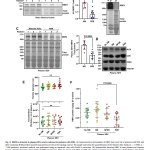
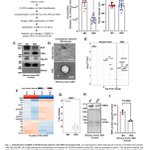
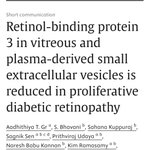
📌 Title: Retinol-binding protein 3 in vitreous and plasma-derived small extracellular vesicles is reduced in proliferative diabetic retinopathy

Some more reading materials on this topic:
science.org/doi/10.1126/scit…
mdpi.com/1422-0067/24/5/4408
ophthalmologybreakingnews.co…
Exciting times ahead!!!😃 😃 😃