
PhD Candidate @mila_quebec @UMontreal | Research Scientist Intern @Meta | Prev. @Samsung @Amazon @ServiceNowRSRCH @RecursionPharma @withupstride
Menlo Park, CA
Joined February 2021
- Tweets23
- Following2.4K
- Followers346
- Likes21

In the original SwiGLU paper, @NoamShazeer attributed the success of GLU variants to "divine benevolence."
Can we explain some of that magic mathematically?
Excited to share our #NeurIPS2026 paper, CP-MLPs: A Tensor-Rank Theory of Tied and Untied MLP Blocks!
arxiv.org/abs/2611.13647
We use tensor rank to study MLP blocks such as ReLU², ReGLU, and SwiGLU, focusing on tied vs. untied feature detection and value readout.
The intuition:
x² − y² = (x + y)(x − y)
For this quadratic interaction, one untied unit does the work of two tied ones.
Our theory characterizes when this helps: untying can halve the required width for certain quadratic interactions, with even larger exact gaps at higher degrees.
The key: the advantage depends on the interaction.
Joint work with Farzaneh Heidari, @irinarish, and Guillaume Rabusseau at @Mila_Quebec.

Md Rifat Arefin retweeted

What happens when weight decay is used for only part of LLM pretraining, then turned off? They trained 162M to 3.4B models with the Muon optimizer.
In a 1.4B model, early weight decay was worse than no decay when it stopped, but better at the end. They used decay for the first 44% of training. When decay stopped, validation loss was 0.26 higher than in the no-decay run. After that, both runs used exactly the same update rule. The decay run only passed the no-decay run at 73% of training. Its final loss was 0.0275 lower than no decay, and 0.0264 lower than the best constant weight decay they tried.
Early decay keeps working after it stops because it leaves the weights smaller than in the no-decay run. At 1.4B, weight norms dropped to 12 to 16% of the no-decay level and were still 60 to 66% at the end. Muon makes each update about the same size, no matter how large the gradient is. So smaller weights mean each update changes them by a larger fraction. In a 162M model, they shrank the no-decay run's weights to the decay run's norms when decay stopped. Nothing else changed, and that alone recovered 96% of the gain from early decay.
Compared with no decay, the same decay window helps at the start of training and hurts later. A window over the first 10% beat both no decay and the best constant decay at 162M, 405M and 1.4B. Starting the same window at 60% made final loss worse than both, at all three sizes. Both windows shrink the weights by the same total amount, so the difference comes from timing.


Last year’s Meta internship, this year’s paper. We did call it “Delayed Effects.”
Great working with @ziv_ravid, @erniecyc, @Chinnadhurai, Rylan Conway, Aristide Baratin, @irinarish, Adithya Sagar, and @huberpa91 this one!
Md Rifat Arefin retweeted

1/n 🚀 Introducing MobileLLM-Pro: Our latest 1 billion parameter foundational language model designed to deliver high-quality, efficient on-device inference across a wide range of general language modeling tasks – A thread 🧵
🤗Model Checkpoints: huggingface.co/facebook/Mobi…
Work done with my amazing collaborators Ernie Chang, Wei Wen, Igor Fedorov, Chinnadhurai Sankar, Tarek Elgamal, Hanxian Huang, Naveen Suda, Vish Vogeti, Yanghan Wang, Alex Gladkov, Kai Sheng Tai, Zechun Liu, Abdelrahman Elogeel, Tarek Hefny, Yangyang Shi, Vikas Chandra, Ahmed Aly, Anuj Kumar, Raghuraman Krishnamoorthi, and Adithya Sagar

Md Rifat Arefin retweeted

I am looking for a postdoc to lead projects related to this collaboration, on scaling laws, emergence and interpretability in pre- and post-training & inference/reasoning, in multimodal foundation models (language, time series, tabular data etc). HPC experience is a plus.

So excited to join the new @SimonsFdn Simons Collaboration on the Physics of Learning and Neural Computation, to further advance our understanding (mech interp) of learning & reasoning in large networks, including classical deep nets and other bio-inspired network models!
Come see our poster and talk if you are at ICML!
If you're at ICML, come tomorrow (Tuesday) to Oscar's talk, where he will present our paper "Layer by layer: Uncovering hidden representations in language models" at 10am (West Ballroom D) and for the poster session at 11am (East Exhibition Hall A-B #E-2607).

Md Rifat Arefin retweeted

Interested in representation in intermediate layers of LLMs? What is a good representation, and how can it be measured? Visit Oscar's poster on "Does Representation Matter? Exploring Intermediate Layers in Large Language Models"

Join the world's largest and diverse community of academic researchers in deep learning. Apply by December 1!

Mila's annual supervision request process opens on October 15 to receive MSc and PhD applications for Fall 2025 admission! Join our community! More information here mila.quebec/en/prospective-s…

8
501
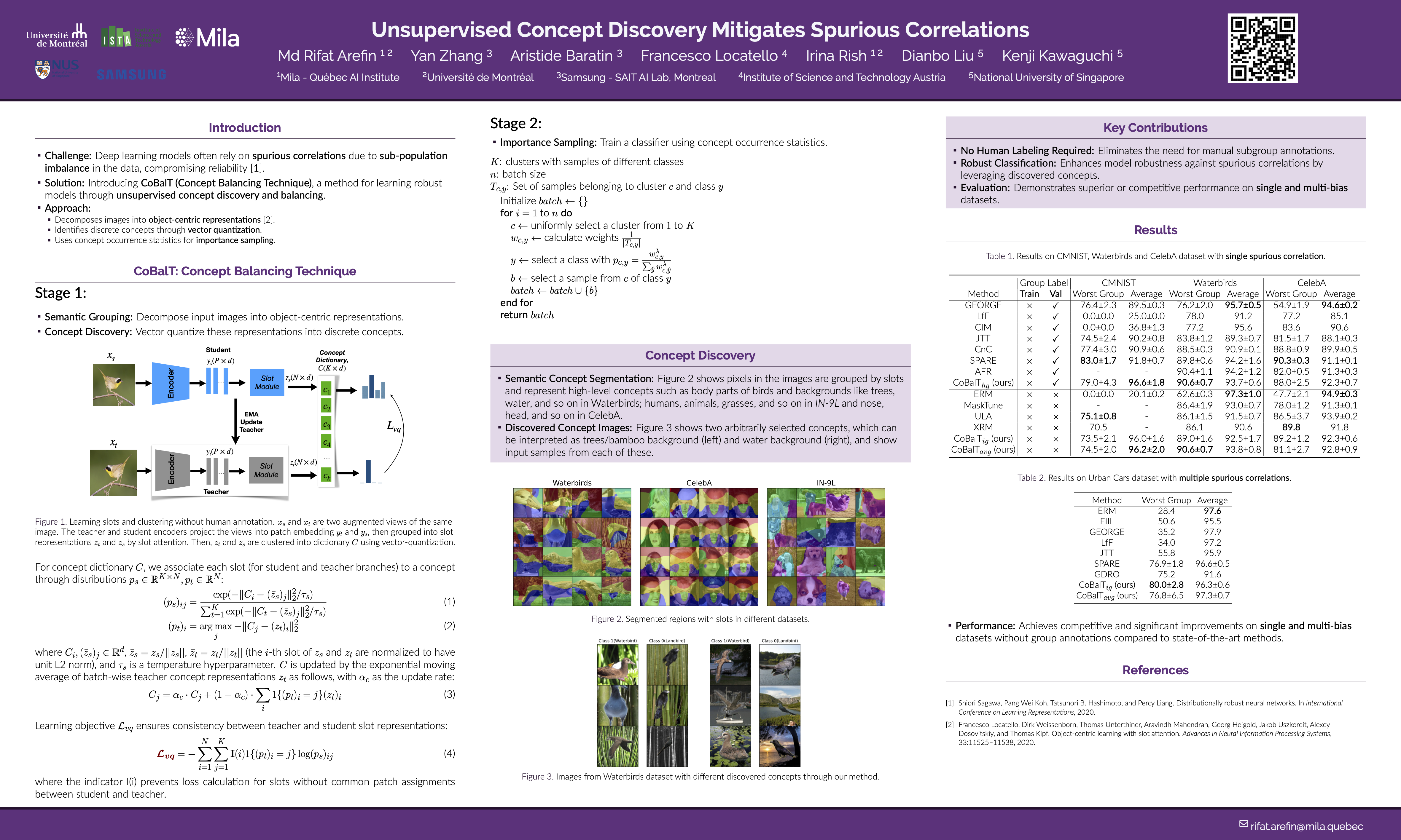
Excited to share our work "Unsupervised Concept Discovery Mitigates Spurious Correlations" at #ICML2024
Come see our poster today, July 25th at 1h30-3pm.
Paper: arxiv.org/pdf/2402.13368
Poster: icml.cc/media/PosterPDFs/ICM…
Code: github.com/rarefin/CoBalT
@Mila_Quebec
Md Rifat Arefin retweeted
🚨 Open-source AI community - stop building everything from scratch, let's build on each other's (and your own) work over time - continually, as we should! Don't waste previoius compute and human effort!
See arxiv.org/abs/2403.08763 - simple & useful tips on how to just keep training foundaiton models on new data without forgetting or performance degradations w.r.t. usual large-scale training!
Kudos to our amazing team, @kgupta24 @benjamintherien @ai_phd @MatsRichter @QuentinAnthon15 @TLesort @ebelilov !


Interested in seamlessly updating your #LLM on new datasets to avoid wasting previous efforts & compute, all while maintaining performance on past data? Excited to present Simple and Scalable Strategies to Continually Pre-train Large Language Models! 🧵arxiv.org/abs/2403.08763 1/N

Md Rifat Arefin retweeted
Join our Scaling, Alignment & Open-Source AI workshop Fri, Dec 15 in New Orleans or remotely shorturl.at/RXZ16!
Hear Nick Bostrom, Yoshua Bengio (TBA) @ylecun @tegmark @percyliang @juliabossmann @JJitsev @ethanCaballero @irinarish and others discuss the Open Source and the Future of AI, and engage in discussions on new scaling laws, "emergent" behaviors, continued pretraining, multimodal alignment, compression & fast inference, time-series foundation models and open generalist agents, and recent supercomputing efforts (Trillion Parameter Consortium) and more! Join us for the Open Source AI party sponsored by @cerebras, @togethercompute and @UMontreal's CERC-AAI Lab led by @irinarish!
Md Rifat Arefin retweeted
Great job, @togethercompute and INCITE (@UMontreal @AiEleuther @laion_ai ) teams and all the collaborators! It's awesome to see the RPI 7B (RedPajama-INCITE) model outperform ALL the best open models of same size - Llama-7B, Falcon-7B, and MPT-7B on HELM benchmark!

Announcing RedPajama 7B trained on 1T tokens! 🚀
• Instruct, chat, base, and interim checkpoints on
@huggingface
• The instruct model outperforms all open 7B models on HELM benchmarks
• The 5TB dataset has been used to train over 100 models
Details👇
together.xyz/blog/redpajama-…

Md Rifat Arefin retweeted

We are glad to announce that our paper: "Challenging Common Assumptions about Catastrophic Forgetting" co-authored with @ostap__alex, @__z__9, @rarefin15, @prlz77 , @lcharlin , @irinarish has been accepted to @Collas2023.
(arXiv arxiv.org/abs/2207.04543)
[A thread (1/N)]