
Machine learning professor at Mila & HEC Montréal.
Montréal, Québec
Joined December 2009
- Tweets190
- Following214
- Followers1.5K
- Likes624



Laurent Charlin retweeted

Mila's annual supervision request process is now open to receive MSc and PhD applications for Fall 2027 admission! For more information, visit mila.quebec/en/prospective-s…

We’re coming out of stealth with some exciting AI-optimized compute results.
Some highlights:
1) Works on industrial-grade and consumer-grade GPUs.
2) It can optimize different compute layers, from the kernels to tokens, for higher tokens-per-watt on your GPU.

The entire industry is racing to make AI cheaper. Most people assume the answer is better chips or bigger GPU clusters. However, while the industry is buying its next 2× when there's a 1.78× speedup is sitting in the software.
We've been hard at work @unifiedsciences, building an autonomous optimization engine toward radically more efficient compute.
Today I'm very happy to share some early results where our unified engine:
1) wrote faster GEMM kernels for cuBLAS (up to 1.78x faster)
2) made an efficient AI model 6x smaller and 5x faster without any quality loss
3) optimized diverse everyday AI workloads on a consumer GPU!

Laurent Charlin retweeted

🎨 Introducing the TMLR Beyond PDF Editor, a web-based editor for creating Beyond PDF submissions!
🚀 Zero setup + live preview + download & import.
🤝 Compatible with local compilation.
🎉 Thanks to @hugo_larochelle @thegautamkamath @NailaMurray Nihar B. Shah @lcharlin!
Laurent Charlin retweeted

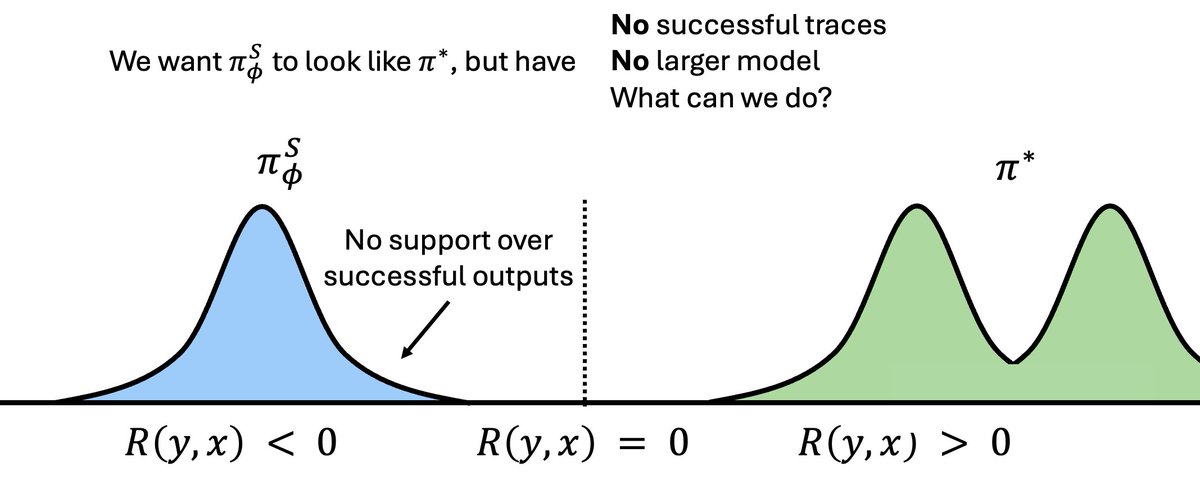
Problem: When your base model is basically clueless at a task, how do we get any RL signal?
Solution: Use the guidance (e.g., logprobs) of a privileged teacher to guide RL.
Over the past few weeks, MANY papers have converged on this idea. This comprehensive blog breaks down self-distillation and privileged distillation objectives and gives clean intuition on how they work.
Link to X article, with the link to the full post in the 🧵(recommended for best experience).
xitter.cf/emilianopp_/status/202…


Laurent Charlin retweeted
Remember all the self-distillation papers that came out last week. Well, we also propose it 😅, but…
But alongside something better 😎 π-Distill
We show that with this method, you can distill closed-source frontier models even tho their traces are hidden 🔒.
Both our methods can reach and even surpass the performance of the industry-standard SFT + RL with access to reasoning traces 🤯.
🔬And we spent ~100,000 hours GPU hours on a comprehensive analysis, not because the method is finicky, but because we wanted to understand why it works so well.
🧵
1/10
Laurent Charlin retweeted

How can we predict multiple plausible targets from a single context in joint-embedding self-supervised learning (SSL)?
Check out our paper titled “Self-Supervised Learning from Structural Invariance” accepted at #ICLR2026! Previously Best Paper Award at @unireps 2025.
arxiv.org/abs/2602.02381
We introduce AdaSSL, which models the target uncertainty and relaxes the standard assumption that the positive pair share the same semantic features.
Derived from first principles, we realize @ylecun’s JEPA with a learned latent variable for jointly learning better representations and world models, extending SSL’s utility to a broader range of data types.
1/🧵

Laurent Charlin retweeted

🚀 Exciting news! Our work LitLLM has been accepted in TMLR! LitLLM helps researchers write literature reviews by combining keyword+embedding-based search, and LLM-powered reasoning to find relevant papers and generate high-quality reviews.
LitLLM.github.io/
🧵 (1/5)
Laurent Charlin retweeted

📢 Deadline Extension Alert! 📢
Good news! We’re extending the #CoLLAs2025 submission deadlines:
📝 Abstracts: Feb 26, 2025, 23:59 AoE
📄 Papers: Mar 3, 2025, 23:59 AoE
More time to refine your work—don't miss this chance to contribute to lifelong learning research! 🚀
🔗 lifelong-ml.cc
#MachineLearning #ContinualLearning #LifelongLearning #AI
Laurent Charlin retweeted
🚀 Why Lifelong Learning Matters 🚀
Modern ML systems struggle in non-stationary environments, while humans adapt seamlessly. How do we bridge this gap?
📖 Read our latest blog on the vision behind #CoLLAs2025 and the future of lifelong learning research:
🔗 lifelong-ml.cc/blogs/1
#MachineLearning #ContinualLearning #AI #LifelongLearning
Natural language user embeddings for recommendations. Work led by @emilianopp_
How can we make recommender systems more transparent and controllable without sacrificing quality? Introducing TEARS a scrutable RS that replaces numerical user profiles with editable text summaries (accepted @TheWebConf).
arxiv.org/abs/2410.19302
1/🧵

Checkout the compositional workshop today at NeurIPS
compositional-learning.githu…

Le professeur affilié à Mila Laurent Charlin (@lcharlin) co-organise l'atelier Compositional Learning: Perspectives, Methods, and Paths Forward à @NeurIPSConf aujourd'hui, West Meeting Room 118-120. Venez le découvrir!
Thank you so much @CIFAR_News for your continued support through the AI Chair Program.
It's an honour! It allows me to recruit fantastic students and spend more time doing research.
I look forward to contributing to the success of the program.
Congrats to my colleagues!

Congratulations also to @arbtal, @pierrelux, @apsarathchandar @lcharlin, @sivareddyg and @irinarish, all Canada CIFAR AI Chairs at @Mila_Quebec, on their renewal 🎉
Consider submitting your CL-related work to CoLLAs 2025 (deadline Feb: 21)!

📢 Exciting News! The Fourth Conference on Lifelong Learning Agents (CoLLAs 2025) will be held at the University of Pennsylvania (@Penn) in Philadelphia, USA 🇺🇸
🗓️ Important Dates:
Abstract Deadline: Feb 21, 2025
Submission Deadline: Feb 26, 2025
Conference Dates: Aug 11 - Aug 14, 2025
We invite submissions that present new theories, methodologies, applications, or insights into algorithms and benchmarks designed for non-i.i.d. and non-stationary settings. Accepted papers will be published in the Proceedings of Machine Learning Research (PMLR). 📚
Full CFP: lifelong-ml.cc/Conferences/2…
#CoLLAs2025 #AI #MachineLearning #ContinualLearning #LifelongLearning #ResearchConference #CallForPapers #NonStationaryLearning

Introducing a framework for end-to-end discovery of data structures—no predefined algorithms or hand-tuning needed.
Work led by Omar Salemohamed.
More details below.
arxiv.org/abs/2411.03253
It can adapt directly to your data, optimizing both query and space complexity:
+ Learns nearest-neighbour data structures from scratch (binary search, k-d trees, LSH-like solutions!)
+ Adapts to 1D and high-dimensional settings
Come study with us at Mila!
I will be looking for new students to work with.
Our current projects explore continual learning, modularity, scrutability, algorithm discovery, AI for law (reasoning), invariances, and decision-making...
Mila's annual supervision request process opens on October 15 to receive MSc and PhD applications for Fall 2025 admission! Join our community! More information here mila.quebec/en/prospective-s…

Wearing butterfly socks today in honour of @SashaMTL being recognized as one of the top 100 AI people in the world! Congrats again!!!


I'm lowkey never going to get over being in this millionaire sandwich between @satyanadella and @sama😆 #time100ai

Come work with @chrisjpal and me on a research project toward creating an assistant to help researchers write the literature reviews of scientific papers.
A collaboration with @ServiceNowRSRCH and @Mila_Quebec
Details are here: mila.quebec/en/news/call-for…
Deadline: Sept. 1
