

PSI focuses (in part) on the development and application of global MHD models of the Sun's corona and heliosphere to answer fundamental scientific questions.
San Diego, CA
Joined September 2015
- Tweets181
- Following66
- Followers757
- Likes14
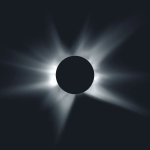
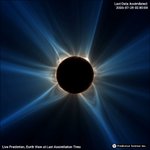


Our 2026 #eclipse simulation of the #solar #corona and #heliosphere has been nominated for an @HPCWire Reader's Choice Award for "Top #HPC/#AI-Enabled Scientific Achievement"!
Check out our #simulation here:
eclipse.predsci.com
and #vote here!
buff.ly/UQm8T1e

Tired of #solar #eclipse images already? Neither are we -- #NASA put together a photo essay with some captivating imagery and videos, as well as an interactive comparison featuring our prediction! Check it out: science.nasa.gov/science-res…

We are grateful for dedicated resources from the ACCESS program, the Expanse supercomputer at the @SDSC_UCSD, and NASA's Advanced Supercomputing Division for allocations on Athena. Thanks to the #SDO/#HMI and the @ESASolarOrbiter PHI teams for near-real time vector magnetograms.
This work is supported by #NASA and #NSF. We are grateful to @IAC_astrofisica for providing a dedicated allocation at the LaPalma supercomputer, and we're proud to support the North African Telescope Eclipse (#NATE) project, led by #IAC.
We now have simulated heliospheric images available for @NASAScience_/@esa's SO/SoloHI, #NASA's Parker/WISPR, STEREO/SECCHI/HI, and NASA/@SwRI's #PUNCH, and coronal imaging for Proba-3/ASPIICS.
We began assimilating @ESASolarOrbiter's (SO) vector magnetograms on 8/1 (special thanks to the SO PHI team!). SO is on the solar "far side," and moving close to the east limb. This is the *first-ever* opportunity to incorporate accurate east limb data during an eclipse!
We're one week away from #solar #eclipse #totality!
Our prediction model is running 24/7 (buff.ly/XjD4lRk), and we have some exciting updates -- read on to learn more!

Predictive Science Inc. retweeted

¿Cómo será la corona solar que veremos el 12 de agosto?🌞 El director del IAC, Valentín Martínez Pillet, explica cómo el IAC y @predsci la consiguen prededir mediante simulaciones realizadas con el Superordenador de La Palma. #Eclipse2026 👇
We assimilate magnetic field data from SDO/HMI into the High-performance Flux Transport (HipFT) surface flux transport model, producing full-Sun maps approximating the magnetic field over time. These maps are then used to drive our time-dependent coronal and heliospheric model.
We employ a continuously running prediction model updated in near real time. As totality approaches, the prediction materials will become more accurate in time. The solar cycle is still near its peak, and the corona's appearance changes significantly over several days.
New this year:
- Assimilation of HMI vector data and Far Side Solar Orbiter PHI magnetograms
- Highest-ever resolution SFT calculations
- Simulation from 1 Rs to 1 AU
- Instantaneous magnetic field connectivity for in-situ spacecraft
- Simulated PUNCH and Proba-3/ASPIICS images
As has been our tradition for over 30 years, Predictive Science is predicting the structure of the corona for the upcoming total solar eclipse on August 12, 2026!
buff.ly/e9WPME4
There are several new features in the model this year, keep reading for details!

Our POT3D code (buff.ly/QtRzBJc), which is part of SWiG, has been accepted and released as part of the new SPEC CPU 2026 Benchmark suite!
More details here: buff.ly/6qmq6lS

While other effects (e.g., electron scattering) must also be accounted for when comparing simulations to in-situ data, these results underline the importance of including surface magnetic flux evolution when investigating magnetic connectivity of the corona and heliosphere.
Lionello et al. developed a method to identify folded field lines in the models, allowing for easy comparison with in-situ strahl statistics. The time-dependent runs agree well with ACE/WIND data, while the steady-state runs contain too little disconnected and folded flux.

This paper combines several important types of analysis: high and low solar activity; steady-state and time-dependent simulations; and finally, model results and in-situ measurements. The combination results in a clear picture of how to reproduce and interpret solar wind data.
🚨 New paper alert! 🚨
PSI's Roberto Lionello led a team (including U of Reading's Matt Owens) to investigate the magnetic connectivity of the corona/heliosphere system under busy (solar maximum) and quiet (solar minimum) conditions. Details below!
buff.ly/lBbygiz

3/19 @ 11:20: "Understanding How Small-scale Photospheric Magnetic Fields Influence the Global Solar Corona and Solar Wind" (Cooper Downs, C.L. Evans, D. Schmit, J.A. Linker, V.S. Titov)
buff.ly/qdoFp49

3/18 @ 09:45: "Global MHD Modelling of CME Evolution as Context for Multi-Spacecraft Observations" (Erika Palmerio, C. Downs, R.M. Caplan, P. Hess, R.C. Colaninno, A. Sahade, C. Mac Cormack)
buff.ly/9o58HJn
Attending the Solar Orbiter workshop? Don't miss our talks!
3/17 @ 10:05: "Comparison of Predicted Solar Polar Fields with Solar Orbiter Observations" (Jon Linker, C. Downs, R. Caplan, J. Turtle, P. Riley, G. Valori, Solar Orbiter PHI Team)
buff.ly/AJIjRMe