

ICP OG & Investor | 20y+ IT PRO
World Internet Computer
Joined September 2021
- Tweets25K
- Following5.1K
- Followers2.8K
- Likes35.4K





Pinned Tweet
Understanding of crypto sector is really tough 😶
And it's even more difficult to explain the technological dominance of ICP, Internet Computer and its chain-key tech 🤔
So I'm 'zooming out' and simplifying both by visualization of my (high-level) blockchains perception 🤞🫡

goodcoin.icp ∞ retweeted

@_GeekFactory it has been almost a month since you said you were stepping back. Anything we can do to maintain NFT Geek please reach out. We are also taking on a lot of the neglected ic cdks so one more to maintain isn't a big deal. Plus what you built was very useful to a lot of people.
goodcoin.icp ∞ retweeted

Reposting as this is not just Donna but the whole Toko team that want to help!

@_GeekFactory it has been almost a month since you said you were stepping back. Anything we can do to maintain NFT Geek please reach out. We are also taking on a lot of the neglected ic cdks so one more to maintain isn't a big deal. Plus what you built was very useful to a lot of people.
goodcoin.icp ∞ retweeted

We're about to switch the ICP Dashboard to a new version: every number is read straight from the chain, and the dashboard itself is served from a canister. internet-computer:native
Like it? Don't? Found a bug/issue? Tell me below 👇
g3psz-xyaaa-aaaam-ajeza-cai.…
goodcoin.icp ∞ retweeted

BREAKING: Shielded ICP is live via Menese Protocol, keeping balances and send history private even from node providers. DFINITY founder Dominic Williams called it "true cryptographic privacy on top of the Internet Computer."
@dfinity @dominic_w @meneseprotocol


goodcoin.icp ∞ retweeted

OpenChat is now integrated with both @ICPSwap and @tacodaoicp for swaps!
It'll get quotes from both, then proceed with the best one.

goodcoin.icp ∞ retweeted

An important advantage that network cloud can provide to onchain services is better "AI Safety". Here's how.
When AI makes cryptography unsafe, networks can be rapidly upgraded, protecting all hosted software.
With traditional tech stacks, algos are linked into the various layers and components, making upgrading difficult and laborious for those operating services.
Networks, like the Internet Computer/ICP, can abstract the core security math that keeps hosted services safe.
They can also upgrade peripheral (non-core) cryptography.
For example, on a dime, the Internet Computer could could upgrade to a new version of HTTPS in response to AI suddenly making the current version unsafe, without those running services having to do anything.
By contrast, on traditional tech stacks, (or "on" traditional blockchains, where the apps are actually served from traditional tech, such as from AWS, with only tokens a DeFi logic onchain), those running services would need to manually upgrade all their web servers and application servers.
Where the software powering a service makes HTTPS outcalls to other services, it will be directly linked to libraries enabling the calls — so it will all need to be upgraded too!
By contrast, the Internet Computer hosts serverless code, where these kinds of complexities are abstracted away from services. If a service makes an HTTP outcall to another service, the call uses whatever version of HTTPS the network chooses (since the network makes the actual call on behalf of the software). If the network is upgraded, then so is every service — automatically.
This further reflects the way that the Internet Computer as cloud dramatically reduces security admin and systems admin demands compared with building on traditional tech, and additional unique advantages.
It also highlights another crucial axis on which networks must be measured, whether they seek quantum safety (when relevant) or AI safety (since today, AI can now find flaws in algorithms and software at any time) — agility.
That is, how fast can a blockchain network be upgraded in response to a new threat?
The Internet Computer is unique in that it is orchestrated by a decentralized governance system called the Network Nervous System (something like a DAO with system privileges, but much more sophisticated).
That enables the network to be agile, and to rapidly respond to emerging threats, by upgrading the code running on the node machines hosting it. The Internet Computer is a self-updating, adaptive network.
The ability of chains to rapidly react to new threats that have been suddenly uncovered/created by AI, whether they are flaws in cryptography algorithms, or flaws in software libraries, will be a defining feature as things get more hairy.
This is a conundrum for traditional chains chasing quantum safety, of course. By definition, they are claiming that upgrading networks is a long and arduous process, and therefore that they have achieved something important and valuable by upgrading to quantum-safe algorithms ahead of time.
But the algorithms they are upgrading to — so they can claim "quantum safety" — are new and do not benefit from the decades of examination that e.g. ECDSA has.
What then, if AI finds suddenly problems with them, like it did with HAWK?
They have tacitly declared that they cannot quickly switch back, because transitioning is something that takes time, which is why their upgrades are such an achievement...
I will press the point no further, but as an industry, we need to get much more nuanced and sophisticated in how we understand security in an age where AI can suddenly upset security assumptions and make software insecure.
The Internet Computer has got this crucial agility axis covered, and it's agility, not the premature adoption of new and unproven quantum safe crypto algorithms, that really defines safety.
The key point is, if a network has to adopt these unproven algorithms years before a cryptographically-relevant quantum computer exists, then it's doing something very wrong.
The Internet Computer has solved agility. It provides an end-to-end alternative to traditional tech, where people can build services, and gain safety and independence from the rapidly shifting sands of security that the AI era will bring.
It is another reason that the mainstream world needs Internet Computer cloud. It's a security and resilience haven.
goodcoin.icp ∞ retweeted
Crypto Quantum Fool Index (CQFI)
In replies, score chains 1-10 with examples.
why:
1. Quantum-safe algorithms new/AI dangers
2. Cryptographically-relevant quantum computers 2029+ (conservatively)
3. Premature adoption = bad judgement & Y2K narrative chasing over user safety
goodcoin.icp ∞ retweeted

The Internet Computer runs whole web apps on-chain, inside canisters that hold both code and state.
@dfinity launched it in May 2021. Under its reverse gas model, developers pay for compute and $ICP app users pay no fees.
How canisters work:
bsc.news/post/internet-compu…


goodcoin.icp ∞ retweeted

The Internet Computer (@dfinity) charges a rejection fee on Network Nervous System proposals to deter spam on the $ICP network, and the size of that fee has changed over time.
bsc.news/news/internet-compu…

goodcoin.icp ∞ retweeted

What it costs to lose a vote on the Internet Computer
The Internet Computer, built by the DFINITY Foundation (@dfinity), is governed by a voting system called the NNS. ICP holders lock tokens in “neurons” to vote on network changes, and a neuron that takes at least 6 months to unlock can also submit proposals.
Each proposal carries a 25 $ICP fee, charged against the proposer’s neuron. If voters adopt the proposal, the fee is returned. If they reject it, the proposer loses the fee.
The fee is meant to keep useless proposals from flooding the system. It has gone up over time, older versions of the docs had the fee at 10 ICP.
The rule does not judge intent. An honest idea that voters turn down still costs the fee. Because the fee comes out of the neuron’s locked ICP, a neuron needs at least 25 ICP to submit anything.


goodcoin.icp ∞ retweeted

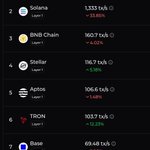
Forget the hype. Which blockchains are actually being used?
The latest TPS data tells a very different story.
$ICP leads with 2,240 transactions per second, ahead of Solana at 1,663.
Then comes a massive drop.
$BNB Chain: 205 TPS.
$TRON: 177 TPS.
$SUI: Just 97 TPS.
And here's the twist.
Sui recently demonstrated 40.6 MILLION TPS through offchain tunnels, yet its live onchain activity is nowhere near that figure.
There's a HUGE difference between what a blockchain can handle and what people actually use.
Which chain do you think is the most undervalued?

goodcoin.icp ∞ retweeted
Nice 🔥 This illustrates how you can build true cryptographic privacy on top of the Internet Computer. There are lots of privacy narrative protocols these days where operators have backdoors, or which rely on weaker hardware-based privacy (TEEs). Here, performance + real privacy

The wait is over shielded $ICP is now live.
Every transaction is private, even from the node providers running the network. Your send history, balances, and activity stay protected.
We built it to go beyond SEV’s limits, using pure cryptography so proofs are generated in your browser and verified on-chain without exposing anything.
$BTC is coming next.
$ICP #Privacy #ZK #InternetComputer
goodcoin.icp ∞ retweeted

🚀 @dfinity reached 800 developers on Saturday.
Even the weekend couldn't slow the builders down.
📊 chainspect.app/chain/icp

goodcoin.icp ∞ retweeted
ICP Makes Credit Card Payments Easier For Developers
Dfinity (@dfinity) $ICP founder Dominic Williams (@dominic_w) highlighted a new way to buy Internet Computer cycles using credit cards.
The latest icp-cli update lets users scan a QR code and pay through Stripe.
Cycles are then credited to their Cycles Ledger account within seconds, according to Dfinity COO Josh Drake (@JoshHQ).


goodcoin.icp ∞ retweeted
The cycles you are buying are created from ICP (i.e. when you pay using your cc, behind the scenes, you are buying ICP, that's being transformed to cycles). This is a convenience layer over the decentralized network that removes token processing friction for mainstream users.
goodcoin.icp ∞ retweeted
You're not skipping ICP. When you pay by card, CyclePay does your exact steps for you:
1. You pay by card
2. CyclePay takes ICP from its own balance
3. It sends that ICP to the NNS cycles minting canister, which burns it and mints the cycles (the same thing icp cycles mint does for you)
4. The cycles land in your account about 20 seconds later, ready to top up your canisters
There is no way to create cycles without burning ICP. Paying by card just means someone else holds the ICP and does the minting for you. Every card purchase shows on the ICP ledger as ICP sent to the cycles minting canister. At current prices, a $25 purchase burns about 8 ICP.
So ICP still:
- is the only thing cycles are made from, and gets burned on every purchase, card or not
- is what you stake in the NNS to govern the network
What changes is who can use ICP. Lots of developers and companies won't buy crypto on an exchange just to pay for hosting. Now they can pay by card, and their usage still burns ICP.
If you already hold ICP, nothing changes for you. Keep minting the way you do.
goodcoin.icp ∞ retweeted
With cloud engines, apps run without cycles, and now, deploying to the shared Internet Computer subnets will be a breeze too. Agents can show users QR codes, so they can pay with their credit cards, avoiding token friction.
ICP is becoming mainstream agentic infrastructure.
