
Retired. Former British Chess Champion. Bridge Grandmaster. Former World Senior Chess Teams Champion.
St Albans, England
Joined January 2010
- Tweets2.8K
- Following837
- Followers494
- Likes4.7K





Paul Littlewood retweeted

Foreword
Hans Böhm
When the door opened, I was a bit startled. Jan looked yellow.
“Just plain bad luck, they said it was pancreatic cancer, but normally you’d have back pain and I don’t have it.”
His face had also become somewhat gaunt, I noticed it now. We sat, as usual, at a chessboard with an interesting position, but I couldn’t have cared less about chess at that moment.
I’d brought a bottle of Barolo, because it brings back fond memories.
“I don’t drink wine anymore, but I’ll have a sniff. The aroma is lovely. Two weeks ago I was still giving a simultaneous exhibition, nothing wrong, felt fine. And the next morning, I woke up and I was all yellow.”
“Jan was even more jaundiced back then,” said Geertje from the sofa, “so I sent him to the doctor.”
I let it all sink in. So unexpected, so sudden.
“Yes, but... what’s the prognosis?”
Jan shook his head. “I asked for a second opinion and it turns out I have bile duct cancer. That doesn’t help, because only two hundred people have it and there’s no cure for it either. And if I do want to do something, I’ll have to go back to the pancreatic cancer specialist and I’ve lost all confidence in him.”
My old bosom friend – I had no clue what to do – yet I felt an urgency to act.
“Shall we write a biography – actually, a joint autobiography, because our lives have been so tightly intertwined?”
“Good idea,” Jan said straight away.
That spontaneity, that positivity, that quick understanding, coupled with a fine sense of humour – that’s what I’ve always appreciated in Jan.
That’s what you get with real friends. Even though you don’t see each other as often as when you lived together in a student flat some fifty years earlier, but you pick up where you left off in no time.
“But then you’ll have to write a foreword and an afterword and a retrospective too, Jan, and it mustn’t turn into a chess book.”
We brainstormed a bit about the layout and chapters and agreed to think it over further, as I unfortunately had to dash off again, to a special Chess Festival at the Rozet cultural centre in the heart of Arnhem, close to where Jan and Geertje live. Jan and I were the main attractions, but Jan had politely declined and arranged for Grandmaster Erwin l’Ami to stand in.
We agreed to meet again a week later.
Jan looked better. They’d placed two stents in his oesophagus so that the bile no longer flowed freely through his body, which had caused that yellow colour.
This time I’d brought along various types of fish, thinking it would be good for his insides or something.
“I don’t eat fish anymore,” said Jan.
“Then I’ll bring some ice cream next time, or is that not allowed either? I’d rather know.” Ice cream was fine.
Erwin was there this time, too; he’d brought some pineapple chunks, which went down well.
Jan started by showing us some fine chess studies. In recent years in particular, Jan had been composing more and more studies, and he was also working on a book featuring 165 of his own studies, including many prize-winners.
That felt familiar again, because, so often in our lives, with various groups of people, we’ve analysed games and looked at studies behind a chessboard in the middle.
“When was that trip to Sicily with that American professor of archaeology, again?” I asked, taking a sip of Italian wine.
“1973.”
Jan’s memory for dates is remarkably good; it always has been. I remember things in a different way.
We agreed that I would drop by in the coming months with a recording device and then we would go through our whole lives chronologically. One period at a time.
For each chapter, Jan would then suggest a game that was memorable to him and a special study.
Erwin immediately offered to help with the chess analysis, because he is not only a chess study enthusiast, he understands the dilemma of relative values that Jan has suddenly found himself in. In 2021, Erwin was diagnosed with Hodgkin’s disease, a form of cancer. He was thirty-five at the time and everything changed; everything became relative. He managed to recover with a rigorous course of medication and played his best tournament at Wijk aan Zee in 2022, going on to become Dutch champion later that year.
“Let’s also hear from some people who have been important in your life, Jan; have a think about that.”
The idea for a dual autobiography was born; now we just needed a publisher.
Jan has already published many books through New in Chess and I through Tirion Sport, later Kosmos Publishers.
But this time we wanted to work with a proper biography publisher.
I sought help from Marcel van der Kraan, head of the sports desk at De Telegraaf, the newspaper for which I have been writing the chess column since 2008.
He introduced me to Raf Willems from Best in Books, which specialises in sport and life stories.
It couldn’t have been better.
And that’s how it all began.
Hans Böhm
Hilversum, July 2025
***
Foreword to the English version of Herinneringen van twee schaakvrienden by Jan Timman and Hans Böhm. To be published by Elk and Ruby later this year in full color.

Paul Littlewood retweeted

For the second time in a decade, a FIDE President is threatened with sanctions. In February, the European Union declared its intention to sanction Arkady Dvorkovich. We have been here before. In 2015, sanctions were imposed on Kirsan Ilyumzhinov by the US Treasury. As a result, FIDE lost access to bank accounts, lost its credibility and our standing with the IOC was damaged.
Fortunately, the proposed European Union sanctions, which would include an EU visa-ban and asset-freeze, have not yet been imposed on our President. If sanctions are imposed, the President should not stand for a third term at the General Assembly, to be held during the 47th Chess Olympiad in September.
In this circumstance, should the President stand for re-election, I will stand against him and a broad-based electoral coalition should be formed with the intention of taking FIDE in a different direction. This coalition can be established in the coming months, before the electoral deadline towards the end of July.
My team and I are assembling a ticket, including candidates for the FIDE Council. We are preparing a campaign program which will emphasise our objective of transforming FIDE into a modern, self-sufficient and independent non-governmental organisation.
A necessary condition for the success of our campaign is of course the support of the international chess community. Throughout my 50 years in chess, I have been involved in: competition as a professional player, tournament organisation at all levels, journalism, commercial sponsorship, chess in schools, social projects, as well as chess administration in the European Chess Union and English Chess Federation. I am uniquely qualified.
Ahead of the deadline to submit tickets, I would welcome expressions of interest in joining our campaign to transform the organisation that governs the game we all love.
Feel free to get in touch:
Email: [email protected]
Let's do it. Gens Una Sumus!

When is the latest you have castled in a game? I managed move 27 yesterday and it was Q-side as well!
Paul Littlewood retweeted

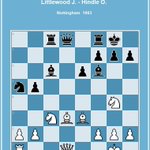
In his latest HTBAGM column, @plittl pays tribute to star organiser IM Nigel Povah, of @ChessGuildford and @ecfchess Seniors fame. Nigel has been on holiday in Marbella, where in 1982 John Nunn won one of his most striking games as Black against Gert Ligterink. Who needs a queen?
