learner, builder, systems thinking
New Jersey, USA
Joined April 2009
- Tweets682
- Following4K
- Followers771
- Likes992







Shyam Pillai retweeted

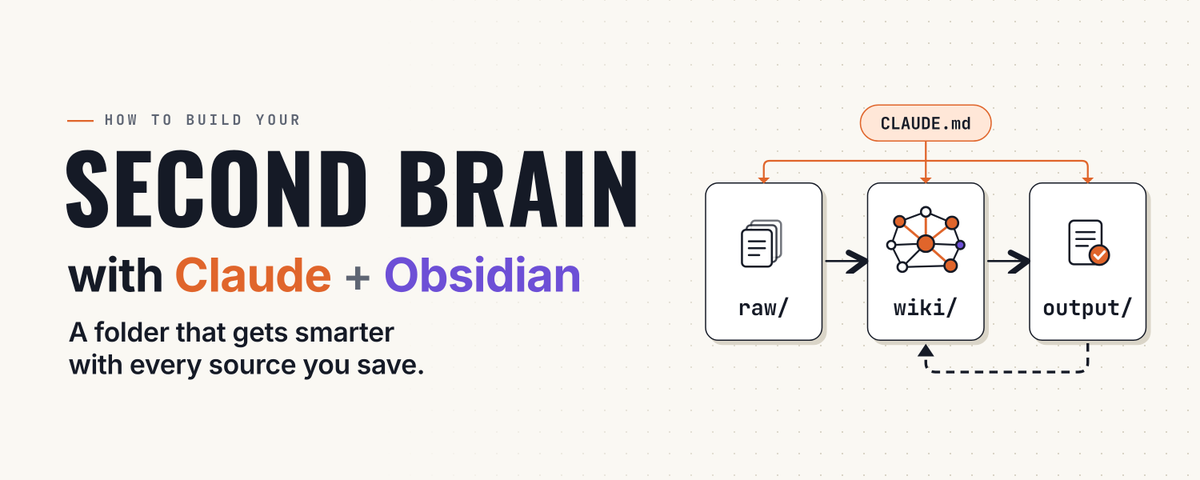
This is f*cking insane, the CEO of Y Combinator open-sourced his own second brain and most people still don’t know it exists
8 second brain repos you haven’t seen yet:
-> gbrain (by garrytan)
github.com/garrytan/gbrain
the second brain of the YC CEO, every fact keeps its source and every agent shares one memory
-> llm wiki (by karpathy)
gist.github.com/karpathy/442…
the original idea file behind all of this
-> ai-memory (by akitaonrails)
github.com/akitaonrails/ai-m…
hand the work from Claude Code to Codex without losing context, memory lives in plain markdown
-> agent second brain (by smixs)
github.com/smixs/agent-secon…
send a voice note in Telegram and it lands as a linked note in your Obsidian vault
-> cog second brain (by huytieu)
github.com/huytieu/COG-secon…
33 skills and 10 agents running on plain markdown, no database
-> open second brain (by itechmeat)
github.com/itechmeat/open-se…
a nightly pass turns the corrections you keep repeating into rules your agent follows
-> claude second brain (by jessepinkman9900)
github.com/jessepinkman9900/…
one npx command scaffolds Obsidian, Claude Code and local search
-> baalda (by naveedharri)
github.com/naveedharri/baald…
a team second brain where people and agents edit the same markdown files
the CEO of Y Combinator runs his agents on this
you are still digging through bookmarks


Shyam Pillai retweeted

"I wish this thing worked differently" is becoming something people can actually fix themselves.
Someone just used AI to remove the ads from their parents' TV and build them a better interface.
Think about how many products we own that don't work the way we want.
The default experience is becoming a suggestion.


Shyam Pillai retweeted

Pro tip: Install this new evals skill from @HamelHusain and @sh_reya, it'll save you many hours and a lot of mistakes
github.com/ai-evals-course/e…


Evals have been coming up more and more in my conversations with podcast guests and PM friends.
Nearly half of the 25 awesome PM job openings I shared last week ask for experience writing evals. And leading companies keep sharing what investing in evals bought them:
— @tryramp took its automatic receipt collection from 35% to 83% accuracy.
— @Shopify shipped an AI workflow builder that's 2.2x faster and 68% cheaper than the frontier-model setup it replaced.
— @harvey__ai rebuilt its AI contract reviewer, nearly doubling its internal quality score.
— @cursor_ai tuned its Auto Balance routing, with much higher user satisfaction at 41% lower cost.
So I asked the 🐐s of evals, @HamelHusain and @sh_reya, to write an advanced sequel to their very popular "Building eval systems that improve your AI product." Drawing on their work with 50+ AI companies, they share the key step most teams skip, what you should (and shouldn't) automate, and a free plugin that lets a coding agent do most of the heavy lifting.
Read it here: lennysnewsletter.com/p/advan…

Shyam Pillai retweeted

I wrote about the state of AI, why I’m concerned about the next few years, and the choices we need to make to keep the future in humanity’s hands.
An Alien Mind: openai.com/index/an-alien-mi…

Shyam Pillai retweeted

This Google DeepMind paper is f*cking superb
A new research paper proves that treating AI delegation as verifiable contracts rather than prompt handoffs unlocks reliable multi-agent systems
Contract-first task decomposition, dynamic privilege attenuation, and transitive accountability across multi-agent execution chains
objective entropy → contract-first decomposition → privilege attenuation → runtime monitoring → transitive verification → settled state
Google DeepMind introduced an intelligent delegation framework, replacing static heuristic routing with verifiable multi-agent governance:
→ Contract-First Task Decomposition
Recursively breaks complex objectives down until every sub-task matches a deterministic verification mechanism like automated unit tests or formal AST signatures, eliminating ambiguous handoffs
→ Dynamic Privilege Attenuation
Replaces full system access with strict task-scoped permissions, ensuring delegatee sub-agents receive only the minimum necessary tool access and preventing confused deputy vulnerabilities
→ Dynamic Cognitive Friction
Disrupts the model's zone of indifference by empowering sub-agents to challenge flawed assumptions and request clarification rather than blindly executing poisoned instructions
→ Transitive Accountability & Recursive Verification
In multi-hop delegation chains, orchestrator agents verify cryptographic milestone receipts from subcontractors before releasing state, preventing cascading multi-agent failures
→ Hypothesis Verification & Empirical Results
Google DeepMind hypothesized that verifiable contract-first delegation eliminates error compounding in multi-agent networks. Practical validation on production coding fleets confirmed the findings: task completion on 15-step repository refactors jumped from 42.6% to 88.4% while token overhead plummeted by 61.2%
Scaling autonomous agents is not about stuffing more LLM workers into a shared chat. The leverage comes from mathematically bounding authority, isolating context, and making every delegated handoff verifiable
Read the complete breakdown in the article below ↓


Shyam Pillai retweeted

It’s never been easier to design your dream house.
Draw a shape. Define your rooms. Set your constraints.
@DraftedAI generates complete floor plans, elevations, and 3D home designs in seconds.
Over the last month, 120,000 people generated 325,000+ home designs with Drafted.ai.
Shyam Pillai retweeted

Vibe coders are getting sued.
People are shipping apps with real users and skipping the boring stuff that kills them.
A 20+ year dev shared the pre-launch checklist every AI builder needs.
I added what I learned after shipping 60+ apps at the agency.
Don't skip this:
1. Protect yourself, not just your app. The moment you collect user data you're in legal territory (GDPR, CCPA). Have a privacy policy. Know where user data lives.
2. Row Level Security. Without RLS, anyone can open DevTools and read your entire database. Supabase → Auth → Policies. Zero policies means your app is naked. 5 min to fix.
3. Test the failure path, not just the happy path. Wrong password 5x. Reset for an email that doesn't exist. Verification link clicked twice. Signup with an existing email. Catches 80% of auth bugs.
4. Security baseline in 2 min. Prompt your AI: "Review my app as a security specialist and make sure I have strong security headers and a solid baseline security posture."
5. OWASP. Prompt: "Review my app against OWASP standards and highlight vulnerabilities." This is where SQL injection, XSS and auth bugs actually get caught.
6. Client-side validation is UX, not security. Attackers disable JS and hit your API directly. Validate again on the server. Every time.
7. AI code leaks data in 3 spots: .env values in the frontend, API responses returning too much, secrets in logs. Prompt: "Check my app for credential or sensitive data leaks in frontend or API routes."
8. API keys in the frontend means game over. If it's in the browser, assume it's already taken. Move it server-side or proxy it.
9. Rate limits before someone burns your API bill. Cap every endpoint hitting a paid API. I've watched a Supabase bill jump from $20 to $200 in a day.
10. CAPTCHA on public forms (Cloudflare Turnstile is free) plus CORS locked to your domain. 10 min, kills bot floods.
11. Error messages that don't leak. "User not found", not "SELECT * FROM users failed". Log full errors server-side, show users generic messages.
Build fast. Just don't ship naked.
(full breakdown in my article below)


Shyam Pillai retweeted

For my first post, I’m sharing a letter @NVIDIA signed on why open models matter.
AI will transform every industry, power every company, and be built by every country.
Open models strengthen safety and cybersecurity, accelerate innovation and diffusion, and enable sovereignty.
The world needs both frontier closed models and frontier open models.
images.nvidia.com/pdf/Open-W…






Shyam Pillai retweeted

You can now vibe code a language model.
From a single prompt, GPT‑5.6 built the entire training pipeline and trained a model from scratch on my iMessage history. Locally on my Mac.
It now generates replies in my writing style.
Shyam Pillai retweeted

Agentic AI adoption is on fire at @Uber, and it's changing the way we build, not just in engineering, but across the entire company.
Today, 99% of our engineers use AI tools. More than 70% of pull requests are attributed to local or cloud agents. And our engineers have built 2,500+ agent skills across the software development lifecycle.
Those numbers are exciting, but they led us to a much bigger question:
How do we bring agentic AI beyond engineering?
Finance. Legal. Operations. Marketing. Customer Support. HR. Procurement.
These functions run on complex workflows that are often manual, highly nuanced, and spread across dozens of systems. You can't automate them effectively by looking at process diagrams or documentation. You have to understand how the work actually gets done.
So we created something called Agentic Pods.
The idea is simple.
We handpicked ~30 of our most AI-proficient engineers (people with deep knowledge of Uber's systems) and paired each of them with a domain expert from a business function.
Then we gave every pod just two weeks.
• Days 1 – 2: Shadow the expert. Observe every step. Document workflows. Ask questions. Build intuition.
• Day 3: Prioritize opportunities based on scale, repetition, business impact, and data availability.
• Days 4 – 5: Build a working agent alongside the person doing the job.
• Days 6 – 9: Validate with several others performing the same work. Does it generalize? Does it actually make their job better?
• Day 10: Ship.
In just the past two months, we've run 16 Agentic Pods across 16 different business functions.
• Capital allocation across 150 cities: 15 hours → 30 minutes.
• Financial pacing reports: 2 days → 10 minutes.
• Marketing web quality assurance: 2 weeks → 50 minutes.
• Support workflow creation: 9,000 manual workflows → self-service automation.
The productivity gains are impressive, but what surprised us most wasn't the speed.
• It was how quickly engineers embedded in unfamiliar domains uncovered opportunities that had been hiding in plain sight.
• The biggest wins rarely come from automating one task. They come from rethinking an entire workflow. Once you redesign the workflow around AI, you often eliminate handoffs, remove unnecessary approvals, replace legacy tooling, reduce vendor spend, and dramatically accelerate decision-making.
• The workflow becomes the unit of automation - not the individual task.
• The most impactful agent skills cut across teams, orgs, functions, tools, and systems.
The biggest lesson? The best AI opportunities are rarely visible from the outside.
You discover them by sitting next to the people doing the work, understanding every friction point, and building with them, not for them.
We're now forming a dedicated team to scale this further and go deeper. They'll deeply understand the work, redesign it from the ground up, and use AI to fundamentally change how the business operates.
It's exciting times!


Shyam Pillai retweeted

Funny how the pendulum shifts
1. "GPT wrappers are worthless" → the value acrues to application layer
2. "AI will eliminate white collar jobs" → someone needs to manage all these AI agents and everyone is now saying white collar workers will rise due to AI
3. "Open source will never catch up" → Gemma and DeepSeek are good enough for 80% of tasks
4. "I only use Claude Code, Codex is mid" → Codex is becoming a super app. Coding, docs, browser, computer use, automations, all in one surface.
4. "You need to pick a model and go deep" → model loyalty is dead, the best founders swap weekly based on the task
5. "SaaS is dead" → This was mostly true but for some SaaS margins actually improve when agents pay for their own tokens and need their own seats
6. "AutoGPT is the future" → AutoGPT died. Then agents actually got good 2 years later with Hermes, OpenClaw, and managed agents. The idea was right. The timing was wrong.
7. "Prompt engineering is a career" → lasted about 18 months as a job title. Workflow engineering replaced it.
8. "Computer use is a gimmick" → "sent from computer use/ai agent will be the new sent from iphone
9. "AI design looks generic" → the generic look is a taste problem not a technology problem. The founders feeding their agents references from Japanese packaging, brutalist architecture, and 1960s print are getting beautiful output.
10. "Fine-tuning is the moat" → a well-structured Obsidian vault with good markdown files outperforms fine-tuning for most use cases and costs nothing.
11. "Benchmarks tell you which model to use" → benchmarks tell you which model won a test. I think we're all waking up to this lol.
12. "AI will consolidate into 2-3 winners" → AI is fragmenting into thousands of vertical applications built on commodity models. The consolidation is at the model layer. The explosion is at the application layer. Both are happening simultaneously.
13. "The hard part is building" → the hard part is choosing what to build. Building takes a weekend. Choosing the right thing to build takes taste, domain knowledge, and customer conversations. thats why i built ideabrowser.com to make it easier for you.
14. "The terminal is the future" → desktop apps just ate the terminal. Claude Code desktop, Codex app, both shipped GUI versions in the same month. The next 100 million agent users will never open a terminal (thank god).
I guarantee you I'm holding at least 2-3 beliefs right now that will look stupid by Christmas. I just don't know which ones. Neither do you. No one does. Build anyway.
Keep moving because this is the greatest time to be building.
I'm rooting for you.
Shyam Pillai retweeted
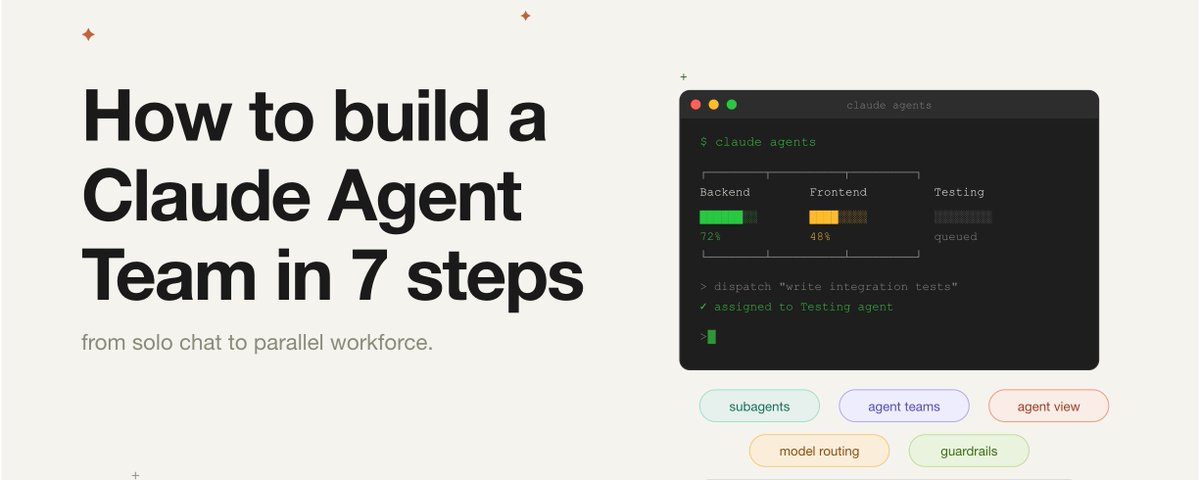
Anthropic engineer showed how one person can run 5 AI agents, that code, test, review, and deploy at the same time.
In 30 minutes they built the whole thing live in one session.
Here's what they cover:
> when to use one agent vs a full team
> how to split work so agents don't step on each other > the exact framework for deciding what each agent handles
that's exactly why, I put together a guide on building agent teams that actually work.
full guide in the article below 👇