Vice President, Research, AI @ IDC. Leading the AI Economics research group.
London
Joined September 2010
- Tweets22.1K
- Following3
- Followers8.5K
- Likes2.5K









Alessandro Perilli retweeted

My OpenClaw booked a car service to take me to the opening England World Cup game today.
When I got in the car, the driver told me he’d used Claude Code to build his whole website and booking system, then asked Claude to optimize it so agents would find him.
What a time to be alive.
Alessandro Perilli retweeted

Recursive self-improvement going from being a ridicule-worthy fringe sci-fi concept to a completely normalized part of the discourse which is “obviously the plan” is one of the more dramatic Overton window shifts I’ve experienced
There’s something disorienting about it, like if the sky suddenly turned red, and everyone acted like it had been that way all along
Alessandro Perilli retweeted

If you don't already know, this new Open Access scientific journal (no pay wall) covers all research topics about human intelligence including genetics & polygenic score predictions, neurobiology, evolutionary psychology, psychometrics, cognition, group differences, & more: icajournal.scholasticahq.com


Alessandro Perilli retweeted
To test the new ACE Step 1.5 by @acemusicAI, I had to tell the story of my cat. So here it is.
- I wrote the lyrics and the audio tags with the help of Codex. It took 6h.
- I generated the song with ACE Step 1.5 inside ComfyUI. It took me 8h to find the best parameters (they will be included in the upcoming Open Creative Studio 14.0 EA4).
- I generated the cover with FLUX.2 MAX. It took just 5min (the focus of this demo was the audio part, not the visuals).
- I generated the cover title with Pixelmator Pro 3.7.1. It took 5min.
- I generated the video from the cover with Grok Imagine 1.0. It took 30min.
- I put everything together in Davinci Resolve 20. It took 10min to make a decent loop with sync'ed start and ending.
I'm an expert in AI automation, not an artist.
Imagine what a creative could do.
I could talk for an hour about all the nuances I discovered about ACE Step 1.5 as I learned how to control it. Kudos to @acemusicAI for such a remarkable release.
Alessandro Perilli retweeted

Software development is undergoing a renaissance in front of our eyes.
If you haven't used the tools recently, you likely are underestimating what you're missing. Since December, there's been a step function improvement in what tools like Codex can do. Some great engineers at OpenAI yesterday told me that their job has fundamentally changed since December. Prior to then, they could use Codex for unit tests; now it writes essentially all the code and does a great deal of their operations and debugging. Not everyone has yet made that leap, but it's usually because of factors besides the capability of the model.
Every company faces the same opportunity now, and navigating it well — just like with cloud computing or the Internet — requires careful thought. This post shares how OpenAI is currently approaching retooling our teams towards agentic software development. We're still learning and iterating, but here's how we're thinking about it right now:
As a first step, by March 31st, we're aiming that:
(1) For any technical task, the tool of first resort for humans is interacting with an agent rather than using an editor or terminal.
(2) The default way humans utilize agents is explicitly evaluated as safe, but also productive enough that most workflows do not need additional permissions.
In order to get there, here's what we recommended to the team a few weeks ago:
1. Take the time to try out the tools. The tools do sell themselves — many people have had amazing experiences with 5.2 in Codex, after having churned from codex web a few months ago. But many people are also so busy they haven't had a chance to try Codex yet or got stuck thinking "is there any way it could do X" rather than just trying.
- Designate an "agents captain" for your team — the primary person responsible for thinking about how agents can be brought into the teams' workflow.
- Share experiences or questions in a few designated internal channels
- Take a day for a company-wide Codex hackathon
2. Create skills and AGENTS[.md].
- Create and maintain an AGENTS[.md] for any project you work on; update the AGENTS[.md] whenever the agent does something wrong or struggles with a task.
- Write skills for anything that you get Codex to do, and commit it to the skills directory in a shared repository
3. Inventory and make accessible any internal tools.
- Maintain a list of tools that your team relies on, and make sure someone takes point on making it agent-accessible (such as via a CLI or MCP server).
4. Structure codebases to be agent-first. With the models changing so fast, this is still somewhat untrodden ground, and will require some exploration.
- Write tests which are quick to run, and create high-quality interfaces between components.
5. Say no to slop. Managing AI generated code at scale is an emerging problem, and will require new processes and conventions to keep code quality high
- Ensure that some human is accountable for any code that gets merged. As a code reviewer, maintain at least the same bar as you would for human-written code, and make sure the author understands what they're submitting.
6. Work on basic infra. There's a lot of room for everyone to build basic infrastructure, which can be guided by internal user feedback. The core tools are getting a lot better and more usable, but there's a lot of infrastructure that currently go around the tools, such as observability, tracking not just the committed code but the agent trajectories that led to them, and central management of the tools that agents are able to use.
Overall, adopting tools like Codex is not just a technical but also a deep cultural change, with a lot of downstream implications to figure out. We encourage every manager to drive this with their team, and to think through other action items — for example, per item 5 above, what else can prevent a lot of "functionally-correct but poorly-maintainable code" from creeping into codebases.
Alessandro Perilli retweeted
In case you are not yet distracted by the celebrations, I just released Open Creative Studio 14.0 Early Access 3. I wrote a long post to describe the terrific new features:
patreon.com/posts/146439498


Alessandro Perilli retweeted
I found the perfect sampler for FLUX.2 Dev. It greatly improves the anatomy of hands and feet, even in images where the subject is not huge. And it improves prompt adherence. Exceptional progress in just one week.
This sampler will be the default for FLUX.2 in the upcoming Open Creative Studio 14.0 Early Access 3.


Alessandro Perilli retweeted
Be blown away. This is done with FLUX.2 and a single prompt. No post-editing, except a tiny bit of upscaling from the FLUX.2 native resolution at 2624x1472px to 4K.

Alessandro Perilli retweeted
If I wanted to cripple the AI innovation of an adversary country, I'd:
1. Inundate its market with free SOTA models
2. Promote adoption until their national labs give up competing + citizens depend on my models
3. Progressively degrade quality until country is no more competitive
Alessandro Perilli retweeted
It's done! Open Creative Studio 14.0 Early Access 1 for ComfyUI is ready for testing.
Read more about what's new in this pre-release, and how to access it, here:
oc.studio/early-access/open-…


🚨 AP Workflow (APW) becomes Open Creative Studio for ComfyUI and reaches version 13.0
You can now generate text, images, videos, voice, music, audio FX, lyrics.
Possibly, the most advanced all-in-one AI workflow for ComfyUI.
Open, Free, Unlimited.
👉 oc.studio

Alessandro Perilli retweeted

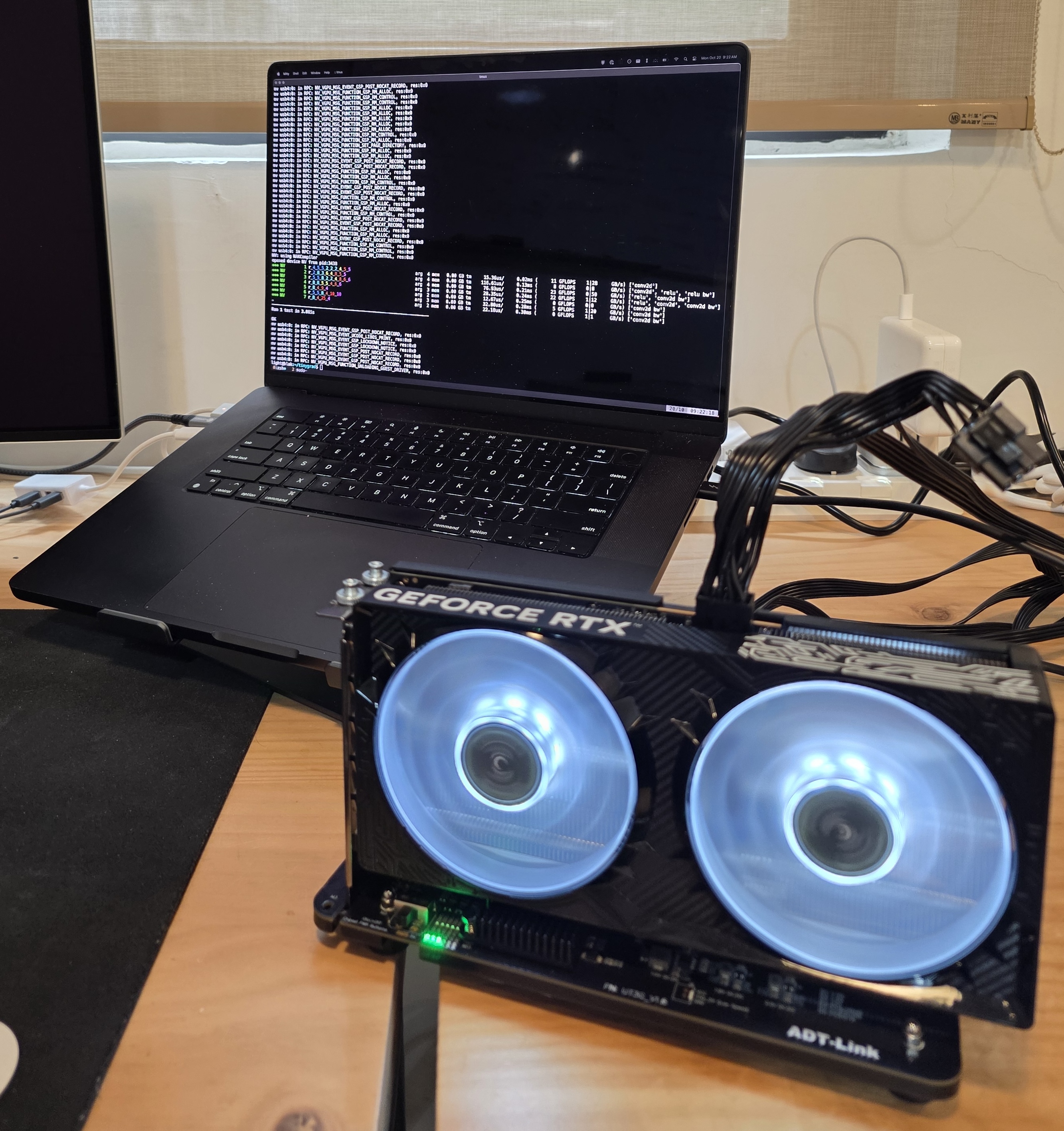
NVIDIA over USB4 on MacBook is ready to try!
* ADT-UT3G dock + any 30/40/50 series GPU
* Disable SIP
* Install driver `extra/usbgpu/tbgpu`
* Install NVK compiler `brew install tinymesa`
* Test with:
`DEBUG=2 NV_NAK=1 NV=1 python3 test/test_tiny.py TestTiny.test_plus`
Alessandro Perilli retweeted

Incredible Bullet Time re-creation — by @CorridorDigital
All you need: 1 PC, phone cameras, and ComfyUI.
Wan 2.1 + VACE workflow with multi-control videos for z-depth, pose & camera motion.
Workflow + Full Video 👇
Alessandro Perilli retweeted
🚨 AP Workflow (APW) becomes Open Creative Studio for @ComfyUI and reaches version 13.0 🚨
You can now generate text, images, videos, voice, music, audio FX, and lyrics.
Possibly, the most advanced all-in-one media generation workflow for ComfyUI.
Open, Free, Unlimited.👇

Alessandro Perilli retweeted

We've launched benchmarks of the accuracy of providers offering APIs for gpt-oss-120b
We compare providers by running GPQA Diamond 16 times, AIME25 32 times, and IFBench 8 times. We report the median score across these runs alongside minimum, 25th percentile, 75th percentile and maximum results. The number of repeats we run has been calibrated based on our confidence interval calculations.
This is the first version of our endpoint accuracy testing. We plan to iterate over time to ensure it provides the fairest possible basis for comparing providers’ accuracy.
Link to benchmarks below 👇


Inference providers have worked hard in the last week to make gpt-oss work well on their platforms.
We just released a guide to help you verify API-compatibility & run your own evals. Additionally, @ArtificialAnlys started releasing per-provider evals for AIME, GPQA & IFBench 🧵
Alessandro Perilli retweeted

Blender Alert 🚨
Few years ago, @PabloVazquez_ said on Blender Today Live that Blender could come to iOS once Vulkan was ready.
Today, it’s becoming reality!
Between version 5.0 coming and a native iPad release, Blender is becoming a true cornerstone of the creative world.✨

Alessandro Perilli retweeted

Intel, the home of Moore's Law, for the first time in history, is evaluating if it will continue at the leading edge. From its 10-Q
"However, if we are unable to secure a significant external customer and meet important customer milestones for Intel 14A, we face the prospect that it will not be economical to develop and manufacture Intel 14A and successor leading-edge nodes on a go-forward basis. In such event, we may pause or discontinue our pursuit of Intel 14A and successor nodes and various of our manufacturing expansion projects."
Just like that we could be could be talking about a TSMC monopoly, and the death of American made semiconductors forever.