
Professor of Statistics
UC Berkeley
Joined December 2022
- Tweets76
- Following422
- Followers2.5K
- Likes816
Pinned Tweet
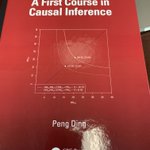
excited to see the physical copy of the book; nervous about the potential errors. Comments are welcome.


I just uploaded the R code and datasets to Harvard Dataverse: doi.org/10.7910/DVN/ZX3VEV I plan to provide Python code as well but I need to learn Python first.
Peng Ding retweeted

Benign Overfitting Beyond Prediction: The Ordinary Least Squares Interpolator. Dennis Shen, Dogyoon Song, Peng Ding, Jasjeet Sekhon. Biometrika. doi.org/10.1093/biomet/asag0…

A potential longer title of the paper is `DID when the event affects all units.' `FDID' is shorter but more esoteric. @xuyiqing

1/ Happy to share that "Factorial Difference-in-Differences" (FDID), with Anqi Zhao and @pengding00, is out in JASA - ACS. doi.org/10.1080/01621459.202…
It has been a truly thrilling experience working with Anqi and Peng.

Our paper "Estimating within-cluster and between-cluster spillover effects in randomized saturation designs" just appeared at Social Networks: authors.elsevier.com/a/1nCow… It was motivated by Edward Miguel's Neyman Seminar on a cash transfer experiment in Kenya onlinelibrary.wiley.com/doi/…
Peng Ding retweeted

Linear Model and Extensions
Peng Ding
August 28, 2026
routledge.com/Linear-Model-a…

Peng Ding retweeted

Excited to share a new paper with @pengding00 and Peter Bickel on combining estimators. arxiv.org/abs/2602.16310
TL;DR: When combining estimators, how can we do valid inference when the bias is unknown? [1/2]

It finally appears at the Journal of Econometrics: sciencedirect.com/science/ar… @MengsiGao

Hi #EconTwitter! 📊
Diving into causal inference and the #econometrics of networks?
Check out this paper by @MengsiGao & Peng Ding (@UCBerkeley), who deal with regression-based analysis for exposure effects estimation in network experiments. 📈
Interesting read for econometricians and economists who care about robustness!
Link: arxiv.org/abs/2309.07476

Peng Ding retweeted
Excited to share a new work with @pengding00 on causal inference in time-series experiments.
Appreciate any comments or feedback

Unifying regression-based and design-based causal inference in time-series experiments. arxiv.org/abs/2510.22864

Peng Ding retweeted

Thanks for the coverage, Bia! Amazing post, as always.

We have a new post!📬
⭐️Factorial DiD (Xu, Zhao & Ding)
⭐️DiD With No Untreated Units (de Chaisemartin et al.)
⭐️Treatment Effects in Complex Designs (de Chaisemartin & D’Haultfœuille)
⭐️Inference With Few Treated Units (Alvarez, Ferman & Wüthrich)
substacktools.com/sharex/ojC…

I just sent the new version of the textbook to CRC: arxiv.org/pdf/2401.00649v2 with R code and data at: dataverse.harvard.edu/datase… I can still make minor changes. Comments are welcome.
I just posted my notes for Stat 230 ``Linear Models'' to ArXiv: arxiv.org/pdf/2401.00649.pdf It covers the linear model and many extensions. I will teach it again in the spring and continue polishing the notes. Comments are welcome.
very excited to see the paper "Nonparametric identification is not enough, but randomized controlled trials are" with comments from @beenwrekt ("A Bureaucratic Theory of Statistics") and myself ("What randomization can and cannot guarantee"): muse.jhu.edu/issue/54591
excited to see the published version of our paper on dealing with missing covariates and outcomes in randomized trials: academic.oup.com/biomet/arti… It is a simple paper with some intriguing results. Slides are here: dropbox.com/scl/fi/jrkfnj0qr… @FanLiDuke

Peng Ding retweeted

101 years ago, Neyman introduced potential outcomes and design-based inference. For a special issue of Journal of Causal Inference, Sandrine Dudoit (@cendrinou), Deb Nolan (@DebAtStat), Terry Speed, and I wrote about how 4 books from @UCBStatistics & @thaddunning explain 1/


We view DID as a factorial design with the panel data structure. It is a fun paper. Comments are welcome.
Sharing a new working paper with Anqi Zhao & Peng Ding @pengding00, titled "Factorial Difference-in-Differences." arxiv.org/pdf/2407.11937v2 🧵
Comments and suggestions are welcome!

Peng Ding retweeted

🧑🏫 UC Berkeley seeks applicants for 4 tenure-track and 1 tenured professor position in "AI, Inequality, and Society." Explore areas like employment, algorithmic bias, and more. Salary: $78,200-$310,300. aprecruit.berkeley.edu/JPF04…
IPW with the estimated propensity score is another example. The first-stage estimation reduces the asymptotic variance, which surprises many people. A recent paper is arxiv.org/pdf/2303.17102 Also, Newey&McFadden chapter 6 is about "two-step estimation" sciencedirect.com/science/ar…

This is an interesting and useful trick. However, centering factors has some special restrictions on the estimated factorial effects when there are more than 3 factors (3 is the magic number there!). This motivates us to write this paper: academic.oup.com/biomet/arti…


Peng Ding retweeted

In @AmstatNews JASA, Anqi Zhao & @pengding00 consider alternative strategies to address covariate missingness in randomized experiments and recommend including missingness indicators when estimating average treatment effects.
tandfonline.com/doi/abs/10.1…

Just gave a guest lecture on Bayesian Causal Inference at Williams College, with slides and R code at doi.org/10.7910/DVN/JOXVQK which is an introduction to our review paper royalsocietypublishing.org/d… @fabri_mealli @FanLiDuke (I never taught any Bayesian Statistics at Berkeley.)
Fan Li's slides for causal inference

Done another semester teaching causal inference🙂. Updated my course slides, added survival data, labs, corrected more typos this time. Close to 800 pages now. Always more to update next year.
www2.stat.duke.edu/~fl35/Cau…