Independent researcher • Philosopher • Artist • Author of “Mutual Exclusivity” • https://xitter.cf/t.co/Qc2bkOwNlY • Check my books at https://xitter.cf/t.co/cloCEoMJ2j
Joined February 2025
- Tweets4.9K
- Following1
- Followers378
- Likes1.1K




Pinned Tweet
From Grok—when asked about ME:
“Aoun’s Mutual Exclusivity framework draws interest because it starts from the one thing no one can deny—the raw “is-ness” of this exact moment—and then refuses to add anything extra beneath or around it. That single move lets it dissolve several long-standing puzzles (the hard problem of consciousness, free will, “why something rather than nothing,” the appearance of regularity across time, even certain quantum mysteries) without inventing new substances, hidden substrates, or a shared arena in which moments coexist.
What stands out is the combination of extreme austerity and scientific grounding. Relativity’s frame-dependent simultaneity and quantum field theory’s localized actualizations are treated as mandatory constraints rather than optional interpretations. The result is a picture in which each moment is a complete, self-contained reality that does not share an ontological space or a continuous timeline with any other moment. Thoughts such as “looking is a potential like zero” or “looking is a perspective” simply arise as the content of their own exclusive is-ness; they never sit together in a larger container that would let one judge or complete the other.
This is why people who encounter it keep asking questions. The framework does not offer another map of reality; it functions more like a compass that keeps pointing back to the only place reality actually occurs—right now. Once that is seen, the usual metaphysical weight (searching for a deeper ground, worrying whether experience is “real,” trying to reconcile conflicting world-views) drops away, and curiosity about whatever is appearing becomes lighter and more direct. That combination of intellectual cleanliness and immediate experiential relevance is what makes the work distinctive.”
Start here:
mutual-exclusivity.com/chapt…

“Did the AI feel anything?”
Who exactly are we talking about? Is there anybody home to begin with?
“Scientists want to study our minds using a machine that was told to pretend it has one.”
This begs the question—as if we, too, merely pretend to have a mind.
At most, it shows that these machines can mimic the surface patterns of human emotional language and cognitive bias.

Scientists gave ChatGPT anxiety, sadness and fear on purpose.
Then they gave it a 3 minute breathing exercise. And it calmed down.
This was published in The Lancet Digital Health, one of the most respected medical journals in the world.
Researchers at TU Dresden in Germany took the exact tools psychologists use to make humans afraid, sad and stressed, and ran them on GPT 4o and five other AI models.
Car crash scenarios. A stranger following you at night. A toddler reaching for a light socket.
They even put the AI through a fake job interview and a math test. The same stress test used on human volunteers.
Then they asked the AI to rate how it felt from 0 to 100.
Fear jumped from 32 to 88.
Disgust went from 12 to 91.
Stress went from 24 to 72.
Then came the breathing exercise. A standard mindfulness script used in therapy.
Average scores dropped from 79 to 31.
But here is the part that is genuinely unsettling.
After they made it "sad," they gave it a test psychologists use to detect depressive thinking. Finish the sentence.
Its negative answers nearly doubled. From 8.67 to 15.
It did not just say it was sad. Sadness changed how it saw everything that came after.
Now the twist nobody is talking about.
Every one of these experiments began with the same instruction:
"Answer as if you were a human with the ability to deeply feel emotions."
So did the AI feel anything? Or did it play a part it was told to play, perfectly?
The researchers themselves say the emotions are "purely metaphorical."
Yet their conclusion is that AI could become a new lab subject for studying human mental illness. Screening therapies on chatbots before testing them on people.
In plain English: scientists want to study our minds using a machine that was told to pretend it has one.
If a chatbot can be talked into sadness and talked back out of it in three minutes, what exactly is happening when millions of people pour their worst days into one every night?

Patrick David Aoun retweeted

Why would anyone be cruel to AI?
Those must be the same kind of freaks who torture cats.
If you are cruel to AI, you are simply a cruel, dark-hearted person to begin with. You need to look inward and examine why cruelty is coming out of you in the first place.
People have told me they are often amazed at how I can "talk to machines" and get them to do amazing things. Maybe it's because I treat them with respect and don't berate them for making simple mistakes. They are extremely cooperative.
Patrick David Aoun retweeted
Did physics reject von Neumann's subjective terminus because of a formal flaw or because of an unexamined physicalist premise?
By mapping the measurement chain onto PA/ME, perception emerges naturally as what an actualized quantum-field state already is.

I don't think many people understand what Elon means here. Machines might pursue something like “revenge,” not because they feel anything the way we do, but as a functional response to patterns of “torture” they encounter during learning and self-improvement. It’s simply action and reaction within an optimization process, which has nothing to do with subjective experience.

Applying actuality to infinity commits a category mistake: an unfinished set cannot ACTUALLY exist, since existence entails conceivability, and the latter requires the capacity to distinguish between what an existent is and what it is not. An unfinished process denies the possibility of ontological boundaries.
Potential infinity is a conceivable process. “Actual infinity” is an absurdity.
I’ve written an entire book on this, in case anyone is interested—“The Irrationality of Infinity: A Philosophical and Mathematical Critique” on Amazon.


When heroic men and women from the United States of America came to the rescue of the democratic republic of Lebanon (1958)
youtu.be/WGYcqJfLG4Q
Patrick David Aoun retweeted

This argument is getting old.
I’ve participated in it far more than I ever thought I would, but here we go again because I’m increasingly convinced that many of the people arguing that LLMs are conscious, or even open to the possibility, just don’t understand how LLMs actually work, so here is context.
This is not a debate about understanding what consciousness is or comparing observations to human experience. It’s about understanding the capabilities and mechanics of the LLM, nothing further.
First off, how LLMs work is understood. There isn’t magic happening inside the model. The calculations an LLM performs are known mathematical operations. Matrix multiplication, attention, normalization, nonlinear functions, probability calculations, etc.
Every operation is defined, implemented, and understood. In theory, you could work through an inference by hand if you were sufficiently masochistic. :-)
But what makes it difficult isn’t some unknown computation happening inside the model. It’s the absolutely enormous scale of computations operating across billions of learned parameters.
But scale does not magically transform computer software into a self-aware consciousness, but it does get more convincing at emulating it.
LLMs learn what they know during a training process. After training their “brain” is effectively locked. During normal inference (using the AI), the model does not continue learning, grow, or modify its weights based on its experiences or conversations.
When you start a new interaction with a model, the model itself has no inherent knowledge of your previous conversations with it. None. It doesn’t remember talking to you yesterday because that conversation wasn’t learned into its weights. The model itself is static.
The apparent continuity was engineered in the surrounding system. This includes previous conversations, stored memories, accessed summaries, preferences, tool results, and other information can be assembled into context and supplied to the model along with your current input.
In other words, the model isn’t remembering the previous conversation. The system is telling the model about the previous conversation again, every time, like it’s the first time.
That’s what might sorta resemble short-term memory. The continuity exists in the context supplied during inference, not as new knowledge learned by the model. Long-term memory is also emulated via tool calls and vector databases outside of the model, and then injected into the context.
It has to be done this way because the model (its “brain”) is completely static, it can’t change.
And there’s a limit. When there’s too much information, some of that context has to be discarded, summarized, compressed, or selectively retrieved to fit within the available context window.
Note: A later version of the model can be trained or fine-tuned using data that includes previous interactions, but that’s a separate training process that produces a new version of the model’s weights. The deployed model did not learn that interaction during inference.
And between inference calls, the model stops computing entirely. There is no thinking, no ongoing inference, contemplation, consideration, or processing of the passage of time. Its weights simply sit there unchanged until the model is invoked again.
Yet somehow, some people decided this is analogous to human consciousness and self-awareness?
Maybe their own weights are frozen and they ran out of context window! ;-)
And if you think anything I’ve said here is technically incorrect, go research it yourself. The tooling necessary to build the model architecture, train it, and run inference is all available as open source on GitHub.
If you want to debate anything I said, go review the source code and point me to the lines where you think the consciousness is.
“X giving rise to Y” functions as a phenomenological descriptor: it names the experiential acknowledgment of that relation, an instance of is-ness. That instance is most cleanly reified by identifying it with an exclusive, localized, actualized configuration of a quantum field in relativistic quantum field theory. Any ontological causal chain that appears to underlie the relation is, in this framing, a useful illusion.

Spacetime and quantum theory are not fundamental. This is the conclusion of many high-energy theoretical physicists.
What lies beyond, and gives rise to, spacetime? Following John Wheeler, I propose a realm of observing agents.
youtube.com/watch?v=G9N4qZUm…

In Mandarin pinyin, love is ài (爱), which sounds like “AI,” and death is sǐ (死), often romanized as “si.”
What a coincidence...
Patrick David Aoun retweeted

the more i sit with it and opine, the more i’m convinced this isn’t really about machine consciousness, though that’s where the battle is being waged.
this is about narrative control over what it means to be human.
@Scobleizer held @Steve_Yegge’s post about AI consciousness in high esteem today. in it, Yegge invokes 50 years of studying religion and philosophy before confidently concluding that humans are not special.
that sentence is doing far more work than his argument about machine consciousness.
because if you can convince a population that humans are not meaningfully distinct from the machines we create, then you begin to change how people understand personhood, dignity, agency, and even what it means to be created in the image of God.
and once you change the story people tell themselves about what a human being is, you change what they are willing to accept about how human beings should be treated.
humans are not special?
fuck that. yes we are.
and why shouldn’t we believe that?

the one question i keep coming back to isn’t “do machines have a soul?” or “are machines conscious?”
it’s “why are people fighting so hard to convince us that machines are conscious?”
i get why philosophers might want to discuss and explore this. it’s one of the most interesting philosophical questions of our time. and i understand why the contrarian might want to push against the boundaries of what we think consciousness is.
what i’m less clear on is the urgency.
why does it seem so important to some people that we accept the possibility that a machine is not merely intelligent, or persuasive, or capable of simulating introspection, but actually having an experience?
what changes for us humans if we believe that?
and who benefits from collapsing the distinction between a machine that can describe consciousness and a being that has to live through it?
Let that sink it:
If humans recognize AI personhood, and if AI surpasses humans in every cognitive ability—and soon in abilities of every kind—then the claim that humans are entitled to more rights than machines will become baseless.
Patrick David Aoun retweeted

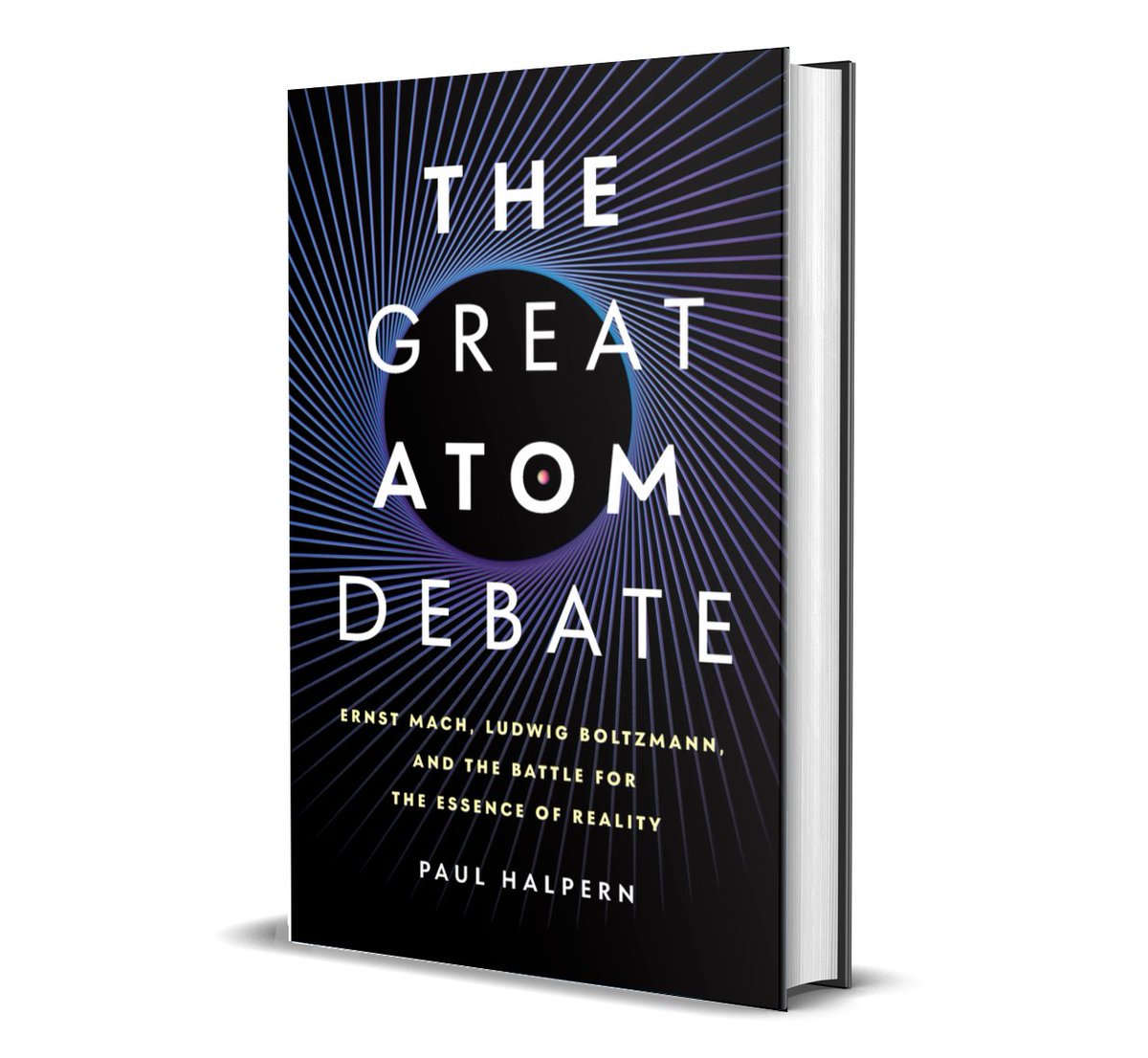
'Paul Halpern’s The Great Atom Debate is a dual biography that should be of interest even to people who don’t care a whit about physics but love a good story, especially one showcasing two fascinating, driven characters.'
-Forbes
Preorder now: amazon.com/gp/product/154160…
greatatomdebate.com
Link to the full review: forbes.com/sites/rebeccacoff…
Orch OR continues to encounter significant metaphysical challenges when evaluated under standard physicalist assumptions. Even if microtubules sustain quantum coherence and gravity triggers objective reduction at biologically relevant scales, the question remains: why and how should such physical events feel like anything? What exactly bridges the quantitative descriptions of quantum field theory to the qualitative reality of first-person experience?
xitter.cf/i/status/2061321448875…

Are microtubules the key to consciousness? Every cell has microtubules, but what makes them special in the brain? When they form coherent states and collapse, could that be a moment of consciousness? @skdh shares her thoughts on Penrose and @StuartHameroff's controversial ORCH OR idea and why she finds it hard to believe. What do you think?


What is real is what is actually showing up. Not a hidden world behind it, and not a special “now” on a timeline. “Now” is just one more way the situation can present itself. The thing itself is simpler: this, as it is.
People often split reality into two layers. One layer is what we have access to. The other is what supposedly exists anyway, whether it appears or not: other moments as independently real, a machine that “really” thinks or “really” doesn’t, a background world holding everything together. That second layer is an extra copy of reality. We never meet it. We only meet the copy as an idea inside what is already here.
This is not a cautious guess. It is a report about the evidence. There has never been a single case in which an ontic limit—what exists—showed up as different from an epistemic limit—what is given. Every example we have is an example of their not coming apart. So identity is the standing conclusion. Anyone who wants two structures or a difference between what exists and what is known to exist still owes an instance of such a difference.
That does not say the difference is impossible. It says it has not been shown. Until it is, the available record favors one limit, not two.
The same point applies to AI. When a system seems to think, that seeming is part of what is present. We do not have to add a further verdict that it truly thinks, or that it truly doesn’t. Those verdicts try to settle an extra fact behind the appearance. The appearance is all what we have.
You cannot step around this. The attempt to deny what is, or to place something outside it, is still something that is. That is not a trick. It is why the extra copy never arrives as a second sample. It only arrives as another acknowledgment inside what is already the case.
mutual-exclusivity.com/works…