
Professor, Stanford Law School. Senior Fellow, Hoover Institution. Read my book: https://xitter.cf/t.co/NScgWkDNEI
Stanford, California
Joined March 2013
- Tweets78.8K
- Following4.3K
- Followers13K
- Likes63.3K






Pinned Tweet
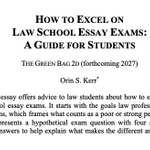
1L exams are coming soon, and here's a reminder that I have this short essay, forthcoming in the Green Bag, on how to earn top grades on law school essay exams.
papers.ssrn.com/sol3/papers.…


Red Garland, "Soul Junction," from Soul Junction (1957), with John Coltrane on tenor, Donald Byrd on trumpet, Garland on piano, George Joyner bass, and Art Taylor drums.
youtube.com/watch?v=UnrNWaOH…
1
7
4,185
Kinda puzzling exchange. I would think the way through is "if it were up to me, judges would use originalism, but my views on this will be irrelevant if I am confirmed as a trial judge because that's not up to a trial judge." (which I *think* is what the nominee is saying, but so it goes.)
No Fourth Amendment search occurs when officers piggyback behind gym member with a key card to enter locked building where gym was open and operating (this was during Covid, FWIW), Washington Supreme Court holds. courts.wa.gov/opinions/pdf/1… #N


As the court notes, this has come up before.
xitter.cf/OrinKerr/status/148948…

Gym was operating during COVID. Members had keycards to enter. Cops entered w/o a warrant to check for violations of COVID large-gathering rules, using keycard provided by the gym's prior owner. Held: Entry violated the 4A, and no qualified immunity. drive.google.com/file/d/1TnG… #N


Orin Kerr retweeted

Very sad. Wendel was a giant of legal ethics & a wonderful man. He will be missed.

This news is so painful. I had recently been corresponding with him about coming down to see us in New Orleans to give a talk at Tulane. His work, his generosity, and his kindness were and will continue to inspire so many of us for years to come. 1/2 lawschool.cornell.edu/in-mem…

Interesting First Amendment case. Oral argument: ca11.uscourts.gov/sites/defa…
Prior ruling on the stay: media.ca11.uscourts.gov/opin…

Harvard Law administrators take photos of IDs of protesters protesting prior protest to protest punishment of prior protesters.
harvardlawrecord.com/breakin…

oh, and in case you're wondering: Harvard has a formal policy that you're required to show your Harvard ID when a "properly identified University official" asks for it.
campusservicecenter.harvard.…
Orin Kerr retweeted

Where did the 59 AIII confirmations so far in Trump 2.0 (double counting St. John) get their J.D.s from?
Yale will take first place after Adkisson, Axt, and Falvey get confirmed. A couple other schools will move up with the final batch of 2026 confirmations.
Via the FJC.

I wrote this long post about viewpoint diversity in academic hiring back in May, but the issues are still circling so I figured I would post it again.
Niche tweet, but there's a lot of discussion of "viewpoint diversity" in academic hiring, and what it means, and whether it's an affirmative good.
In law schools, at least, I think it's a good thing and important. I thought I would say what I think viewpoint diversity is, and why I think it's good and important in academia—focused, at least for now, on scholarship. (As I said, it's a niche tweet—feel free to skip.)
I'll start with an observation. One of the things you realize when you start law school is that legal argument is a cultural practice and a language, not a science governed purely by logic. As a result, whether a particular legal argument is deemed persuasive often depends on the legal culture that the judge who is to be persuaded is steeped in, and how the lawyer has framed the issue in light of that legal culture.
There are some parts of the legal culture that are broadly shared by essentially all lawyers. But the legal culture splinters, too. On a lot of topics, there is no one prevailing legal culture, but rather two or more different legal cultures.
To pick an accessible example, you may have one group that sees a close reading of text as the important part and policy and purpose as sideshows, while another group sees policy and purpose as the focus while the details of text are side shows.
Often, these different legal cultures emerge organically from different political or ideological perspectives, which themselves change over time. It's human nature, I think. People are naturally enthusiastic about the modes of legal thinking that tend to deliver results they like. Over time, they gravitate to modes of thinking that have tended to lead to those results.
People won't see themselves as result-oriented in coming to those views. Rather, they will just notice (being insightful people) that certain modes of thinking usually lead to pretty inherently attractive outcomes, and the principled arguments for those modes of thinking will be more present in their minds than the principled arguments against them.
Attitudes towards the different schools of thought tend to follow. Every approach has its principled arguments for and against—no approach is perfect. But people will naturally focus on the principled arguments in favor of viewpoints that lead to results they see as fundamentally heartwarming, positive, or great. And on the flip side, they will naturally focus on the the principled arguments against viewpoints that tend to lead to results they see as fundamentally troubling or terrible.
What does this have to do with viewpoint diversity in academic hiring?
A lot, I think.
First, when it comes to evaluating the merit of scholarship during the hiring process, professors naturally tend to put a thumb on the scale of work within their subcultures. Scholarship speaking from within their legal subculture will resonate with them more than scholarship speaking from a different subculture. It's enough of a difference that, if they're not paying attention to the dynamic, what they casually perceive as just trying to hire the best people will often mean trying to hire the best people among those within their particular legal subculture.
As I see it, the importance of "viewpoint diversity" starts with just being aware of this limit to our own perceptions and the need to overcome our own biases. In law, at least, you tend to hire the best people only when you're aware that good ideas don't only come from the particular legal subculture that you personally live in, and that you need to try to step outside yourself to see that people with other views and assumptions have good ideas, too.
So that's the start, and it's basically just about overcoming our own biases as we try to measure merit.
The next part of it is the belief, based on experience, that a clash of ideas tends to sharpen them. Scholarly ideas are like a muscle. They need to be stressed to become strong. I can't be sure if I'm right unless I encounter someone who disagrees with me and who challenges me, and who forces me either to defend my view or change it. Ideally, the challenge is not just on a minor point, like how best to express an idea, but on a more fundamental issue like whether the basic premises of the argument are right or wrong.
A big benefit of viewpoint diversity is that it tends make that clash of ideas a lot more likely. If everyone basically thinks the same way, there are less likely to challenge basic premises. They won't think of basic critiques as readily, and they won''t be as willing to raise them, as those outside their subcultures would be. So to make your own work stronger, it's far more valuable to get feedback from those who don't share your basic premises than those who do. Having viewpoint diversity on a faculty creates an environment that makes it more likely to strengthen scholarship among those in the majority group.
This second value of viewpoint diversity doesn't have an obvious normative "to do" in response. Different people will have different senses of what it should lead to. Maybe it simply emphasizes the importance of the de-biasing discussed above. And it doesn't mean just (roughly) left and right, or left and center, or political ideology: Different subcultures can be different methodologies, PhD disciplines, and different subject areas, too. But I think that clash of ideas based on different views of the law is a key way to improve legal scholarship, and that having viewpoint diversity makes that clash more likely to happen.
There are other benefits to viewpoint diversity, I think. I haven't addressed those to students in class, who get to learn different worldviews in their courses that can help them persuade judges from different worldviews, too. But this tweet was long enough.
Orin Kerr retweeted

BREAKING: DOJ is sending @USAttyEssayli to Florida to work on an investigation into the 2022 raid on Trump's Mar-a-Lago home & the ensuing classified documents investigation/prosecution. Essayli will continue to run US Atty office in L.A. w/@dlippman politico.com/news/2026/11/19…
