







Pinned Tweet
It was great to speak with @_MatiasMichael and the Emet team, @deel's new AI lab, at GTC Berlin a few weeks ago.
Deel was founded by @Bouazizalex and runs payroll, HR, and compliance for 40,000+ customers across 150+ countries. For a company like that, owning its intelligence instead of renting it is fast becoming the path to being truly AI-native.
Frontier models know what payroll is in general. But put them to work on real, country-specific questions, and they still get things wrong. In payroll, one missed detail means someone gets paid incorrectly.
So we teamed up to experiment if an open model could beat the best frontier models like Claude and ChatGPT.
Deel brought the domain expertise: in-country specialists, expert criteria, and real-world knowledge.
Our Forward-Deployed Researchers brought the post-training toolbox, built on NVIDIA’s open Nemotron model.
A project that would normally take quarters took a few weeks.
The results:
• Higher accuracy on the hardest payroll tasks in Deel’s EmBench Payroll benchmark.
• About 50x lower cost than the top frontier model.
We built a model customized to Deel’s work, competitive with frontier quality where it matters, at a fraction of the cost.
These are the early stages for post-training on open models.
Ori Goshen retweeted

more businesses will want to own their own intelligence
almost every c-suite executive i talk to at enterprise companies is looking at alternatives to ChatGPT and Claude
too expensive
privacy concerns
limited customization
they will still use frontier models for certain tasks but the reality is most companies don't need frontier models for 90% of their operations
they are better of finetunning a open source model.
For years, enterprises faced a dilemma with AI.
They didn't want to share their proprietary data. But the capability gap between frontier models and everything else was so big that they said, "We'll share because there's no other choice or else we will be left behind in the AI race."
@satyanadella explained this dilemma best in July:
"You essentially pay for intelligence twice, once with money, and again with something even more valuable: the proprietary knowledge you must reveal to make that intelligence useful."
However, midway through this year a paradigm shift happened.
Between spring and summer, a wave of open-weight models trained on agentic trajectories arrived in China:
- @deepseek_ai V4: announced on April.
- GLM-5.2: released by Zai on June.
- @Kimi_Moonshot K3: launched in July.
In June, @nvidia released Nemotron 3 Ultra, the strongest U.S open-weight model to date.
They're not quite at the frontier, but they're close. Close enough that taking an open model and customizing it for your own needs suddenly became attractive.
A year ago, you wouldn't have seen this demand.
Now enterprises have an alternative to frontier models like Anthropic's Claude or OpenAI's GPT models.
They don't have to hand over their data, rather they can build their own models.
There are three reasons they are exploring this space:
1. Unit economics. A general-purpose model charges you for intelligence you don't use. Specialize a model for your domain or task, and it can be 10x, in some cases 100x, more efficient.
2. Differentiation. If your core product is AI-based and you rent it, there's not much alpha. You're using the same model as everyone else, operating with the same economics as everyone else.
3. Ownership. Your proprietary data and customer interactions are your most valuable assets. With a model you own, they stay inside your walls.
Here is one case study:
@Gong_io, software that helps sales teams learn from every customer conversation, built an agent that reads sales calls, emails and meetings.
They used frontier models to pull out what revenue teams need, like deal stage and health scores, and it performed well. But Gong processes tens of millions of interactions a month. At that scale, every call to a frontier model adds up fast.
And no cheaper model could match the quality and getting customer records wrong wasn't an option to compromise on.
So our team and Gong's further trained @NVIDIAAI's open Nemotron 3.5 Super for this one job. In two weeks, we built the training data and the checks for every CRM update. Gong's own tests found it matches Claude Opus 5.5 on speed and accuracy.
At a small fraction of the cost.
Owning a specialized model fixed that.
So my suggestion to any enterprise looking to explore their options:
Use closed models to rent AI for every day tasks.
Use open weight models to own it for your core intelligence.
6
358
Ori Goshen retweeted

Cognition Founder Scott Wu: Running Your Own Models Is a 5-10x Cost Game
"For our own models, no cost on being able to serve, being able to serve our own models means that we can kind of, like, serve Devin for those particular tokens about five to ten x cheaper, which is obviously a massive difference."
— @cognition's @ScottWu46
On October 22, speaking at Sheba Medical Center's ARC innovation summit in Tel Aviv, @BillAckman predicted that Israel will produce a $1 trillion company.
"I would be surprised if not in the next five years, let alone the next 10," he said.
As ambitious as that prediction is, that's a leap from where @Israel is today. As some of the largest listed companies are the following:
- Teva about $45B (Pharma)
- Bank Hapoalim about $33B (Banking)
- Elbit Systems about $32B (Aerospace)
A trillion-dollar company would be roughly 20 times larger than any of them.
Around the world, only a few companies have ever crossed the trillion dollar market line. For example, Apple, Microsoft, and Nvidia. SpaceX and Anthropic joined them this year through record IPOs, OpenAI might join soon. Nearly all of them come from AI, semiconductors, software, or e-commerce.
Ackman's argument is that: “Israel, by contrast, has a small population but boasts the highest concentration of IQ and intellectual property relative to its size, which is precisely what matters in the age of AI”.
He also argues that model companies like Anthropic and OpenAI won't capture most of the value of this technological breakthrough. Even with Anthropic now public at over $1.4T, Ackman's point is that most of the value will sit in the layers around the models.
If that's slightly right, there are many opportunities to build in the layers around AI.
Here are three layers where an Israeli company could become a trillion dollar company:
1. Compute layer.
2. Application layer.
3. Deployment layer.
Compute layer - financial markets
Compute is the processing power every AI model runs on.
Like oil or electricity, compute is scarce, expensive to produce, and used up as it's consumed. Unlike them, no mature financial market exists. According to @socialcapital research, AI capex is projected to reach $765B in 2026, ahead of oil and gas at about $681B. Oil supports more than $25T a year in futures on roughly $2.5T of physical trade.
Compute now draws more capital than oil and has no mature financial layer.
Lenders struggle to value GPUs, neoclouds can't lock in future rental income, and AI labs can't budget their largest cost. However, the pieces of this market are starting to form. Silicon Data and Ornn publish daily GPU price indices, CME and ICE have announced compute futures, and venues like Compute Exchange match buyers and sellers.
For compute to become a real market, it needs a standard unit.
Today, AI compute is rented by the hour on chips like @Nvidiaai's H100 or its newer, much faster B200. But "one GPU-hour" isn't one product. An hour on a newer chip gets far more work done than an hour on an older one. And every chip loses value as newer generations arrive, so the same hour is worth less next year than it is today.
Other markets solved this:
- Oil comes in many grades, so traders price everything against benchmarks like Brent.
- Treasury futures use a conversion factor so different bonds can settle against one contract.
Compute needs the same thing: a unit that measures actual work done across chips and accounts for how fast each one loses value.
Another opportunity here are Neoclouds. Companies that build data centers full of GPUs and rent them out. CoreWeave, the largest, went public in 2025 carrying billions in GPU-backed debt.
Why Israel?
Building this market takes two things we're unusually good at.
The first is deep infrastructure knowledge. A huge part of Nvidia's networking business was built in Yokneam, by Mellanox. The second is people who can price risk. Israel has a deep bench of quants and trading-tech engineers.
Put those two groups in a room and you get the team that builds the West Texas Intermediate (WTI) of compute.
Application layer - Agentic AI
If a GPT answers a question online, an agent pursues a goal for a user.
It plans a task, uses different tools available, checks the result, and tries again until the job is done. That loop is what turns a model from something that talks into something that acts. The market is still small but compounding.
The agent software layer was roughly $5B in 2024.
IDC counted about 28.6M active AI agents in enterprises worldwide in 2025 and projects 2.2B by 2030. The bigger prize isn't the software itself but the work it absorbs: hundreds of billions in annual SaaS spend, and a far larger pool of knowledge-work labor.
Adoption, though, is early.
McKinsey found fewer than 10% of organizations have scaled agents in any single business function.
The reason is trust in technology. Another part of the problem is how agents are tested. For example, a recent analysis of seven weeks of real developer traffic found that only about 11% of messages asked the agent to write code. About 40% were confirmations, redirections, git commands, and pasted context, which almost no public benchmark tests.
That gap has a real cost.
A router tuned on a public benchmark sent nearly 50% of live traffic to the premium model, against a 25% target. Tuned on a benchmark built from real traffic, it landed within half a point.
Each of these gaps is a category of infrastructure that doesn't fully exist yet. As models become interchangeable, value moves to whoever makes agents reliable, governed, and cheap per completed task.
Why Israel?
Israel has spent 30 years building security and cyber, from @CheckPointSW, @CyberArk, @Wiz.
Behind them is a talent pipeline, from Unit 8200 to the founders it produces, that thinks about access and attack before anything else. Securing and testing agents is the next version of the same job, and Israeli teams don't have to learn it from scratch. As models become interchangeable, value moves to whoever makes agents reliable, governed, and secure to act on its own.
You can enter this layer through a niche and expand.
Deployment layer - Post-training
“The best predictor of Fortune 500 behavior is what AI startups are doing today. we saw this with coding agents, inference spend, and evals. Now we’re seeing it with post-training.”
@BrendanFoody, CEO of Mercor.
If pre-training gives a model broad knowledge from massive public datasets, post-training taps into proprietary data the public does not have access to and shows a model a better behavior: what a good answer looks like, how it follows instructions, and how it handles a company's terminology and edge cases.
It runs on owned data, human feedback, and rigorous evaluation.
The spending is already large, but most of it goes to data vendors serving AI labs. For example, Micro1, founded by @aliansarinik, passed a $1B annual run rate in October 2026, by the company's own figures. And this is early: @willdepue argues that labs are on a trajectory toward more than $100B a year of data spend by 2030, up from roughly $7 billion a year across vendors today.
In this category, data vendors sell expert data to a handful of labs, which use it to train their closed models.
The other category here is: open weight models, post-trained on enterprise proprietary data, that improve with use.
The first signal of that market arrived recently. Applied Compute was founded in 2025 by former OpenAI researchers and helps companies customize and train open-weight models on their own business data. It reached a $100 million annualized revenue run rate 18 months after founding. On November 18, Palo Alto Networks agreed to acquire it in an all-stock deal valued at $4.5 billion.
The second signal is the trend where enterprises are looking to keep their proprietary data and create their own proprietary intelligence with an edge.
At @AI21Labs, we recently worked with Emet, @Deel's AI lab, on exactly this. Deel brought payroll and compliance knowledge built across more than 40,000 companies in 150+ countries. We post-trained a specialized model on it. The result was a 20.7-point gain from post-training, and the model scored 8 points above frontier models on payroll questions.
That's what owning intelligence looks like in practice: a company's own expertise, turned into a model nobody else can buy.
And Anthropic's IPO filing shows how big the bet on enterprise AI is. Nearly 250 customers now spend more than $10M a year on its rented AI. There are obviously nuances here as to who would need a full blown post-training. At this level of spend it makes sense to start thinking about owning vs. renting.
The next question is, as companies realize owning their intelligence rather than renting is superior, how big can the TAM get?
Why Israel?
Israel has the highest concentration of AI talent in the world among LinkedIn members, according to Stanford HAI's 2026 AI Index Report.
That's a big part of why we're headquartered in Tel Aviv. The city pulls in AI researchers, forward-deployed engineers, and the founders who build on their work.
Amazon's acquisition of Decart last week, reportedly for $7.5B, is the latest proof of what this ecosystem produces in the broader AI space.
-----
I’m curious what other industry you think an Israeli company can reach this $1T prediction?
Tag them below, or maybe someone can start a Polymarket with this ;)
Anthropic starts trading on Nasdaq today in less than 2 hours…
Their numbers show the pie is much bigger than any one lab, and a growing share of it will go to open and specialized models.
Some observations on Anthropic’s IPO filing that stood out to me:
1. Anthropic itself names the competition. Open-weight models and specialized AI labs are called out in their own filing. When the leading frontier lab lists them as competitors in its IPO filing, the category is real.
2. Spend is huge and concentrated. About 250 customers pay $10M+ a year and Net Revenue Retention (NRR) is about 9x. At that level of spend, owning part of the workload stops being a nice-to-have and becomes a cost, control and margin question.
3. Post-training is where the value is created. By Anthropic's own definition, it's the stage where a model becomes helpful and accurate, and their data spend there went from about $900M to $2.4B annualized in a few months.
4. Proprietary data becomes proprietary intelligence. Post-training is also an opportunity for a company to turn its proprietary data into proprietary intelligence. A competitor can rent the same frontier model, but it can't rent your data or what a model learns from it.
Side bonus: Market leaders are already putting money behind this thesis. “Every enterprise is going to run a mix of open and closed models.” That’s @PaloAltoNtwks CEO @nikesharora, announcing a $4.5B deal for @appliedcompute, a post-training and inference platform for open-weight models.
Kudos to @AnthropicAI, they're growing the market for everyone building in this space.
6
411
We have access to thousands of high-end Nvidia GPUs (H100/H200/B100/B200), and our most important training runs could still wait up to three days to start.
In an AI world where everything can change in 24 hours, time is super valuable and any delay can be a setback. So we paired Kueue, an open-source traffic control for AI tasks. with AI Hypercomputer’s flexible, open operations through Google @kubernetesio Engine (GKE), the automated control panel that runs the whole show, to solve our problem.
We split the work across many GPUs, because post-training project includes:
* Training job runs on different datasets.
* Training experiments with different configurations.
* Evaluation jobs.
The main change is that it isn’t a single model training job that requires this concert of tasks but the project.
The tasks are short, but every one of them needs expensive compute.
At any moment we have tens of these tasks working in parallel, each with its own compute requirements.
And they have a different order of priority:
* Training a new version of the model comes first.
* Evaluating a model checkpoint comes second.
* Ablations and experiments span a range of priorities and urgency.
Ideally, we want every task to run as fast as possible. But we are bottlenecked by compute to run them all at once. So a system has to decide the order, weighing both how important each task is and how much compute it requires.
That’s cluster management.
We run our reserved fleet close to 100% capacity, on purpose. Before we automated scheduling, we negotiated capacity, manually via Slack. If you needed GPUs, you posted in a channel called #gpu-resources and hoped for the best.
A typical day there looked like a stream of manual requests and researchers waiting on replies.
That worked fine while the cluster had spare room. It stopped working once utilization was pinned near 100%. Then every request became a negotiation, and team leads spent valuable time refereeing compute disputes.
On top of that, there were about 20 manual scheduling interventions a week.
The second problem was different, sometimes we had plenty of free capacity on paper, but it was scattered across machines in pieces too small for a large job to use. You can have 8 free GPUs spread 1, 1, 4 and 2 across four machines and still be unable to run a single 8-GPU job.
That’s fragmentation, and no amount of negotiation in Slack fixes it.
Worse, a big job that got only part of what it needed could sit there holding GPUs without doing any useful work. Our fix was to stop managing the cluster by hand. Now Google Kubernetes Engine runs the cluster, and Kueue, an open-source scheduler, queues every job and orders it by priority.
It knows our physical cluster layout, so it can refuse to admit jobs that won’t fit on a single machine. It also shares capacity fairly between teams without disrupting work already running. That fairness feature didn’t exist yet, so we wrote up what we needed and the Kueue team built it.
The results:
* High-priority waits: up to 72 hours → 12.
* Manual interventions: ~20 a week → zero.
* Fragmentation: 15% → 8%.
* Compute bill: unchanged.
I want to give a big shoutout to the entire team for this amazing work.
I’m curious whether other teams had a similar cluster management issue and how they fixed it?

2
5
544
You can read about this accomplishment here: cloud.google.com/blog/produc…

118
This Wednesday I’m speaking in Tel Aviv, hosted by Anu Banu and @fusion_vc_com as part of their “High-Tech for Israeli Society” series.
The timing is good, as Israeli startups raised $13.2B in the first nine months of 2026, close to the $15.6B raised in all of 2025.
If you follow the capital allocated closely, in the third quarter, Israeli cybersecurity startups raised about $2.4B, nearly half of all venture money invested in cybersecurity worldwide. Much of it went to companies that secure AI agents and the infrastructure behind them.
In Israel, we know how to build cybersecurity companies at scale. We have the talent, the investors and decades of practice due to the urgency of innovation and war.
But in AI, we are still working out what our version of that looks like.
That is part of what this conference is about.
Founders, investors, tech leaders and public-sector representatives will be in the room for an open conversation on three questions:
1. How can Israel become a global leader in the age of artificial intelligence?
2. How should the government, entrepreneurs, and the high-tech industry act?
3. And what is needed for this revolution to serve Israeli society as a whole?
The conference will start at 9AM at the Pearl Cohen TLV office. At 11:30AM, I will join @NadirIzrael, GVP at Servicenow and founder of @ArmisSecurity, to talk about where Israel is headed.


Ori Goshen retweeted

Ori Goshen is the founder of @AI21Labs, the multibillion-dollar AI lab often called
the “@OpenAI of Israel.”
We first met a few months ago in San Francisco at a Shabbat dinner hosted by our friend @menemazarakis.
Today, @origoshen and I wrapped tefillin together for his first time in over 25 years!
Ori is a true pioneer.
He’s been building frontier AI models since 2017, and today, he’s helping some of the world’s leading companies build their own frontier models.

I recently joined @gracegongGG on Venture with Grace for a conversation about AI agents, language models, and enterprise AI.
In this episode we discussed:
- How open-weight models have become a practical alternative to frontier models. And how companies can customize them with proprietary data, gain a competitive edge, and use smaller, cheaper models for specialized tasks at scale.
- The three kinds of companies adopting agents. AI-native startups, digital-native businesses, and traditional enterprises and how each must develop AI capabilities in different ways.
- The paradigm shift that happened around May - June 2026, with the releases of Kimi K3, new DeepSeek, and Qwen. Which became the first agentic open-weight models, sharply narrowing the gap with the frontier models.
- Recruiting, hiring, and training from Israel’s military, academic, hardware, and software talent pools.
We also explored why the next wave of AI gains may come from AI improving the systems that run AI, and much more. Thank you Grace for this conversation!
You can watch the entire interview natively here on X.
xitter.cf/gracegongGG/status/211…


1
2
312
Most executives are waiting for a smarter model. The companies pulling ahead are teaching an open model their own rules.
Here is why…
An AI frontier model can have all the knowledge about an industry and still produce the wrong output for an enterprise.
The fix is teaching an open model how your business does the work, using your own specialized intelligence.
Because knowing an industry and producing what one business needs are two different things. The first relies on general information that’s publicly available and misses many nuances. The second depends on the business’s data, policies, standards, which most general AI models don’t have access to.
Post-training on open models closes that gap by teaching a model how your business expects the work to be done with your own data.
We did this with Deel and NVIDIA in October 2026.
Deel supports more than 45,000 companies across 150+ countries. For any payroll question, the right answer depends on local tax rules, employment contracts and company policies. All three change regularly.
Frontier models know most of these rules, but they often leave part of the answer out. In payroll, a wrong or incomplete answer can mean an incorrect paycheck, a missed filing, or compliance problems.
For example, a typical task, usually a few sentences long, might be: “We have an employee in France who started maternity leave on 14 August. My understanding was that CPAM would fund this. How does the funding and the employer’s part work?”
To get the answer right, the model also has to phrase it in Deel’s terminology, policies, style, and make it sound like their own experts, not like a general model.
To teach it, our Forward-Deployed Researchers (FDRs) relied on expert-verified training data and benchmarks from Emet by Deel, a frontier AI evaluation lab that builds benchmarks and expert-generated training data. Emet’s in-country payroll specialists defined what a complete answer contains.
Then we ran two steps to bake that behavior into the model weights:
1. SFT (supervised fine-tuning): the model generated sample answers with guidance. We kept only those meeting every expert-defined criterion and trained on them without the guidance.
2. SDPO (self-distillation policy optimization): the model, given detailed instructions on the desired behavior, acted as its own teacher, so it now behaves that way without them.
The result: on Emet’s 8-country payroll benchmark, the share of expert criteria Nemotron 3.5 Super VL’s answers met rose from 51.3% to 72%. That’s 8 points above Claude Opus 5.5, at 33x lower cost per query.
Payroll is one example of many use cases.
Any business that needs precise and accurate outputs and depends on its own standards and ways of working faces the same gap.
And face a similar fix with post-training an open model on how that business expects the work to be done, with its own proprietary data.

In May 2017, The Economist ran a cover story headlined “The world’s most valuable resource is no longer oil, but data.”
At the time, the data that mattered recorded what people searched for, clicked on, and bought, and companies like Google and Meta used it to sell ads.
Nine years later, data has a new use: training AI models. Based on Anthropic’s IPO filing, Wing’s @tanayj estimates the company’s spending on data vendors reached an annualized pace of about $2.4 billion in September, up from about $900 million in June.
For most of the last decade, the public internet supplied that data for free, but most websites are now closing it off.
Between April 2023 and April 2024, sites used robots.txt to fully block AI crawlers from more than a quarter of the most actively maintained sources behind C4, one of the most widely used public training datasets.
But the data that matters most now was never on the public web.
Pre-training on the open web gives a model broad knowledge of the world. Post-training teaches it a specific job, using examples of the task paired with correct answers, and graders that score each attempt so the model’s weights can be nudged toward the better ones. That data has to be specific and correct.
Enterprises already own data like this.
For example, a bank’s past underwriting decisions and an insurer’s settled claims record years of expert judgment on real cases, with the outcome attached. None of it sits on the public web, so no lab can crawl it. Who captures the value of that data depends on which kind of model a company trains.
Fine-tuning a closed model means sending the data to whoever hosts the model, and the resulting model stays on their servers. The company can’t download it.
An open-weight model can be downloaded, trained on the company’s own servers, and kept there along with the data. The usual objection is performance. The early evidence suggests that on specialized tasks, the gap can be closed.
For example, Gong is a revenue AI platform used by more than 4,800 companies to record and analyze their sales teams’ customer conversations. At AI21, we post-trained NVIDIA’s open Nemotron 3.5 Super model with Gong for its Data Extractor, an agent that reads sales calls and emails and updates deal records in the customer’s CRM.
Gong processes tens of millions of these interactions a month, so frontier-model costs compound quickly.
After two weeks of work, Gong’s own evaluations found the post-trained model matched Claude Opus 5.5 on speed and accuracy at a small fraction of the cost.
The Gong project follows a pattern that will repeat for other companies:
1. A company finds one task it runs at enormous volume.
It rents a frontier model.
2. As volume grows, so does the bill.
3. Then it seeks an open model to the same standard, and the bill drops.
4. Each time that happens, a share of AI spending moves from renting general models to owning specialized ones.
The companies that move first will own an edge their competitors can’t rent. The ones that wait will keep paying for intelligence anyone can buy.

1
4
445
In June 2025, the Islamic Revolutionary Guard Corps (IRGC) announced it had successfully hit “strategic Israeli targets” in Tel Aviv.
The crazy part? I found out in real time, from the bomb shelter, when our security officer shared videos minutes after the attack.
I stopped, stared at my screen for a long moment, and then texted our CMO:
“I think we should hire the IRGC. They just gave us international coverage.”
Israeli humor aside, here is what actually happened:
A ballistic missile struck near the complex housing AI21 Labs’ Tel Aviv headquarters. Windows shattered, alarms blared, and the entire complex was evacuated.
A few days later, we learned the damage was less severe than we feared, but we still couldn’t set foot back inside for months. Overnight, our entire team had to relocate to a temporary office nearby, under immense stress.
As a leader, a crisis like this strips away the superficial noise.
It reminded me of my time in the IDF, where we were taught that a plan is only good until the first variable changes, and that true leadership requires continuous adaptation.
Leading an AI company through this taught me one fundamental truth:
Adaptability is the ultimate MOAT.
In both military intelligence and the AI race, conditions change overnight, whether it’s an incoming missile or the sudden launch of a model like Fable or Astra that can do things you couldn’t do the day before.
You cannot freeze. When our physical office was struck, we did not fall into victim mode; instead, we rose up and kept building.
In AI, if your team can’t pivot when the market demands it, you risk falling behind or becoming obsolete.

S&P 500 CEOs should read @chamath's deep dive on open vs. closed AI models.
An MIT FutureTech study of SEC filings found that only 11% of S&P 500 companies had deeply integrated AI into their core operations by 2025. For most large companies, a key decision is still ahead: which models to build on. At AI21 Labs, we post-train Nvidia’s open Nemotron models for enterprises, and most companies we talk to are weighing that question now.
This deck clearly educates, analyzes, and contextualizes the decision, and I shared it with my executive team.
Three takeaways stayed with me:
1. The rented model improves when its provider ships an update. Owning one trains on data that’s uniquely yours.
The deck quotes Microsoft CEO Satya Nadella’s point that renting a model means paying for intelligence twice: once in money, and again in the know-how you reveal to make it useful.
Every prompt and correction you send teaches whoever holds the weights, so when you rent, your learning compounds for the vendor. Which is why Cursor, the AI coding editor, retrains on live use and Meta discounts about 95% for the right to train on yours.
Owning reverses the flow.
An open base model gives you most of the cost of building one for free, tuning it on your own data costs thousands of dollars, and the lessons stay inside your company. When Nubank fine-tuned its coding agent on its own past migrations, task completion doubled.
For routine tasks, renting is fine. For any company that has proprietary data, owning your model keeps learning from your production traffic. Compounding value you own.
2. The model is the brain and the harness is the body.
The harness is everything around the model: its tools, its context, its memory, and the routing that picks which model handles each task.
Of the seven most-used harnesses, Cursor, Claude Code, Codex CLI, Pi, Hermes Agent, OpenClaw and OpenCode, only Cursor and Claude Code are proprietary. Claude Code is also the only one that doesn’t allow you to swap the underlying model.
Models will keep leapfrogging each other, and a company that owns its harness and its data can swap them as prices and rankings move.
3. The quality gap is now measured in months, so the question has moved to economics.
In 2024, the best open model trailed the best closed one by about a year, according to Epoch AI.
By mid-2026 the visible lag was about four months, largely through distillation, where a smaller model learns from a larger one’s answers. Once a model is good enough for the job, what matters is the cost of each finished task. The deck’s best example is Cognition’s Devin Fusion: a frontier model plans and reviews the work while a cheaper model writes the routine code. Cognition reported tasks at $1.35 on average, against $3.51 for Anthropic’s Opus 5 working alone.
At the scale of millions of customers, that difference decides whether you can deploy at all.
The deck goes further, into why American labs closed their models while Chinese labs opened theirs, what closed labs still sell when a free model does most of the work, and where a model can run so that nothing leaves your building.
It’s worth the 1 hour it takes to read it in one piece.
xitter.cf/chamath/status/2101006…

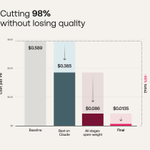
Researchers at @AI21Labs cut @gitlab Duo Code Review’s cost by 98% by swapping out frontier for open models and improving the harness. Quality untouched.
The results:
> Baseline (Claude Sonnet 5): $0.589
> Best frontier setup (Claude Haiku 4.5): $0.385
> Open model at every step (DeepSeek V4 Flash): $0.086
> Open model at every step (DeepSeek V4 Flash) + harness optimization: $0.0135
Kudos to @stephbny who led this study 🏆
More on why open models + harness optimization is the winning pair for companies looking to lower costs while maintaining frontier quality: ai21.com/blog/gitlab-case-st…

2
2
205
Ori Goshen retweeted

It was a pleasure working with @googlecloud's GKE and Kueue teams on this, and we’re proud of the impact we got to have on a brilliant product - with some of our production requirements making it back into Kueue itself. More details on our blog: ai21.com/blog/how-ai21-manag…


AI21 achieved an 83% reduction in AI workload wait times. By orchestrating thousands of @nvidia H100 and H200 GPUs with Kueue on GKE and AI Hypercomputer, @AI21Labs cut high-priority job wait times from 72 hours to 12 hours.
Learn more → goo.gle/4jyuzfM
