

Team Science. No Borders. Bring It On.
Joined March 2021
- Tweets234
- Following51
- Followers503
- Likes49


Huge thanks to @Julia_Czs @pietznerm @BurulcaU @KopruluMine @KastenmullerLab @Julian_H0ffmann and many others!
@QMULBartsTheLon @MRC_Epid @berlinnovation
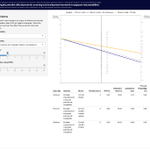
We enable the community to query and visualise our results interactively through our webserver: omicscience.org/apps/protdet…


We performed #Mendelian randomization to identify major biological influences with putative causal effects on plasma protein levels.


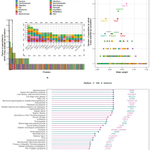
Liver and kidney function, inflammation and smoking status have wide-spread effects on the proteome (influencing >3k proteins).
Anthropometric factors influenced a fewer number of proteins but had a stronger influence.

Joint genetic and biological factors explained >10% of variation for over a third of proteins.
#Plasma proteins cluster into groups according to their major biological explanatory factor.
Over a third of proteins were best explained by #modifiable factors.

#Proteomics capture thousands of plasma proteins. Most are not secreted, their origin and role are unclear.
We characterised the joint contribution of >60 biological, #genetic and technical influences on 5k #plasma proteins in the Fenland study.

Want to get a summary of our paper and of the implications of our research? Check out our research briefing at @NatureMedicine
nature.com/articles/s41591-0…

Precision medicine requires finding people at a high risk of disease.
We used >3,000 proteins to develop sparse models for prediction of future risk of 218 diseases using #EHRs and #MachineLearning in @uk_biobank.
nature.com/articles/s41591-0…
rdcu.be/dOxQQ

Amazing industry-academia collaboration with @Julia_Czs @pietznerm @jonathandavitte @profhhemingway @robert_a_scott and many others
@GSK @QMULBartsTheLon @UCL_IHI @MRC_epid @Cambridge_Uni
We make our results available through our webserver (omicscience.org/apps/protpre…) to visualise the potential benefit of #proteomic screening in a Bayesian framework.

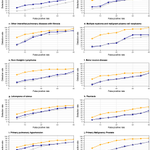
Severe diseases with poor prognosis among the best predicted: dilated cardiomyopathy, pulmonary fibrosis, #MultipleMyeloma , non-hodgkin lymphoma.

We find proteins predictive across more than 1 clinical specialty and specific disease predictors e.g. BCMA (TNFRSF17) for multiple myeloma, a target of multiple myeloma treatments.

For 52 diseases these performed better than standard clinical blood tests. e.g. those who will develop #MultipleMyeloma >6 times more likely to test with a high proteomic risk.

For 67 diseases, 5 to 20 proteins improved prediction over clinical risk factors up to 10 years before onset.

Precision medicine requires finding people at a high risk of disease.
We used >3,000 proteins to develop sparse models for prediction of future risk of 218 diseases using #EHRs and #MachineLearning in @uk_biobank.
nature.com/articles/s41591-0…
rdcu.be/dOxQQ


Outstanding scientists elected to EMBO Membership: in EMBO’s 60th anniversary year, 100 new members and 20 associate members join the community
embo.org/press-releases/outs…

We are so honoured for this recognition of our science. Go team!
Outstanding scientists elected to EMBO Membership: in EMBO’s 60th anniversary year, 100 new members and 20 associate members join the community
embo.org/press-releases/outs…
Amazing collaboration with @SpirosDenaxas @pietznerm @_MatthiasArnold @KastenmullerLab
@berlinnovation @QMULBartsTheLon
@UCL_IHI