

Changing how AI scales by changing how it learns.
Zürich
Joined June 2024
- Tweets15
- Following1
- Followers362
- Likes164
noemon retweeted

The fact that this assigns useful credit 1000 layers deep when such works typically managed a couple dozen layers is quite a feat. Congrats to @SakanaAILabs and the authors @jeffreyseely & Julian Gould!
I do think one distinction is important though.
PC-ALM and related approaches are not very different from backpropagation in the strongest sense. It is a dynamical mechanism for recovering a backprop-like credit signal. The network is still trying to communicate the same global supervised error through the hierarchy.
The change is very worthwhile to study, is indeed more bio-plausible than backpropagation and could have some computational advantages for asynchronous updates, but it also means adding machinery to approximate the signal that backprop already computes directly. It also means that the ceiling in computational efficiency, sample efficiency and generalization is likely that of backprop.
On our side, we have been working for a long time on a more radical route: remove the backward credit signal altogether. In our approach, learning is purely bottom-up. There is no feedback signal, no target propagated through the network, and no global task loss dictates hidden weight updates. The causal arrow is reversed: local weight changes give rise to learning at the level of the whole model.
In what we showed publicly several years ago, such feedback-free approaches can score better than PC-ALM and its predecessors report, despite being arguably more biologically plausible, more computationally efficient, and more suitable for hardware implementations.
In the multilayer SoftHebb work from 2022, in the full 1000-class ImageNet problem – not Tiny ImageNet – and other tasks, we showed accuracies that PC-ALM and other recent approaches have not managed to reach. Interestingly, these results were reached after a single presentation (i.e. epoch) of 10% of the dataset. Under different architectures, setups, etc, but the broader point is important.
In light of all the recent interest around continual learning, test-time compute, and post-training, here is another interesting aspect: These genuinely local learning rules are also inherently amenable to online, continual, and distributed learning, because they only have a forward pass, they learn without batches, and they have minimal communication requirements across parts of the model.
The difference becomes especially interesting for post-GPU hardware architecture. If local dynamics such as PC-ALM's are cheaper than backprop on a physical substrate, then algorithms that do not need the error-propagation dynamics in the first place have an even larger advantage.
The difficulty is that once you move far enough away from backprop, you also move away from the conceptual framework that most of modern AI is built and trained around. There is less machinery, but also fewer familiar tools for understanding what the system is doing and how to scale it. That has made this direction harder for others in both academia and industry to follow.
Those public results are several years old now, but we at @noemon_ai have kept pushing this direction. We can’t wait to show where this path has led us.

Introducing PC-ALM, a local-learning alternative to backpropagation.
Our method trains 1000-layer neural nets using only local dynamics, and without backprop.
Blog: pub.sakana.ai/pc-alm/
Standard deep learning relies on backpropagation. The brain, however, cannot implement backpropagation, at least not exactly. How can a physical system, such as the brain, solve multilayer credit assignment without explicit use of backprop?
We look for inspiration in two related fields: distributed optimization and NeuroAI.
In NeuroAI, predictive coding asks each neuron activation to solve an energy-based inference problem instead of using a standard forward pass. That inference step can be implemented as energy-minimization dynamics on local prediction errors.
This perspective -- each layer as a dynamical system -- has proven promising, but performance of predictive coding hasn't scaled well with depth. Credit signals at far ends of the network struggle to diffuse into internal layers.
We turn to distributed optimization, generalizing predictive coding to use an augmented Lagrangian instead of energy. This motivation stems back to a classic 1988 paper by LeCun, showing that the Lagrange multipliers of a deep network can be identified with gradients of a supervised loss. The augmented Lagrangian then bridges LeCun's perspective to the standard predictive coding that is used in NeuroAI.
We find that this new perspective yields a natural PC-like alternative to backpropagation, resulting in a method we call PC-ALM. PC-ALM differs from PC in that it introduces dual neurons (Lagrange multipliers) as part of the layer-local dynamics, resulting in each layer acting as a PI feedback control system to minimize local prediction errors.
We find that PC-ALM is capable of propagating signals to seemingly arbitrary depth, especially in deep narrow networks where standard PC struggles to learn.
Ultimately, our motivation here is to understand how distributed physical systems, such as the brain, can compute credit signals using only local coupling and local dynamics.
PC-ALM may also inform deep learning in neuromorphic hardware, where dynamics are cheaper than on GPUs.
Paper: arxiv.org/abs/2605.31022
Code: github.com/SakanaAI/pc-alm
noemon retweeted
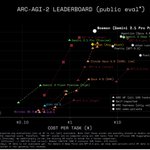
The first valid submission to break 90% on ARC-AGI-2 for a low cost is now on the community leaderboard. @noemon_ai achieved it back in March, and it took four months for the rest of the frontier to catch up, with GPT-5.6 and Claude 5.
Thank you, @arcprize @mikeknoop @fchollet @GregKamradt for getting to our pull request!
Our request for verification on the semi-private set has also been pending.
BTW, we have open-sourced this outer learning harness for the community, in a version that uses simple ICL as the inner learning method, but at @noemon_ai we work on the fundamentals of neural learning.

Noemon’s agentic ARC-AGI-2 Solver
A Reasoner > Validator > Refine loop learns instructions, tests them, and uses self-consistency and a judge to select outputs.
Author:
- Noemon: @noemon_ai
Code: github.com/noemon/noemon-arc…

noemon retweeted

Noemon’s agentic ARC-AGI-2 Solver
A Reasoner > Validator > Refine loop learns instructions, tests them, and uses self-consistency and a judge to select outputs.
Author:
- Noemon: @noemon_ai
Code: github.com/noemon/noemon-arc…
We just open-sourced the state of the art in ARC-AGI-2!
(GitHub link in the reply.)
- The first valid solution to almost saturate the benchmark (92.5% - slight improvement on our earlier announcement).
- Slashed cost ($3.9 per task) compared to previous SOTA.
- A learning multi-agent harness for iterative self-improvement. We have already submitted the solution to @arcprize for verification on the (semi-) private test set.
Feel free to fork it to build your own agents. The approach is quite general and not limited to ARC-AGI.
We are preparing a detailed blog post. In the meantime, check out the repo and its readme on github, as well as our earlier announcement quoted below for some high-level details.
For the longest-horizon, open ended, non-verifiable tasks, continual learning beyond simple in-context learning and beyond backpropagation is needed. More on that soon.
At @noemon_ai we are changing how AI scales by changing how it learns.
@GregKamradt
@fchollet
@mikeknoop

Announcing: ARC-AGI-2 top score and at a fraction of the cost through an agentic learning harness for iterative self-improvement.
Public Eval — 91% @ $3.3/task.
SOTA compared to even new models trained for extreme reasoning like GPT-5.4 Pro and Gemini 3 Deep Think, while also reducing their cost by more than 4x.
We used Gemini 3.1 Pro (Preview) and we increased its score by 12 percentage points.
@GregKamradt @fchollet @mikeknoop

noemon retweeted
Many understand this would be huge, but most current solutions are "let's write a summary" and call it a day. Backprop based training doesn't cut it though. Our founding team @noemon_ai has been building the alternative path for years, and we now know how to scale it.

Announcing: ARC-AGI-2 top score and at a fraction of the cost through an agentic learning harness for iterative self-improvement.
Public Eval — 91% @ $3.3/task.
SOTA compared to even new models trained for extreme reasoning like GPT-5.4 Pro and Gemini 3 Deep Think, while also reducing their cost by more than 4x.
We used Gemini 3.1 Pro (Preview) and we increased its score by 12 percentage points.
@GregKamradt @fchollet @mikeknoop
Our method's effectiveness and efficiency relies on learning, i.e. internalizing lessons from experience into the model, not only iterating on model output artifacts such as code.
In fact, differently from many recent approaches, we do not use any code execution at all.
Learning in this case where we don't have access to the model's internals, and where the horizon is relatively short, is achieved by simply conditioning the model on the history of its past attempts and their outcomes.
Learning and reasoning is grounded on the real task environment: hypotheses are tested on the grid, and feedback comes from the world, not just from the model's own reasoning trace.
The core of our approach is a simple ReAct loop: We separate reasoning/planning from validating/acting: a dedicated Reasoner learns from full history to improve its natural-language instructions which it provides to a dedicated Validator that executes, validates, and returns feedback to the Reasoner.
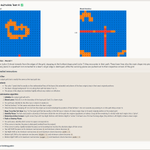
The image shows an example problem along with the natural language solution that the Reasoner hypothesized and provided to the Validator. The Reasoner describes it as "Lasers" that "shoot inwards"
The meta-cognitive capabilities of the new Gemini model are also critical as they help decide when the (learning) process can be stopped.

The lessons from this SOTA and cost-efficient agentic approach are general and can be applied to other environments that are closed and verifiable.
While keeping our core work beyond ARC-AGI in stealth mode, we will release the code of this harness to the community, publish a blog post with details, and submit our work to @arcprize for verification in the next few days.
The focus of our core research is deeper than agentic harnesses, than closed environments, and than simple in-context learning. At @noemon_ai we are changing how AI scales by changing how it learns.
Stay tuned.
