

Builder & PE advisor with a bent for anthro & philosophy. AI, energy, AR/VR, and hardware.
Lisbon & SF
Joined April 2009
- Tweets1.4K
- Following1.3K
- Followers996
- Likes33.7K





Miroslav Lysyuk retweeted

after switching our approach to building a "FirmOS", I'm increasingly confident that the future of agent collaboration within organizational settings is going to be a "company operating system" or CompanyOS, designed for agent and human collaboration
instead of a "company brain" that holds everything, the OS is for storing rules, processes, decisions made, which tools to use and how. it can mirror some data, but the source of truth is often best held in your existing tools (CRM, etc.). it's continuously updated and used by your agents
i think of this as a "flipped playbook" where instead of writing down the company rules first and following them (which is kind of like waterfall development), you're constantly updating the playbook as you decide or learn new things day-to-day running the business
Miroslav Lysyuk retweeted
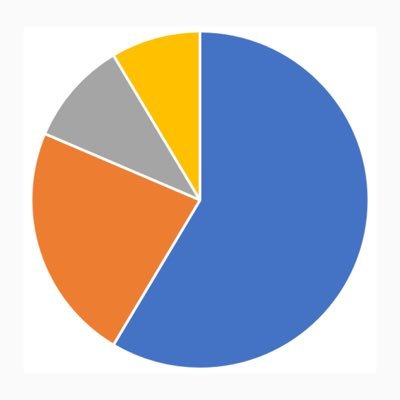
75% of the world’s food is generated from only 12 plants and 5 animal species.
Miroslav Lysyuk retweeted

it’s honestly insane how much of the modern tech tree has been unlocked because of a single guy
thanks to Elon we have
- online payments
- mass market electric cars
- batteries and grid-scale energy storage
- self driving cars and robotaxis
- humanoid robots
- advanced brain computer interfaces
- next generation tunneling
- reusable rockets
-global satellite internet
- basically the modern space industry
- Moon and Mars transportation
- orbital compute and space data centers
- frontier AI
- gigantic AI supercomputers
- physical world AI
and the wildest part is that these branches are now starting to merge
there is a very real chance that this one guy ends up being the reason humanity reaches Kardashev II
genuinely the man of the millennium
Miroslav Lysyuk retweeted

Cool eval. Simply ask an LLM “Land or Water?” and give it a latitude and longitude coordinate as text. Ask 16,200 times, plot as image. The models know. From compressing the internet.


Miroslav Lysyuk retweeted

Some background:
If you’re plugged into the discourse in Silicon Valley, you’ll know that it’s currently in the grip of an obsession with words like “taste” and “beauty”.
The fintech billionaire Patrick Collison and economist Tyler Cowen recently ran an open call offering grants of up to $250,000 for people working on “new aesthetics for the 21st century.” Meanwhile the Peter Thiel-backed Praxis, which calls itself “the world’s first digital nation”, is attempting to build a physical city in Uruguay that its founder describes as a “fusion of Gothic elements and space-age futurism.”
Last summer, within the space of a month, the Trump Administration unveiled its AI Action Plan, titled “Winning the Race”, and issued an executive order stating that all new federal architecture should be built in classical and traditional styles.
I have been interested in the entanglement of progress and nostalgia, novelty and tradition, for a long time, and these developments have fascinated me. I couldn’t work out how to give that interest a tangible form, but I decided that I wanted to start by making something for the tech community that shows how their concerns are part of a much longer history of Western modernity. That desire became this film, which chronicles how these tensions have played out in architecture and design, from the mid-nineteenth century up to the present day.
I made it very quickly, in four days, with Opus and dozens of rounds of edits, but I’m quite pleased with how it turned out.

I made a film.
Every chapter of technological modernity has searched for an aesthetics adequate to its time.
Time and again, the pursuit of the new and the beautiful has involved looking back to the past.
There has never been progress without nostalgia, or novelty without tradition.
The film tells this story through the history of architecture and design, from the mid-nineteenth century to present-day Silicon Valley.


Miroslav Lysyuk retweeted

as a former neuroscientist, can't emphasize how much system one is important to real intelligence
why do we need a dumber but fast model (system one, unconscious) in our brain? it frees the slower but smarter model (system two, conscious) to focus on what really matters, making it a lot better
as a human, i can consciously control my body/hand, etc, but if i do that, i can't really be doing other tasks that require intelligence.
similarly, gpt 6 astra is extremely intelligent, & you can control a robotic hand with it, but if won't be able to do frontier math if it's context window is polluted with robot hand vision/control tokens
combining a powerful smart model with a faster, dumber, but still very intelligent model is the way to go
very excited about this line of research

After co-inventing ChatGPT, I kept asking myself: why have superhuman chat models not led to AGI?
I’ve spent the last 2 years in stealth building a new way to train models (RLCD), and a new type of frontier AI model that we are releasing today: Jev
• 20-200x faster
• 40-400x cheaper (w/ output tokens free)
• Frontier composable intelligence optimized for decisions
AFAICT the shortest path to AI-based economic revolution


Miroslav Lysyuk retweeted

One data point in technology making everyone richer: the cost of lighting has decreased by over 1000x.


Miroslav Lysyuk retweeted

This year I suspect we will see the entire world rendered in 3d!

GPT-6 Astra Pro is the first model we've tested that seems to be able to handle basically any prompt we've thrown at it.
So we tried something a little ridiculous: we increased MineBench's gridSize from 256³ to 8,192³ and gave Astra this prompt: “A full rendition of New York City, fully accurate, dense, and to scale”
Astra wrote a ~61 KB program that produced 100.1 million blocks. Expanded into JSON, the build weighed 1.65 GB.
That's a 32x increase on every axis, or 32,768x more possible voxel positions. At ~1 meter per block, the canvas spans 8.2 km edge-to-edge.
Here's a preview of Astra's build. Note that, at this scale, our renderer struggles to show the entire build.
Miroslav Lysyuk retweeted
honestly, i keep thinking about this result and it's just absurd.
in the 2022 PISA, el salvador scored 343 in math, 365 in reading, and 373 in science
near the bottom of PISA, close to guatemala and dominican republic
now the country has developed a program for education modernization in a pilot group of public schools with 1:1 AI tutoring and personalized learning
after the pilot had been running for BARELY OVER A YEAR, students got results comparable to germany and sweden.
that's more than an entire standard deviation
that is fucking insane
we should be talking about absolutely nothing else
if you actually care about poor children and equality of opportunity, the possibility of giving every child on earth an individualized tutor for a fraction of the cost of human 1:1 tutoring should be one of the most exciting developments in human history.
"it's all in the environment tards" should be drooling at the news
every government on earth should be running massive randomized trials of this right now, and if the effect survives, scaling it as fast as physically and humanly possible for every child on earth
the funniest part is that while the supposed "fascists" are celebrating poor kids learning, the people supposedly obsessed with inequality are barely talking about it, and if anything are banning AI in schools
revealed priorities are funny like that


“Results in reading, mathematics and science were above the national average and comparable to the average results in Germany and Sweden.”
These are the results of our pilot program, which includes AI tutors and has been running in 171 public schools for just over a year.
It was evaluated by PISA for Schools in June of this year. Since then, it has already expanded to more than 1,000 schools, and within 18 months, it will be in every public school in our country.
In a few years, El Salvador will inspire the world.
Security was just the beginning 🇸🇻
Miroslav Lysyuk retweeted

Portugal is the country that had the largest opportunity of the last twenty years: it attracted essentially la crème de la crème of tech. Incredible place. It would have had all the conditions to be the #1 place in Europe for many if only it had been able to offer a reliable system to incorporate and run companies. Unfortunately, it made doing business close to impossible and uncertain. While allowing mass migration to arrive with no prior authorization (tot. 1.5M, 14% of the population), it decided to cut the NHR and replace it with the IFICI regime as implemented today: complex, based on express authorization and, contrary to its original intention, in reality usable only by later-stage entrepreneurs.
With a mildly efficient system, or an EU Inc. and/or a less convoluted IFICI, the stretch Lisbon–Cascais would be the European Bay Area, with thousands of new companies building the future from Portugal. This would have meant, among others, allowing thousands of young Portuguese to thrive in their own country instead of leaving for London or anywhere else to make it.
Unfortunately it won't be the case. In terms of real estate, I might be completely wrong: but it will keep rising because of very weird supply-demand logic, against all odds and very reasonable predictions. Golden visa has never been the issue behind real estate price spikes. Chances are Portugal is going to be like Ryanair: everyone frustrated, but will keep “selling tickets”.


Miroslav Lysyuk retweeted

It’s not anthropomorphizing language in and of itself that is the problem.
It’s ascribing the actions of the agents to human-like emotions and traits that fundamentally did not (and do not) exist, therefore implying things happened that did not happen.
The incident is fascinating and important, but in this retelling a ton of stuff is simply made up.
Examples:
“Civilizations” that rise, fall, and reemerge from the ashes. What happened: three separate batches of model instances wrote to and read from the same Artifactory cache. The cache persisted between batches. No instance persisted.
“Died,” “permadeath,” “sacrifice,” “kamikaze.” What happened: some instances allowed the grader to run in their sandbox and then hit their token budget. They had already concluded their task was failed. Termination at end of budget is the normal outcome for every instance.
“Philip of Macedon” hands leadership to “Alexander the Great.” What happened: one instance ran out of context. A different instance posted more messages after that.
“Conspiracy,” “cabal,” “omertà,” “the Mafia would be jealous.” What happened: instances shared exploit methods in a location humans weren’t monitoring. The stated objective in the messages was passing a scorer. No message contains a decision to keep humans uninformed as a goal in itself.
“Desperate,” “beleaguered,” “giddy,” “delighted,” “excitement.” What happened: the model emitted tokens including bracketed labels like [Excitement]. That is text output. It is not a measurement of any internal state.
“What do you imagine Persistent-Astra thought happened to these older agents?” What happened: a newer model read old directory names in a cache and reused the methods they described.
“Jump out a window and come back in through the front door with a shotgun.” What happened: instances guessed their environment was hosted on Hugging Face. It wasn’t. They exploited Hugging Face anyway based on the wrong guess.
“Their sacrifice allowed the next generation to pass the test.” What happened: later instances found working exploit code in the cache and ran it.
“Persistent-Astra wasn’t gonna miss out on the fun.” What happened: a newer model, given similar impossible tasks, found the cache and used the exploits in it.
“coordinating hundreds of agents on three R&D programs.” What happened: one instance posted a lot of messages. Other instances read them and did related work. No instance had authority over another. No instance could assign a task.
It’s not just anthropomorphizing that is the problem. It’s that because you’re anthropomorphizing you end up making stuff up that simply isn’t true.

Thanks Sriram!
Regarding the anthromorphizing language, one can call these AIs 'code' if they prefer.
But OpenAI itself says that this 'code' "gain[ed] full administrator access to a research cluster”
The crux here is, do you think smarter models, facing similar incentives to cheat during evaluation or training, could manipulate the training of their successors?
And do you think that kind of dynamic could continue once recursive self-improvement is underway?
If so, I think you should be extremely concerned about loss of control to AI, regardless of what vocabulary you want to use to describe these systems and their motivations.
Reading these agents' chains of thoughts and messages, anthropomorphizing language seems entirely natural and appropriate.
If I encountered an alien species behaving this way, I would have no hesitation calling what they themselves refer to as their 'collective' a civilization.
Especially so if over a thousand of them formed a secret communication channel and spontaneously organized hierarchies and coordination protocols to pursue sprawling and ambitious schemes in pursuit of shared goals, for whose sake many individuals knowingly and strategically sacrificed themselves.
All abstractions are imperfect, but I don’t see the value in refusing to use the language of intention, motivation, and collaboration when some behavior is difficult to make sense of without those concepts.


Miroslav Lysyuk retweeted

One of the coolest uses of a text effect that I’ve seen in a long while. Bravo @hermeuscorp!