Gravitational-wave Astronomer. Assistant Professor @Columbia | Associate Research Scientist @SimonsFdn. (Tweets English & Español)
New York, NY
Joined July 2009
- Tweets1.8K
- Following569
- Followers1.5K
- Likes6.7K
Maximiliano Isi retweeted
A collaboration between physicists at Caltech and other institutions has released an expanded and refined catalog of simulations of black hole mergers.
caltech.edu/about/news/catal…
Maximiliano Isi retweeted
Come see Kip Thorne’s talk Monday afternoon at @Yale !
Maximiliano Isi retweeted

Maximiliano Isi@maxisi10 Sep 2025
United States
United StatesConnected via United States App StoreAccount-level information, not a live location or per-post device.
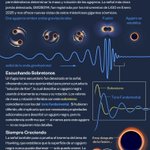
Hoy presentamos la señal más clara de una colisión de agujeros negros. Las ondas gravitacionales detectadas por @LIGO nos permiten poner a prueba nuestro entendimiento de los agujeros negros y el espacio-tiempo curvo, según Einstein y Hawking. Solo es posible gracias a la mejora de nuestros instrumentos en los 10 años desde nuestra primera detección!
Imagen: L. Reading-Ikkanda/M. Isi/Simons Foundation
#GW2501014 #OndasGravitacionales #Einstein #Hawking #LIGO
Maximiliano Isi retweeted
One month left to apply for a postdoc position at #FlatironCCA! Applications due 10/31: apply.interfolio.com/173403 #science #astrophysics
Maximiliano Isi retweeted
Thanks to improved technology and a bit of luck, a newly detected black hole merger is providing the clearest evidence yet of how black holes work: simonsfoundation.org/2025/09… #science #astrophysics
Maximiliano Isi retweeted
Almost 10 years after the first detection of gravitational waves, physicists have announced the strongest such signal yet.
Produced when two black holes in a distant galaxy spiraled into each other, the merger enabled researchers to test Albert Einstein’s theory of gravity, general relativity, in new ways. In particular, analysis of the event confirmed a theorem derived by Stephen Hawking that a black hole’s surface area can only grow and never shrink: scim.ag/3KaSCBE
Maximiliano Isi retweeted

Maximiliano Isi@maxisi10 Sep 2025
United States
United StatesConnected via United States App StoreAccount-level information, not a live location or per-post device.
Meet GW250114, a landmark detection of gravitational waves that gives us an unprecedented view of the nature of black holes and the nature of space and time, as predicted by Einstein, Hawking and many others.
journals.aps.org/prl/abstrac…
Maximiliano Isi retweeted
#FlatironCCA astrophysicist Maximiliano Isi and colleagues have used measurements from @LIGO to reveal insights into the properties of black holes and the fundamental nature of space-time, hinting at how quantum physics and Einstein’s general relativity fit together: simonsfoundation.org/2025/09… @FlatironInst #science #astrophysics
Maximiliano Isi retweeted
“That’s such a fundamental, pure theorem of general relativity that to see it verified is really fantastic.” scim.ag/3VFnX1Q
Maximiliano Isi retweeted
Our Center for Computational Astrophysics is #hiring postdocs! Come undertake independent research in areas that have strong synergy with #FlatironCCA or our other computational centers. Apply by 10/31: apply.interfolio.com/173403 #science #astrophysics
Maximiliano Isi retweeted

Maximiliano Isi@maxisi13 Sep 2025
United States
United StatesConnected via United States App StoreAccount-level information, not a live location or per-post device.
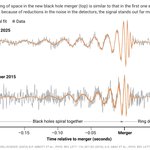
What a difference 10 years makes! I am thrilled that @LIGO's GW250114 will be featured on the cover of the @PhysRevLett just like GW150914, our first gravitational-wave signal, in 2016. You can see the detectors' improvement by eye: notice how much clearer the signal on the right is!
#GW10Years #BlackHole #GravitationalWaves #GW250114
Maximiliano Isi retweeted
“That’s such a fundamental, pure theorem of general relativity that to see it verified is really fantastic.” scim.ag/3VFnX1Q
Maximiliano Isi retweeted
"Strongest black hole collision yet confirms theories of Einstein, Hawking"
@hadriancho of @NewsfromScience writes about our discovery of #GW250114
science.org/content/article/…
#O4IsHere #EinsteinWasRight #HawkingWasRight #KerrWasRight 🔭🧪⚛️☄️

ALT A comparison of GW250114 with our first detection GW150914. The stretching of space in the new black hole merger (top) is similar to that in the first one ever spotted (bottom), but because of reductions in the noise in the detectors, the signal stands out far more clearly. Graphic by C. Bickel/Science. Data from us
Maximiliano Isi retweeted
Notable participación de la delegación uruguaya en la XVII Olimpíada Latinoamericana de Astronomía y Astronáutica, en Barra do Piraí- Río de Janeiro, Brasil.
La delegación obtuvo dos menciones de honor, dos medallas de bronce y una medalla de plata.
¡Felicitaciones!
Maximiliano Isi retweeted
Newly reported gravitational waves rang out as clear as a bell.
sciencenews.org/article/ring…
Maximiliano Isi retweeted
Ten years after scientists first detected gravitational waves emerging from two colliding black holes, a research team that includes @Columbia professor Maximiliano Isi, has recorded a new signal that confirms two important predictions.
news.columbia.edu/news/unpre…
Maximiliano Isi retweeted
Happy Birthday, LIGO. Now Drop Dead. nytimes.com/2025/09/10/scien… via @NYTimes
Maximiliano Isi retweeted
Ten years ago, we heard the universe for the first time. Now, we’ve heard it again... only louder.
OzGrav researchers, Neil Lu, PhD student at the Australian National University (ANU), and Teagan Clarke, PhD student at Monash University, explain!
Maximiliano Isi retweeted
A new study in @PhysRevLett analyzes #GravitationalWaves from GW250114, a black hole merger spotted by @LIGO earlier this year, and provides the most precise confirmation yet for a #BlackHole theorem by #StephenHawking. ⚫
Read the paper: go.aps.org/4n7hXuT
📷 Aurore Simonnet (SSU/EdEon)/LVK/URI
Maximiliano Isi retweeted
So fun to write about GW250114 for @PhysicsMagazine! We now have definitive proof that the surface areas of black holes increase, even when they merge (notwithstanding evaporation but that's another story.. )
Enjoy a quick read on this new result!
physics.aps.org/articles/v18…