

Melbourne, Australia
Joined October 2009
- Tweets2.2K
- Following600
- Followers439
- Likes1.2K





Martin Pretty retweeted

Who would have thought appointing a political scientist as the Federal Treasurer may have repercussions?
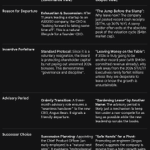
$170 yards discrepancy - Eye watering
Source: theaustralian.com.au/nation/…


It is along way down in priority but I guess at least they didn't bury the eighth dot point on another page - that being the point I presume is driving a halving of the stock price this morning.

Martin Pretty retweeted

The prime minister told the ABC to “do better” when it examined a Marrickville golf club grant. Here’s how that’s going… abc.net.au/news/2026-10-27/p…


Martin Pretty retweeted

For $2.24 BILLION market cap - this is what you get on the ASX 🫠🫠🫠
$4DX $1.6m cash receipts for quarter
🤦♂️

Martin Pretty retweeted

David Einhorn explains why the value investing industry has been defeated, and walks through how it leaves Greenlight as a "dinosaur"
“The market structure has changed, and there has been what I consider to be a broken market, or the value investing industry, I think, is defeated, so to speak."
"It used to be that most money was invested by these long-only investors, these big mutual funds and stuff like that."
"And they had money coming in every day, and they were getting nice fees on all of that money, and they had large research teams, and they would sit around following all of the companies with teams of analysts and they would say this company we think is undervalued by 30% and it might be a growth stock or a value stock or Magnificent Seven or otherwise, but they would say I think this is undervalued by 30% and if I buy it and I hold it I’ll make the S&P plus 30."
"Now as we’ve moved to passive they’ve lost their customers and the remaining customers are paying them lower fees and they have reduced their research staffs and they don’t have new money coming in to make new investments in any case."
"But the market is now dominated by passives, index funds, which buy what everyone else has already decided things are worth, or algorithms, which are basically trying to figure out what is everybody else doing and how do I front run that, or retail, which is buying things because they think it’s cool or they think it’s going up."
"And so most of the investing these days is no longer done by people who are buying something because they think it’s worth more. They have opinions about price, like what is the price going to be tomorrow. And so the result is most trading that is going on right now has nothing to do with value."
"So it leaves us sort of as a dinosaur. We’re one of the remaining few people left who are looking at things on a traditional basis.”

Dan Sundheim explains why real risk management has to happen before the trade, not after
“Yeah, you could follow Reddit tweets all day long, but what does that tell me? The stock went up 100%. There’s a bunch of people who like the stock. Obviously, if I read the Reddit, they like the stock."
"It went up 100%. There’s no information signal there. I know that people are buying the stock. I know that they’re buying the stock for a reason that I think is kind of silly."
"And the most important thing to me is that we just have to be able to ride it out. So whatever happens, risk management cannot happen after the fact."
"Anything you do after the fact is not risk management. It’s actually just destroying capital. Risk management has to happen before the fact, meaning you size these positions so that when it goes up you don’t have to cover."
"Anyone who says, ‘Oh, I risk-manage the portfolio because things were going against me’ -- if you’re a bad stock picker, sure. If you’re any good at stock picking, risk management after the fact is a bad idea."
"So we now size things... All I can do is size a position such that if they get excited and the stock goes crazy, we don’t have to cover it. We just kind of let it go and ride it through.”
Martin Pretty retweeted

Day 2 @AusMicrocap and @KylieMerritt talking Microcaps in and out of the market and the research vacuum. Fascinating. #ausmicrocap

Martin Pretty retweeted

I get it, there are nuances for tech-bros who are deep in the weeds. Everyone has an anecdote about why I’m wrong.
Take a step back and be a commodity-bro who’s seen enough supply/demand cycles. Tokens are a commodity. Currently, the token factories are out-stripping token demand. Pricing is the adjustment factor. Except token factories are mostly fixed-price businesses. They have take-or-pay. They have commitments. They will produce tokens at a loss rather than turn off.
I’m not saying that token demand is slowing. It’s still growing at astronomical rates. I’m saying that token production is now out-pacing demand. The cycle will turn when demand accelerates or token production slows. There’s like half a trillion $ of GPUs waiting to be installed. I don’t think token production slows anytime soon.
Yeah, I get it. Jevon’s and all. It’s great for AI consumers and innovators. But the guys owning token factories are gonna all go bust in the process, and that’s like $2T of capex to date. You cannot even restructure these things and crush the debt. They’re just stranded by new, and more efficient chips. They’re always going to be stranded by new chips. More efficient Models will strand the more expensive ones. It’s a race to the bottom against fixed costs. It’s the most godawful business misallocation I’ve seen in a while. Makes the Chinese look like prudent capital allocators🤣🤣
It’s like having iron rails when the new railroads run on steel. This bankruptcy cycle will be epic…


In a normal functioning ecosystem, when the price of tokens drops below the cost of production, the quantity of tokens declines to normalize with pricing. In this case, nothing in AI has any unit economics and you don’t see normalization because everyone is still going full-speed ahead with external funding. (Sort of like shale oil in 2016-2019). Meanwhile, compute prices are based on LT contracts that were signed at above market prices, and are now capital destructive. They’ll eventually catch down to token prices in free-fall.
What we’re seeing here is spot price negatively diverging from term pricing. Usually, when this happens in a cyclical industry, it’s INCREDIBLY BEARISH. Especially when there are take-or-pay contracts that make it difficult to ration supply at prices below cost. What we’re witnessing is a world where losses will accelerate, just as more supply comes online….



Martin Pretty retweeted

At an interesting seminar hosted by the Singapore Government Economic Investment Team


Martin Pretty retweeted

bill ackman on why large, boring companies now drop 25% in a day, something he says almost never happened when he started:
"a quarter of every american business, plus or minus, is owned by some combination of vanguard, state street and northern trust. when you shrink the float of a public company, the marginal buyer and seller is going to have more impact on the stock price."
"the marginal buyer and seller today is a citadel or a millennium. they operate with a large amount of leverage, very large gross books, and they're increasingly short-term."
"most investors are very short-term focused because they're compensated that way. they won't invest in a company unless they're confident the price is going to be higher on december 31st."
passive owns the float, pods set the price, and both are structurally unable to hold through a bad quarter. that inability is the opportunity.
Nice chart.

Breaking: Michael Burry says the AI boom is running on one giant loop and time is running out
Here's his breakdown:
1. Burry shared a report from Wall Street lender Ares tracking $573B of AI financing from the last 12 months
2. All of it runs through just 8 companies: Meta, Oracle, Microsoft, Amazon, OpenAI, Anthropic, Broadcom and Nvidia
3. They lend to each other, guarantee each other's debt and buy from each other, so one company's loan is backed by another company's promise to keep spending
4. Every deal depends on one thing: AI spending never slowing down
5. If AI revenue disappoints for even one season, the guarantees could all get called at once, right when the companies backing them are at their weakest
6. Burry says it's the same circular financing that turned the 2000 telecom fiber boom into a bust
Burry claims the stock market in the first stage of grief and the crash is soon

Martin Pretty retweeted

A few thoughts on the current state of venture capital.
When the Music Is Playing
In July 2007, a few weeks before the credit markets seized up, Chuck Prince, then the CEO of Citigroup, gave an interview to the Financial Times. The line everyone remembers is this one: "As long as the music is playing, you've got to get up and dance." He was mocked for it for years afterward, and he lost his job a few months later. But I have come to think he was saying something honest. He wasn't claiming the music would play forever. He was admitting that he couldn't sit down while it was still going, and neither could anyone else in his seat.
I've been thinking about that quote a lot lately, because right now is the most disorienting period in venture capital I can remember, and I have been doing this for a while.
Here is what makes it disorienting. It's not that things are bad. Some things are spectacular. We have companies in our portfolio growing faster than anything I have seen in my career, and I don't say that lightly. At the same time, we have companies with no revenue, no product, and a founding team you could fit in a conference room raising billions of dollars at valuations of $10 to $50 billion. Both of these things are true at once, and if you try to reason about them with the same framework you will drive yourself crazy.
Two ideas have helped me make sense of it. Neither is mine.
The first is reflexivity, which George Soros has been writing about since the 1980s. In most of life, perception follows reality: the weather is what it is, and your opinion of it changes nothing. In markets, it runs the other way too. Prices change what participants believe, and what participants believe changes the prices. The feedback loop can run for a long time, and while it's running it looks exactly like progress.
Here is how reflexivity is playing out in AI. Full disclosure: Menlo is an investor in Anthropic, so read the following with that in mind. People watched a frontier lab go from a $4 billion valuation to $18 billion, then $60 billion, then $180 billion, then $380 billion, and now something close to a trillion. They drew the obvious conclusion: that is what a neo lab looks like. So the next neo lab gets priced off that path, not off anything it has built. Then it gets marked up in a subsequent round, and the markup itself becomes the proof. Look at Thinking Machines. Look at Reflection. At that point valuation has stopped being an output of the metrics and has become the metric. Nobody is discounting cash flows. They are discounting the last round.
Soros is very clear about one thing, and it's the part people skip: you cannot know when or how a reflexive process ends. You only know that it does. Every one of them has.
The second idea is Chuck Prince's, and it explains why smart people keep dancing even when they can see the loop for what it is. As far as I can tell, there are two groups on the dance floor.
The first group got in early. Firms like ours were in some of these AI companies before the numbers got silly, and the paper gains are enormous. When you are sitting on gains like that, you start to feel like you're playing with house money. I have been around long enough to know that house money is the most dangerous kind, because you don't respect it the way you respect money you had to earn.
The second group missed the early rounds and knows it. Their LPs know it too. So they are trying to make up for lost time by writing very large checks very late, which is the one strategy almost guaranteed to turn a missed opportunity into a real loss.
House money on one side, FOMO on the other, and reflexivity feeding both. That's the whole story. Everyone has a reason to keep dancing, and the reasons are different, which is why nobody can talk anyone else off the floor.
So what do you do? The instinct in our business is to answer with company identification: just pick the right neo lab and you'll be fine. I think that's the trap. When price has become the signal, being right about the company is not enough, because you can be right about the company and still be wrong about the price by a factor of ten. The public-market investors I admire figured this out a long time ago. They spend as much time on how much to own as on what to own.
The winners in venture over the next decade will be the firms that treat portfolio composition and position sizing as seriously as they treat sourcing. How much of the fund is in companies whose valuation rests on the last round rather than on revenue? What happens to the portfolio if the reflexive loop breaks next year instead of in five? Those are not exciting questions. They are the ones that will matter.
The music will stop. It always does. Dance if you must, but know where the chairs are.
Martin Pretty retweeted

CHART OF THE DAY: The crisis in the oil tanker market.
The cost of hiring a supertanker from the Persian Gulf to the Far East has risen 12-fold in just a few months to a record high of >$1.1 million a day.
My @Opinion column is here: bloomberg.com/opinion/articl…

AI chatbots give wrong answers to financial queries ‘most of the time’ ft.com/content/c0cd359d-df84… via @ft


Martin Pretty retweeted

Regarding “the science,”this is something you all need to know.
Most published science is fake or false
This is out of Stanford University and the author here John P. A. Ioannidis is one of the most-cited individuals on Earth.

Martin Pretty retweeted

BREAKING: The gap between the US 10Y Treasury Yield and China's 10Y Government Bond yield rises to a record 324 basis points.
In other words, the US government's cost of borrowing relative to China's has never been higher.
Absolutely incredible.


Not a single dollar more for aged care: Federal Health Minister theweeklysource.com.au/not-a…
