

amateur astrophotographer🎓AS in space studies
- Tweets125
- Following443
- Followers96
- Likes5.6K






ALT A nighttime sky shows a bright rocket plume forming a large glowing halo with a wispy, swirling cloud above it, resembling a jellyfish shape. A small bright point marks the rocket high in the sky, leaving a narrow illuminated trail.

ALT A nighttime sky shows a bright rocket plume forming a large glowing halo with a wispy, swirling cloud above it, resembling a jellyfish shape. A small bright point marks the rocket high in the sky, leaving a narrow illuminated trail.

ALT A nighttime sky shows a bright rocket plume forming a large glowing halo with a wispy, swirling cloud above it, resembling a jellyfish shape. A small bright point marks the rocket high in the sky, leaving a narrow illuminated trail.





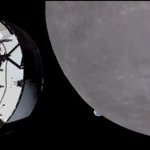
ALT The Moon, backlit by the Sun during a solar eclipse, is photographed by NASA\u2019s Orion spacecraft. Orion is visible in the foreground on the left. Earth is reflecting sunlight at the left edge of the Moon, which is slightly brighter than the rest of the disk. The bright spot visible just below the Moon\u2019s bottom right edge is Saturn. Beyond that, the bright spot at the right edge of the image is Mars. Credit: NASA

ALT A crescent Earth setting behind the Moon\u2019s horizon. Credit: NASA

ALT Earth setting behind the Moon as seen by the Artemis II crew. Over half the left side of the image is filled by the gray lunar surface, pocked with craters. Credit: NASA

ALT A close view of the Moon. Jagged circles of craters dot the gray surface, fading to dark on the left side of the image. Credit: NASA

ALT A crescent Earth setting behind a hemisphere of the Moon. Credit: NASA




ALT A full disk image of Earth, as seen from the Orion capsule. The planet is a pale blue, swirling with white clouds and glowing slightly lighter blue in place from reflected light. From about 8 to 9 o'clock, a large brown landmass is Africa, with the Iberian peninsula twinkling with lights just where the planet curves. At the 1 o'clock spot, aurora glow in a thin green glow, just barely separated from the planet's surface. Earth is set against the black of space. Credit: NASA/Reid Weisman

ALT One-third of Earth peeking through the window of the Orion capsule. The planet is a dreamy pale blue, swirling with white clouds and reflected sunlight. Although Earth only fills a fraction of the image it is the brightest object in the image by far. The capsule window is surrounded by a thick frame held in place with bolts, reminiscent of a heavy duty airplane window. It is dark in the capsule, but the outlines of straps and various components of the capsule are visible. Brighter white components are visible in the upper right corner. Credit: NASA/Reid Weisman


ALT NASA’s Space Launch System rocket and the crewed Orion spacecraft lift off from NASA’s Kennedy Space Center in Florida. Credit: NASA/Michael DeMocker