
A think tank and educational organisation working towards a world free from age-related disease. Founded by @statto and @shoylev.

Joined December 2025
The Longevity Initiative retweeted
I sadly can’t make it, but if you’re in Boston and want to chat longevity policy, regulation, funding and communication, please do grab a meeting with my @longevityinit colleagues Kamen and Sophie! We’re fundraising and looking for collaborators: xitter.cf/longevityinit/status/2…
The longevity science community is converging on Boston for @ARDD_Meeting and @agingbiomarkers, and The Longevity Initiative will be there! Our Director @shoylev and Researcher Sophie Shrimpton will be at the conference to catch up on the latest research, and with the people moving longevity science out of the lab. We’re fundraising, and looking for collaborators to bring regulation and public understanding up to speed with the latest breakthroughs in longevity science. We’d also love to hear your thoughts on the highest-impact things we could be working on. If you’d like to arrange to meet, you can grab a slot here: cal.com/thelongevityinitiati… See you in Boston!
2
2
8
630
The Longevity Initiative retweeted
I was pleased to contribute to a new @NatGeo article from Hannah Singleton out today exploring one of the more interesting questions in longevity science: Could GLP-1 drugs actually slow aging? It’s a thoughtful look at both the excitement around GLP-1s and the important uncertainties that remain. My view is that there is compelling evidence that GLP-1s can improve multiple aspects of health in humans. Beyond weight loss and glucose control, there are signals for cardiovascular, kidney, inflammatory, and perhaps neurological benefits. That makes me optimistic about the use of GLP-1 agonists in proactive healthspan medicine, potentially at doses and quite different from those currently used to treat obesity. But, do they slow aging? And if so, are they anything more than a pharmaceutical way to induce caloric restriction? The recent @Nature paper showing that semaglutide extends lifespan and improves multiple age-related phenotypes in mice is interesting. As I’ve commented publicly, however, the lifespan experiment did not include a calorie-restricted control matched for the reduced food intake caused by semaglutide. Weindruch and Walford showed in 1982 (DOI: 10.1126/science.7063854) that mid-life initiation of moderate caloric restriction increases lifespan in mice by almost exactly the same amount, in the same mouse strain background, as semaglutide in the current study. So, we still don’t know whether semaglutide is doing something fundamentally different from, or additive to, eating fewer calories. Regardless of the answer, I think these are extremely promising drugs when used carefully, in the context of high-quality nutrition and regular exercise, expecially resistance training to maintain muscle. In fact, GLP-1s could ultimately prove extremely valuable for extending healthspan, even if they don’t slow biological aging at all. Preventing or delaying several major causes of morbidity could have enormous value independent of whether we ultimately classify these drugs as true gerotherapeutics. For me, the most interesting next step is figuring out whether there are doses and protocols where the healthspan benefits substantially outweigh the risks, particularly in otherwise healthy middle-aged and older adults. That’s a question we can answer, and I'm optimistic the answer will be "yes". nationalgeographic.com/healt…
7
7
3
59
5,376
The Longevity Initiative retweeted
An interesting read for those in the longevity space xitter.cf/longevityinit/status/2…
1
2
127
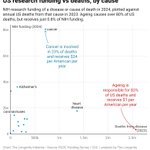
A fantastic complement to our whitepaper, kudos! The math on our current funding allocation within the NIH simply does not add up, and only by Realigning For Impact can we bring research funding in line with what really kills us. If @longevityinit's report, or ours has convinced you, we urge you to sign the petition to get this issue in front of your representatives! actionnetwork.org/petitions/…
Does NIH research funding track what actually kills Americans? Building on @theA4LI’s new report, we ran the numbers: and ageing fares worst. Ageing causes 83% of deaths, yet receives just 1.2% of the research funding per death that cancer does—around $1 per American per year.
1
4
1
21
911
The Longevity Initiative retweeted
New post: Can longevity save us from a population crisis? We tried out @OurWorldInData’s new population projection tool to see if increasing life expectancy could save us from demographic decline: thelongevityinitiative.org/2…
1
18
4
59
5,805
The Longevity Initiative retweeted
🚨 The Human Ageing Genomic Resources Are at Risk For over 20 years, our Human Ageing Genomic Resources (HAGR) have supported ageing and longevity research worldwide (200,000+ users per year, 1,000+ citations, widely used by academic labs and longevity biotech). Due to shifting UK government funding priorities, our infrastructure funding was not renewed in 2024, and these databases are now at risk of going offline. We are raising funds to cover basic server costs and secure their continuity while we pursue long-term funding. If these resources have supported your research, your company, or your thinking, please consider helping sustain them. justgiving.com/page/human-ag…
9
76
14
193
63,025
The Longevity Initiative retweeted
Billion-dollar bets on cellular reprogramming, biotech's rough year, and early FDA success for healthy lifespan extension in dogs. The biggest business news in longevity in the last year: thelongevityinitiative.org/2…
1
4
2
14
904
The Longevity Initiative retweeted
Just in time for Christmas, here are my top 3 tips for a healthier 2026! Watch this, and more details in the thread below…
3
11
4
33
2,606