
Senior EM, Engineering Enablement @mercari_jp / Building blissful platforms in the 🌥 / 🇫🇷🇧🇷 engineer living his dream in 🇯🇵 / Opinions are my own /日本語もOK
Tokyo-to, Japan
Joined July 2018
- Tweets1.1K
- Following521
- Followers619
- Likes2.9K

Raphael Fraysse retweeted

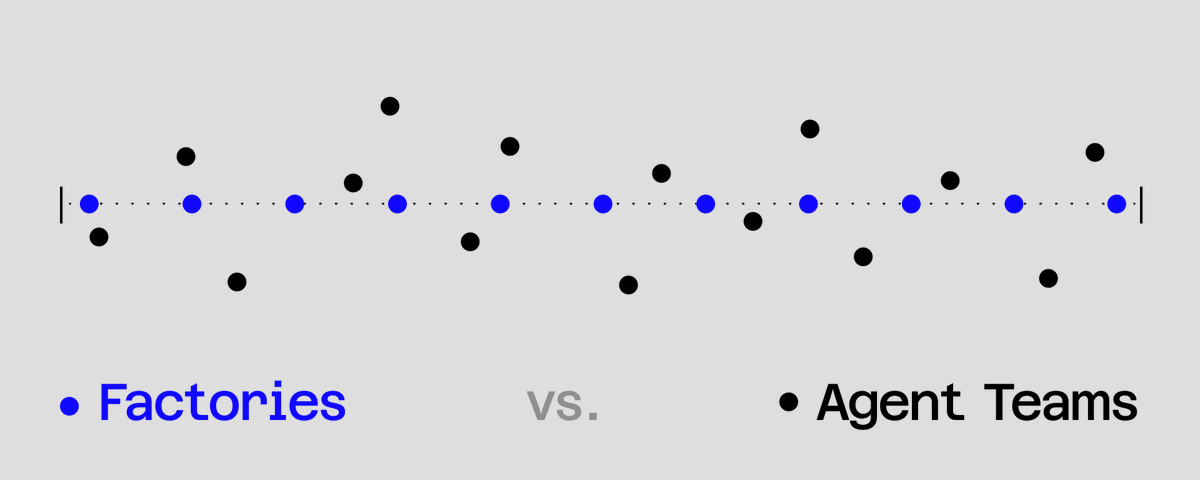
After two years of rapid change in software development, we are again at a crossroads, with two competing visions for what the future might hold:
- agent teams that we orchestrate
- software factories that we build, measure, and improve
Really impressive to see how much Uber is thorough in their agentic skills distribution, lots of great ideas to build off from, esp. the telemetry and feedback loop mechanisms.
Without evals and automated feedback loop it is impossible to scale these skills beyond a few teams.


3
207
Raphael Fraysse retweeted

We’re introducing Shirudo, an open-source Linux runtime allowing agents to defend systems without downtime. It lets agents write dynamic eBPF controls to shield systems from exploits, giving defenders more time to test and roll out patches. Built by @cisco together with OpenAI.
Shirudo is a first step toward self-defending infrastructure that can adapt to new threats while keeping services running. Our goal is for defenders to work with AI agents to find affected systems, test and share shields, and deploy them without disrupting workloads.
openai.com/index/introducing…

Raphael Fraysse retweeted

Distributed systems are hard to test due to inherent non-determinism in their execution traces. Unmesh Joshi describes how deterministic simulation allows reproducible execution.
martinfowler.com/articles/de…

Raphael Fraysse retweeted

A thousand years ago, I made a dent in dev envs with “Vagrant.” The most popular request always was “I want Vagrant for remote envs.” I’ve been asked this to this day!! I tried and failed many times. I made things that worked but didn’t work right. Well, Rex is done right. Rex is my answer, finally.
It’s always lived in the back of my mind no matter what I did. I would come up with something and try it and it didn’t feel right.
I got really close around 5 years ago to the point I setup a website branding etc (via HashiCorp). But at the last minute I pulled it. It still wasn’t right. I couldn’t explain why and didn’t have a better solution. I just knew it had to be binned.
Well, Rex is it. This is the real deal.
Rex is doing for remote development (and a lot more than just dev) what I think a proper solution should’ve done. It’s far more than just a dev tool but I think part of what I knew is once you reach into remote environments that line isn’t clear anymore. You have to solve both remote dev and remote prod.
Here we go, back to the beginning.
Raphael Fraysse retweeted

my AIE talk is up! come hear how the grok @bot team ships so quickly without compromise on quality
youtu.be/O_zcc6Xl12g

Raphael Fraysse retweeted

After the FAA disaster we're all operating in a high-take environment, which is why I'm tapping the sign.
how.complexsystems.fail/
Raphael Fraysse retweeted

I just finished talks about my software factories at two conferences. Afterwards a bunch of people came up and told me what they were surprised about. Here is a distillation of what people thought were hot takes from my two talks.
First hot take: I tell everyone to slow down. Most speakers go on about how fast they're going, but I strongly believe in pacing AI outputs to human speeds. I regularly tell AI-pilled CIOs and CTOs to chill: almost nobody is _actually_ going fast with AI. Engineering still moves at engineering speeds, and business moves even slower. The ones pushing too hard are starting to see downtime for it.
If you don't pace your AI to human speeds, everything starts breaking around you, even at small operations like my online video game. I only have about a dozen humans working with my factory, and only a few hundred active old-timer players in the community who get along well, and still, introducing AI has still been very rocky.
My agents have, at times, overwhelmed my players with features, my accountant with emails, my merge queue with tickets, and my machines with load. Agents have pissed off my admins, resulting in name-calling, they've made messes in the game, and they've launched broken OSS without permission. The list goes on.
I can get away with all this chaos because everyone involved in my operation is very forgiving. They're excited by the potential. But even so, I had to learn to slow down, real fast. And so that's what I preach.
Hot take #2: Should you buy a software factory? Do you even need one? No. You probably don't need one. Factories take an extraordinary amount of upkeep. They turn into garbage mountains unless you put a frightening amount of time and tokens into curating them. I had to burn my previous five factories down since it eventually became cheaper to rewrite them than to fix them. So I'm not out there advocating for software factories or swarms just yet. If you do want one, be aware that it is a significant commitment of both money and human leadership to keep one running.
Several people told me that I was the only one who stood up onstage, at either conference, and said Build, don't Buy. But my experience is that software factories grow to be highly bespoke to your domain. Mine is super tangled up with my game, and I think that's inevitable. Because the factory is not just building my product, it's supporting it too. It's a company in a box. And they're easy for Claude to build for you.
Third and arguably hottest take: Next year will have a lot of human/agent and agent/agent office drama, resulting from bringing in AI employees, and it will be gloriously funny, but also frustrating.
Many of you are already on this bandwagon, but everyone next year will have a personal chief-of-staff agent. Busy people, even hobbyists, will have whole entourages of helper agents. The hot take is that people will become so dependent on these little private entourages, that they'll bring them to work. Your people will talk to my people, etc. Whole protocols will emerge for private entourages negotiating work between humans, inside companies big and small.
Nearly all humans will wind up having to start working with AI employees next year, and it'll be the beginning of the biggest cultural change we've seen in a hundred years.
So that's the hot takes. Slow down. Only build a factory if you think you really need one. And focus on empowering yourself with your own agentic chief of staff (or team). Your entourage will define how you work with others, so start by perfecting how you work with them yourself.
Raphael Fraysse retweeted

SRE Meetupやります!
@rrreeeyyy くんと @ymotongpoo さんに登壇してもらいます.メルカリからは @hatappi さんから最近SRE Agentをゴリゴリ作っているやっていきの話をしてもらいます! ぜひ来てくれー
mercari.connpass.com/event/4…


Raphael Fraysse retweeted

We just shipped AWS Emulator, which gives coding agents a local copy of AWS to test against.
Early in my career, we built test environments like this by hand, one system at a time. Now, agents are writing code far faster than any team can check it in production. Matt Goldberg, a Senior Principal Engineer on our Developer Tools team, wanted to know whether agents could build and test those environments themselves. He gave @kirodotdev a single prompt, and about 15 minutes later it came back with a first version of an SQS emulator. Turing that into a robust solution took much more work
Here’s what I think this means for engineers today: allthingsdistributed.com/202…

Raphael Fraysse retweeted

recommended reading. classifiers are all you need. bonus points if you use an llm to generate labeled data to train idiot models and then replace the llm with it.
strandsagents.com/blog/amazo…

Raphael Fraysse retweeted
while i'm quite bullish on formal methods, i think it's worth tempering expectations and doing your own research on it (disclaimer: i am not an expert in it). it cannot guarantee your code is bug free, only that it matches the spec under certain assumptions, and the specs come from what people want, not math. as long as we build software for humans, nothing can prove that your spec is right, only you can judge.
i created the /statechart skill in pstack primarily because it helps make the state machines implicit in your code more obvious and legible to you, so you can shrink the review surface and review the work at a higher level: does it actually match your intent and goal? i used this skill a ton while building my game tibo.dog, below you can see the statechart for story mode where i was able to find many bugs with it.
in that sense, i think model checking (eg TLA+ with TLC) is quite useful for understanding and checking properties of your system e2e, and you don't have to write tons of new verification code for it. the spec isn't your actual code so there's always a risk of drift, but so far i've had good experiences finding actual bugs with it. i tend to pair it with empirical verification (running the code) also to confirm it's real
other types of formal verification like proving theorems (eg Lean, Dafny), bounded model checking (eg CBMC, Kani) etc have their own tradeoffs. proofs cover every possible input, but only for the properties specified, and it takes a lot more code/work. bounded model checking can run on your actual code, which avoids drift, but it only checks up to a certain number of steps, so it's better at finding bugs than proving there aren't any
so i think in the near-medium term you'll still need to layer your codebase: constraints and guardrails (types, lint rules, api design, refactoring), empirical verification (tests, evals, real usage), and formal verification for the parts that really need it. none of these catch everything on their own, but layered together, they catch a lot more and shrink what's left for you to review
but also maybe in the limit, the bitter lesson will prevail and flawless code will just be printed out perfectly every time with no bugs. even in that scenario, /statechart still seems very helpful in confirming that the agent understood your intent correctly. give it a try if you haven't already!
github.com/cursor/plugins/tr…

Raphael Fraysse retweeted

A mix of the techniques shown here, in short.
This has been my dream for nearly a decade now, and with agents I’m finally able to see this (partially) come true.
But turns out this is what I necessarily require to trust agent generated code. It’s not optional anymore, imo.

Raphael Fraysse retweeted

IaC isn't dying, it's becoming more essential. Non-deterministic layers add new volatility to the stack, but they don't break the core principles. For example, it's becoming more obvious that we want some layers to be truly reproducible.
Raphael Fraysse retweeted
We are building AX to be a Kubernetes for agents to be able to manage other agents. Our assumption is workloads will be provisioned and managed primarily via other agents not by humans. Agentic loop is the new job controller loop.
Raphael Fraysse retweeted

Agents reinvented how we produce code. It changed our tools and half of our workflow. It’s time for the other half to catch up.
Today, we’re shipping Entire: the Git forge for agent-human collaboration. We’ve built @GoEntire using Entire. Now we want to see what you'll build with it.
Here’s why and what’s different. 🧵
Raphael Fraysse retweeted
Two days ago, I was thinking that we made tooling hard for AI developers who need containers. I built aic, which works like Docker (for now) but will explore composition of images soon. Last night, generated code started to work. It runs things in isolation and copies the workspace etc.


