

Just a little goblin looking for the golden pot sharing information, discussing opinions, trading US and EU shares & options. No recommendations #DYOR
Joined March 2019
- Tweets3.2K
- Following320
- Followers3.3K
- Likes1.3K





Barclays´ EU team flags a potential shift in AI infra from “capacity at any price” to “capacity at acceptable returns.”
Anthropic/Nscale pricing implies forward compute economics well below recent scarcity-driven $CRWV /$SPCX AI levels, suggesting buyers are starting to push back.
Seeing mildly negative readthrough for US peers like $ETN $HUBB $NVT $GEV $CRWV if scarcity-driven pricing/margins normalize.
But also potential +ive readthrough for Hyperscalers and AI Labs with lower equipment and compute pricing improves ROI and can actually support more total AI deployment $AMZN $MSFT $GOOGL $META
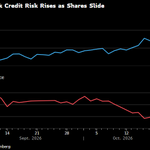
Softbank down 6% today after credit risks rise to a new 4y-high as concerns grow over AI-related funding.
Might be too obvious, but watching $ORCL again today for a potential readthrough with overall AI sentiment being a bit shacky today after the Korean Elice Inc. IPO desaster


SoftBank (-10% in its Asian session today) is the cleanest readthrough here so far: it’s basically a leveraged equity bet on OpenAI with its ~11% stake.
Oracle is a bit different here and arguably even riskier. It’s tied to +-$300B in compute and data center buildout.
If OpenAI demand wobbles, $ORCL isn’t just a valuation story but a balance sheet story.
Short $ORCL today and seeing it even lower than early ARCA prints around $167 but pls dyor!
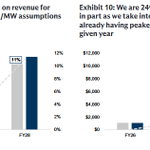
$CRWV upgraded to Buy at Goldman arguing the market is overstating financing risk and understating contract economics. Asset-backed DDTLs mean marginal funding costs look closer to ~7.5-10.5%, while new contracts around ~$13M/MW can still generate ~15% uIRRs; residual GPU value could push that toward 20-25%.
Positive for neocloud/AI infra peers with strong execution and financing access; also supportive for power, cooling, networking and storage vendors as enterprise AI deployment broadens. Biggest risk remains a future collapse in compute pricing once supply normalizes. $IREN $NBIS

Goldman Sachs just raised its global server TAM forecasts by 31% for 2027 and 45% for 2028, now approaching $1.6 Trillion (!!!) by 2028.
Both AI and traditional servers are driving the upgrade, fueled by AI infrastructure expansion, higher memory costs and richer configurations.


FinX discussing how $QQQ performs today and what a massacre this is ... but imagine you are a leveraged Korean seeing this - unable to react in any way, knowing the circuit breaker will enter the stage early monday ... that might hurt even more


$TSM ´s Wendell Huang "It is a bit too early to share the CapEx number beyond this year" ... it is October, when is the right time then?


$NVTS Wolfe has an interesting take here today (if you are interested in latest power developments):
Bottom Line:
800VDC looks like a real CY27 revenue inflection, not just a longdated theme.
Stock´s down 68% from this year´s highs with even the ALLATIS program news from late September being sold rapidly.
Sidecar bookings are already in backlog, mid-2027 ramp is expected, hyperscalers should lead GaN-based 800V to 50V adoption, and NVTS sees roughly $10–15k GaN and $5–8k SiC content per MW, excluding protection/IVR upside.
Might not be the classic daytrade but maybe smth to keep in mind for the mid-/longerm. Stock in kinda no man´s land at the moment so maybe things have to develop first.

$NVTS | Daytrading idea
800V moves from roadmap to backlog
Bullish thesis. Read today’s Hot on the Street:
tradersecho.com/home

Something you could have expected with most trackers showing compressed wait times for the $AAPL iPhone 18 pro ... I mean ofc you get it faster if less people want it!


NIKKEI: APPLE CUTS IPHONE 18 PRO ORDERS DUE TO SOFT DEMAND
"Component orders for this month have been cut by at least 15% from the volumes originally requested due to weaker-than-expected market demand for the iPhone 18 Pro series."
$AAPL


UBS (double) downgrades $BESI.NA to Sell and expects a delay for meaningful Hybrid Bonding adoption from HBM4e to HBM5 which means TCB / conventional advanced packaging lifespan extends.
Hybrid bonding is not “wrong” but the timing and tool-intensity may be wrong (for now at least).


$MRVL
"[...]On our August earnings call, we raised our outlook to approximately $18 billion. That represents 50% year over year growth, showing that even as the company gets significantly larger, our growth rate is actually accelerating. Now, today we're raising that outlook again. We expect approximately $20 billion in total company revenue in fiscal year 2028, representing about 67% year-over-year growth.
Within that, we expect data center revenue to grow approximately 80%. When we raised our fiscal year 2028 outlook in August, that increase was driven by interconnect, scale-up optics, and switching. The additional $2 billion of growth we are seeing for next year is being driven by the same trends. Scale-out optics continues to accelerate. Scale-up optics continues to grow. Our switching portfolio is firing on all cylinders. Once again, it is connectivity leading the race."
Knockouttrader retweeted

Citi raising their 2030 CPU TAM once again, this time to $300B, while at the same time raising $AMD pt to 800


Citi updates their CPU model, raising CPU TAM from $137B to $237B in 2030, with $AMD being the main beneficiary and $INTC the secondary.
"We update our CPU model post earnings and Hot Chips. We believe the CPU TAM expands from $29B in 2025 to $237B (previously $137B) in 2030, or a 52% CAGR. We expect general purpose CPUs to grow at a 21% CAGR to $52B in 2030, AI head nodes to grow at a 50% CAGR to $63B in 2030, and agentic CPUs to grow at a 230% CAGR to $123B in 2030. We model general purpose CPUs to represent 22% of the TAM in 2030, AI head nodes to represent 26% of the TAM in 2030, and
agentic CPUs to represent 52% of the TAM by 2030. For reference, Arm forecasted a TAM of $100B by 2030, $AMD forecasted a TAM of $220B by 2030, and Nvidia
forecasted a TAM of $200B.
With these updates, we now model total server CPU units to grow from ~30 million units in 2025 to 76 million units in 2030, or 21% CAGR (previously 17%). We believe Intel units could grow at 14% CAGR, $AMD units could grow at 31% CAGR (previously 25%), and Arm units could grow at 26% CAGR (previously 25%)
We adjust our 2030 share estimates with our updated model. By 2030, we expect Intel to have 46% share (unchanged), AMD to have 37% share (previously 35%), and Arm/Others to have 17% share (previously 20%). We are more optimistic about AMD’s near-term share opportunity with its leading TCO and supply allocation, as well as confidence in Intel ramping supply and improving yields. Most of our Arm shipment forecasts are coming from Nvidia Arm-based CPUs. We continue to expect $AMD to be the primary beneficiary of the CPU renaissance, and $INTC to be a secondary beneficiary given its manufacturing capacity and improving long-term roadmap."