

Blind monkey looking for a buck. Back-testing confirms I’m half right half of the time.
Europe
Joined April 2022
- Tweets1.1K
- Following287
- Followers2.5K
- Likes2.8K




Maybe long $GOOGL ss $AMD on this.. In addition, Keybanc had this to say about $AMD Helios ramp yday


Amidst this sea of red, JPM raises $GOOGL cloud ests. This selloff can't go on forever, right? Right?

Citi raising their 2030 CPU TAM once again, this time to $300B, while at the same time raising $AMD pt to 800


Citi updates their CPU model, raising CPU TAM from $137B to $237B in 2030, with $AMD being the main beneficiary and $INTC the secondary.
"We update our CPU model post earnings and Hot Chips. We believe the CPU TAM expands from $29B in 2025 to $237B (previously $137B) in 2030, or a 52% CAGR. We expect general purpose CPUs to grow at a 21% CAGR to $52B in 2030, AI head nodes to grow at a 50% CAGR to $63B in 2030, and agentic CPUs to grow at a 230% CAGR to $123B in 2030. We model general purpose CPUs to represent 22% of the TAM in 2030, AI head nodes to represent 26% of the TAM in 2030, and
agentic CPUs to represent 52% of the TAM by 2030. For reference, Arm forecasted a TAM of $100B by 2030, $AMD forecasted a TAM of $220B by 2030, and Nvidia
forecasted a TAM of $200B.
With these updates, we now model total server CPU units to grow from ~30 million units in 2025 to 76 million units in 2030, or 21% CAGR (previously 17%). We believe Intel units could grow at 14% CAGR, $AMD units could grow at 31% CAGR (previously 25%), and Arm units could grow at 26% CAGR (previously 25%)
We adjust our 2030 share estimates with our updated model. By 2030, we expect Intel to have 46% share (unchanged), AMD to have 37% share (previously 35%), and Arm/Others to have 17% share (previously 20%). We are more optimistic about AMD’s near-term share opportunity with its leading TCO and supply allocation, as well as confidence in Intel ramping supply and improving yields. Most of our Arm shipment forecasts are coming from Nvidia Arm-based CPUs. We continue to expect $AMD to be the primary beneficiary of the CPU renaissance, and $INTC to be a secondary beneficiary given its manufacturing capacity and improving long-term roadmap."
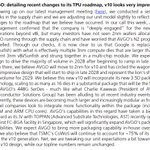
$AVGO strong positive read-through from UBS TPU checks:
UBS says $AVGO remains deeply engaged beyond v8i, with a new 3nm multi-chip design expected to drive most 2028 volume, followed by a 2nm v10 that could take the lion’s share of Google TPU volume in 2029.
v10 seen using up to 16 dies, AVGO 3.5D packaging and 448G SerDes.
Pretty direct pushback on the “AVGO loses $GOOGL after v8” bear case.

A more balanced take on $MU earnings and feedback from Wells' Rocha:
"MU: As the above picture indicates, a bit of a nothing burger in terms of giving investors meat to sink their teeth into. That was the headline point of feedback from most yesterday afternoon and last night. The tactical trade was/is playing the expected pending buyback announcement which MU can commence in December, after anniversary-ing a CHIPS deadline. The structural trade is playing the re-rate on margin stability and increase in visibility/commits from the SCAs. Yesterday didn’t give either camp much incremental to work with. MU effectively sounds good on FCF generation, they have now for a while frankly, but didn’t bite the buyback biting and so we’re now in a 3mo holding pattern until the NovQ print. On the structural side, there are now 26 SCAs up 63% QoQ with some extending out to 2031 and with S/D imbalance into C28. A little incremental for both camps, but again nothing to run home about relative to elevated buy side expectations. Bears were and are nitpicking at the GM% guiding being down QoQ% and margins broadly underwhelming relative to very heightened expects. One interesting point that came up in my convos is the suggestion that bit growth slows while Capex is set to inflect higher, and trying to square both of those impacts. There were rumblings/speculation that Idaho could pull-forward from my investor convos into the print, and now with this bits vs capex dynamic, I suspect that the prospect of supply hitting early becomes a bigger conversation point in the investor debate/narrative. The offset here is the effect of more mix-shift to HBM from conventional DRAM consuming more bit supply and generally the long equipment lead times. If we start to hear rumblings of DRAM pull-ins over the next few weeks and month, the question to me is whether that will be treated as a positive (rev-rec sooner) or negative (inevitable impact on pricing) for MU. For now, my sense is that $MU will sadly get the NVDA treatment from the HF crowd and be treated as a funding short – I definitely got some of that feedback last night."

$VRT $ETN positive read-through from Goldman's 800VDC expert call:
800VDC adoption is tracking slower than expected, with traditional datacenter power architecture likely staying relevant for much longer. For inference, GS says the main architecture change may be liquid cooling rather than a full power-stack redesign.
$VRT: longer runway for existing power + thermal infrastructure, while liquid cooling demand keeps scaling.
$ETN benefits too from a slower transition, with traditional electrical equipment staying in the mix while SST remains future optionality.
Could be a nice incremental positive for both names.
Citi looking past this latest AI scare:
"Continual Learning to Fuel HBM/eSSD Demand (AI Training/Inference)" $MU $SNDK $SKHY
CITI'S TAKE
Despite memory de-spec and recent AI safety concerns, we believe that continual learning in AI will reshape long-term memory demand. We see it driving memory demand across diverse products including HBM (AI training), server DDR5 and eSSDs (AI inference), leading to memory undersupply worsening throughout 2028E and persisting into 2031E. Amid the structural growth trajectory of the memory market, we highlight major potential beneficiaries.

JPM upgrading $IREN:
"Upgrading to Overweight; Deal Momentum and Execution Establishes IREN as a Formidable Neocloud; NVIDIA Support and Strong Industry Trends", pt from $46 to $65
Evercore bulled up in $DELL, sees FY28 EPS >$40 and path for the stock to $1,000.

Citi updates their CPU model, raising CPU TAM from $137B to $237B in 2030, with $AMD being the main beneficiary and $INTC the secondary.
"We update our CPU model post earnings and Hot Chips. We believe the CPU TAM expands from $29B in 2025 to $237B (previously $137B) in 2030, or a 52% CAGR. We expect general purpose CPUs to grow at a 21% CAGR to $52B in 2030, AI head nodes to grow at a 50% CAGR to $63B in 2030, and agentic CPUs to grow at a 230% CAGR to $123B in 2030. We model general purpose CPUs to represent 22% of the TAM in 2030, AI head nodes to represent 26% of the TAM in 2030, and
agentic CPUs to represent 52% of the TAM by 2030. For reference, Arm forecasted a TAM of $100B by 2030, $AMD forecasted a TAM of $220B by 2030, and Nvidia
forecasted a TAM of $200B.
With these updates, we now model total server CPU units to grow from ~30 million units in 2025 to 76 million units in 2030, or 21% CAGR (previously 17%). We believe Intel units could grow at 14% CAGR, $AMD units could grow at 31% CAGR (previously 25%), and Arm units could grow at 26% CAGR (previously 25%)
We adjust our 2030 share estimates with our updated model. By 2030, we expect Intel to have 46% share (unchanged), AMD to have 37% share (previously 35%), and Arm/Others to have 17% share (previously 20%). We are more optimistic about AMD’s near-term share opportunity with its leading TCO and supply allocation, as well as confidence in Intel ramping supply and improving yields. Most of our Arm shipment forecasts are coming from Nvidia Arm-based CPUs. We continue to expect $AMD to be the primary beneficiary of the CPU renaissance, and $INTC to be a secondary beneficiary given its manufacturing capacity and improving long-term roadmap."

$AVGO negative read-through from JPM’s MediaTek note:
JPM’s checks suggest MediaTek could overtake Broadcom in Google TPUv8 units in 2027 and become the primary vendor for TPUv9 in 2028. They also say they see no evidence of a competing Broadcom Pumafish project for 2028.
JPM estimates Google saves ~43% per chip by moving from Broadcom’s fully integrated model to the MediaTek semi-CoT setup.
Looks incrementally negative for $AVGO’s Google TPU share/content.

The sadomasochist in me wants to fade $DELL today, can't help it. Here's JPM's Meyers bull&bear feedback summary.
