Khyati Malhan (@kmalhan07) header
Khyati Malhan (@kmalhan07) profile picture
Copenhagen
Joined June 2015
Photo by Khyati Malhan (@kmalhan07)Photo by Khyati Malhan (@kmalhan07)Photo by Khyati Malhan (@kmalhan07)Photo by Khyati Malhan (@kmalhan07)Photo by Khyati Malhan (@kmalhan07)Photo by Khyati Malhan (@kmalhan07)Photo by Khyati Malhan (@kmalhan07)Photo by Khyati Malhan (@kmalhan07)Photo by Khyati Malhan (@kmalhan07)
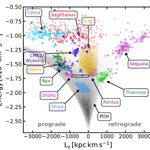
Discovery of two stellar structures in the orbit-metallicity space of our Galaxy. Shiva & Shakti appear to be two of those early, massive fragments that coalesced ~12 Gyr ago, forming the proto-Milky Way. Published in ApJ. arxiv.org/abs/2403.13051 @ESAGaia @APOGEEsurvey @mpi_astro
9
25
3
91
4,598
Milky Way’s Metal-Poor Stars display Chemical Transition near the Solar Radius. Accepted in ApJL. arxiv.org/abs/2508.08360 Results obtained using the data from @ESAGaia and @APOGEEsurvey .
1
129
Our paper made it to the “Selections from 2024” series that looks back at some of the most-read AAS journal articles published in 2024!
Selections from 2024: Possible Proto-Galactic Fragments in the Milky Way Two stellar structures discovered in the Milky Way this year may be fragments of proto-galaxies that formed before our galaxy was assembled. aasnova.org/2024/12/23/selec…
1
154
A schematic overview of MW-mass satellite systems in Local group and beyond (taken from arxiv.org/pdf/2404.14498) #dwarfgalaxies2024 conference in #Durham
2
4
17
1,256
The GD-1 stream surrounded by a "stellar cocoon" in the @desisurvey data! By @monica_valluri et al.
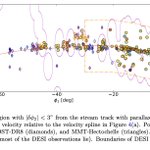
The GD-1 stream shows clear evidence of a broader hotter “cocoon” in DESI Early Release data: arxiv.org/pdf/2407.06336! More data on the way.
1
12
710
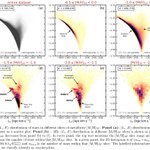
Evolution of merger stars in the (Lz, E) space of a Milky Way analog in the TNG 50 cosmological simulation. youtube.com/watch?v=qGNtSWwk…
1
1
269
The Gaia-Sausage/Enceladus stars, which were previously hypothesized to have originated from an ancient (8-11 Gyrs ago) merger event, likely came from a more recent (< 3 Gyrs ago) event, now dubbed as the Virgo Radial Merger (VRM).
📢 @ESAGaia reveals that the Milky Way’s last major collision was surprisingly recent! Gaia unravels our history by studying the wrinkles created by collisions, but there's a catch. Like Benjamin Button, our galaxy is getting less wrinkly over time 👉 esa.int/Science_Exploration/…
2
1
4
1,292
A webinar I gave @Swinburne, hosted by Prof. Duncan A. Forbes, on "The LMS1 stellar stream: A very metal-poor fossil remnant of our Galaxy's formation". youtube.com/watch?v=6mtrAz5l…
6
273
A talk I gave for the "@IAU_org Commission H1 - The Local Universe" seminar, on the topic "Atlas of Milky Way mergers created using the @ESAGaia dataset". youtu.be/soabSPRFims?t=129
1
2
13
557
Galactic map of #StellarStreams detected in the @ESAGaia dataset. Each star in the stream represents an actual Gaia source, color-coded by heliocentric distance (as computed by the STREAMFINDER algorithm): blue for nearer (~1 kpc) and red for distant (>~30 kpc).
1
15
3
65
6,215
Thanks to @StefanPWinc and the team for this amazing visualization.
3
622
At #EAS2022, presenting my work on the Milky Way's stellar streams, globular clusters, dwarf galaxies and mergers using @ESAGaia dataset. – at Valencia, Spain
2
1
29
Last week attended the conference "Stars to Galaxies II" @chalmersuniv Gothenburg. #Astronomy #Sweden – at Gothenburg, Sweden
6
Euclid said in 300BC (to King Ptolemy): "There is no royal road to geometry, my majesty". Today, maybe we can rephrase this original statement (in the context of @ESA_Euclid) as "There is no royal road to the geometry of the Universe; but it's still totally worth it". #euclid2022 – at Oslo, Norway
1
1
3
#euclid2022 Had the pleasure of chairing one of the sessions during @EC_Euclid meeting.
1
I'm excited about my first 'single-author' paper, now accepted for publication in ApJ. I study the characteristics of the "Pontus" merger of the Milky Way using #GaiaEDR3 and @APOGEEsurvey data. arxiv.org/abs/2204.09058 @ESAGaia @mpi_astro @AvHStiftung @IAU_org @The_Gruber_Fdtn
1
9
53
1> Pontus was recently discovered as a grouping of ~7 globular clusters in the action (J) and energy (E) space; arxiv.org/abs/2202.07660. These GCs also show a tight age-metallicity relation – again supporting the accretion scenario from a gradually enriched satellite galaxy.
1
3
The 2nd key result of our paper: The 3 most metal-poor streams of the Milky Way – "C-19" (FeH=-3.4), "Sylgr" (FeH=-2.9), "Phoenix" (FeH=-2.7) - are associated with the “LMS-1/Wuk.” merger, showing it to be the most metal-poor merger of our Galaxy. arxiv.org/abs/2202.07660
1
3
LMS-1/Wukong comprises 11 objects, and its metallicity distribution function (MDF) is quite broad, with a minimum of [Fe/H]=-3.4 dex. Note that this MDF figure is based on the [Fe/H] measurements of globular clusters and streams.
1