

A new writing system developed for writing Yorùbá.
Joined July 2024
- Tweets595
- Following63
- Followers366
- Likes2.5K






[1/2]
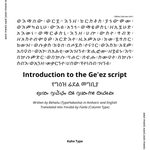
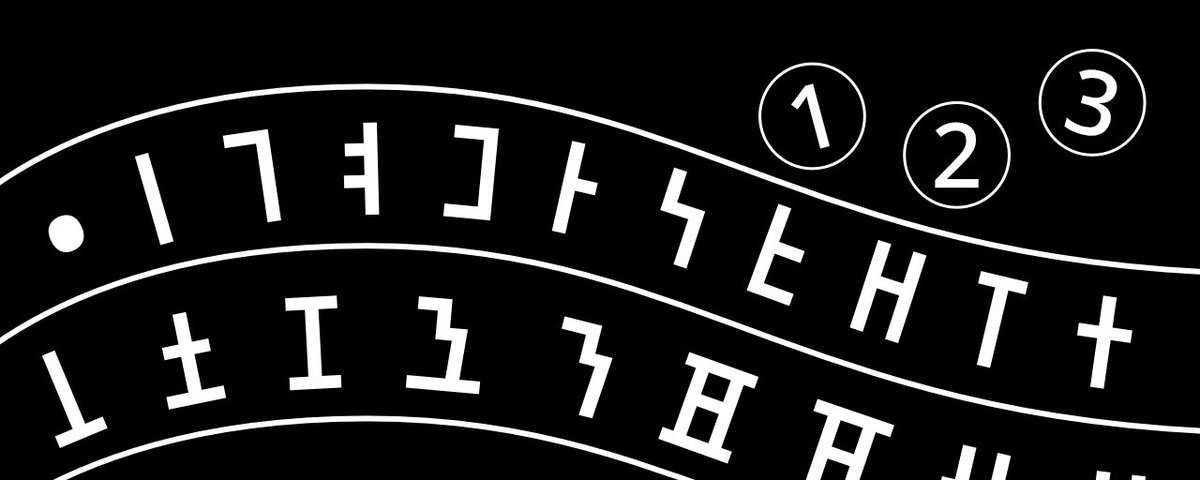
I and an Ethiopian started Kọhe Type on Instagram (kohetype) a while back, focused on font design and development. It is our design lab where we experiment with ideas, learn from each other and beyond, and improve our practice.
The name Kọhe is a bringing together of Yorùbá and Amharic. "Kọ" meaning to write in Yorùbá, and "he/ሄ" which is a syllable letter taken from "ሆሄ/hohe" which as a word stands for another way of referring to the Ethiopic script.
Part of our core focus is language use and representation in the font design space. We make use of Amharic, Yorùbá, and English. This is our first written piece briefly explaining the Ethiopic script.
In referring to the Ethiopic script in Yorùbá, we made use of the preferred Ethiopian term "ፊደል/Fidäl", Yorùbánised as "Fídẹ́lì" rather than a Yorùbánisation of "Ge'ez" or "Ethiopic".
Just like with Kikọ, the Ethiopic script is an Abugida writing system but one with a very long history. It is the oldest African writing system still widely used today, perhaps second only to the Coptic script.
More Images in second tweet
Our Instagram - instagram.com/kohetype/


The kikọ script retweeted

‘Ebi ń pamí’ is usually translated as ‘I’m hungry’. That simple translation doesn’t do justice. Literally, ‘ebi ń pamí’ suggests ‘hunger is killing me’ or ‘I am dying of starvation’. It’s almost like saying the process of experiencing hunger will result in death if you don’t eat.

[1/2]
Final touches to the Ésàn language supplemental letters spoken in Ẹdo state. I have been tugging with the Ésàn language issue for months ever since a follower that speaks the language considered I take a look at the language and attempt a possible design specific to the language.
I felt the previous designs did not do real service to the language both in terms of beauty and functionality. One of the issues was that although I had designed some of the letters, there was no efficient way of actually using it in typing. You could type the base letters but not its tonal variants. The other issue is that it did not fit into the broader Kikọ design language. It made use of a design language that looked a bit too different from how the core of the script operates. In this update, we have rectified all these issues.
Another reason I felt strongly about the Ésàn language was that they had sound inventories that although not included in standard Yorùbá, are present in some of the dialectical variants of the language.


[2/2]
Lastly, although Ésàn is a tonal language, most (if not all) readable documents don't have the tones marked. I was surprised that even the Bible translation available on the JW website, usually done by Experts of the language, had not a single tonal marking throughout the text. I suppose the Ésàn linguists have settled on not indicating tones in the standard orthography.
Font update reflecting all updates to the script will be announced soon for device usage.


The kikọ script retweeted

Gèlè is Gèlè. Names are how a culture keeps credit for what it made. Lose the name, and in one generation nobody remembers where it came from. #GeleIsGele
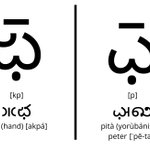
Like clockwork, we still have people confusing the IPA written form of the Yorùbá "p" sound [kp] as me making a statement on it being part of the standard orthography even after writing "apá" as a hint to its orthographically correct form.
Curiosity is a sign of intelligence. When you observe people write a word adding "kp" to sound out the Yorùbá "p" sound, you ought to wonder why. In many west African languages in Nigeria, they have both the [kp] sound and a [p] sound similar to that of English. In those languages, in order not to cause confusion, they write "our" Yorùbá "p" sound as "kp", and the other [p] sound in the retained "p" letter form.
Our Yorùbá orthography dictates we write sound [kp] as "p" because unlike some of those west African languages, the "standard Yorùbá language" does not have a [p] sound. If we did, we would either have had to use "kp" like in other languages, keep using letter "p" to sound out two separate sounds, or modify that "p" letter by adding a mark.
Someone made an argument in the Quoted tweet that in Yorùbá, sequences of consonants are not written together. That is an orthographical lie that even Yorùbá people do not believe. Immediate Proof? We write sound [gb] as "gb".
In addition, why is the Yorùbánised name for Christ written as "Kristi/Kiristi". It is a Yorùbánised word, why not go all the way and write it as "Kirisiti" or just use the English written form? Another is the Yorùbánised word for Chrisitian which is often written as "Kristẹni/Kiristẹni" why not "Kirisitẹni" to make the Consonant-vowel law iron clad. After all, for instance, the Japanese maintain this strict consonant-vowel sequencing in written form even when writing the Japanified religious names from other languages like the aforementioned.
-Shameless Kikọ promotion incoming!
When you use a borrowed writing system for your language's orthography, you also open the doors to other types of borrowings you may not like, "that's just the way it is 🎵". You can only curb this through intense mother language education and a culture of book reading in that language to reinforce orthographical correct rules, but even that has it's natural limits. Inevitably, especially in this digital age, people will choose to write certain things similar to that of their surrounding neighbours. Especially when they share similar sound inventories.
So why not come onboard to Kikọ island, it's only Yorùbá for the most part. We uphold the strict consonant-vowel rule, but we also have accomodations for consonant sequencing. We have a systematic way of writing foreign sounds. What's more, we offer a beautiful view, easy to write about, sketch, and paint.

Learn Kikọ and you will feel relaxed. Be part of the "Ẹgbẹ́ akẹ́kọ̀ọ́ Kikọ" movement.
kikoscript.org/

Learn Kikọ and you will feel relaxed. Be part of the "Ẹgbẹ́ akẹ́kọ̀ọ́ Kikọ" movement.
kikoscript.org/


The kikọ script retweeted

It’s actually a fact. The problem is that some of you have decided to see being Yoruba (insert any other ethnic group) and being Nigerian as competing identities.
When you layer identity from the smallest to the broadest, you would understand.
Being Yoruba is your cultural/ethnic identity. Being Nigerian is your National and Political identity. The name “Nigeria” was coined less than 130years ago, to describe the geographical areas surrounding the River Niger (Niger-Area… Nigeria), and later to classify peoples’ of the ethnic nations in the geographical area.
Nigeria became a country 112 years ago right after the amalgamation. Every single ethnic identity in this country existed long before then.
So, saying you’re Yoruba before being Nigerian does not mean you are demoting your Nigerian political and national identity. It is recognizing that in the order of identities, your ethnic and cultural identity predates your national identity and guess what?? both can be comfortably accommodated without issues.


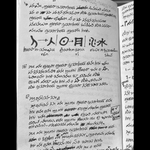
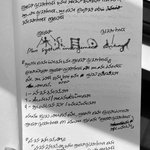
Journal note from one of our followers (soyabee_cw0) on Instagram.
Send us your pictures writing Kikọ to get featured.

Diversity is only a strength when every group knows their place in that system. You can not have diversity with competing voices for dominance.
When you have a group seeking to spread out into the spaces of other groups to occupy their space, you will have a cancer problem. Cancer problems are faced either through aggressive treatment that weakens the entire system for a while, cell population control, total removal of cancerous cells, or management of cells. In some cases, the cancer cell wins and overrides the rest leading to the death of the entire system.
This happens in biology with cells, in nature with invasive species, and in human history with population migrations.
The kikọ script retweeted
A while back I responded to @kokokolarotiadi regarding the numeral system as it is handled in the Kikọ script. Many people struggled with understanding how you write the numbers using the Kikọ numbers, so I promised I will do a write up on the topic.
Truth be told, I did not feel comfortable with the design of the numeral system. I felt a lot was still unexplored. So I took the time to do some redrawing and further studying.
The Yorùbá numeral system has some peculiar advantages to it that can not be dismissed in the realm of numerical computation. If you notice, as you likely will after the reading the first article, the whole system is broken into chunks that form a pattern. It is this pattern, that makes it possible so that large numbers can be said in many ways while still being understood to proficient language speakers.
Let us slowly unravel this pattern together, from 1-1 million and beyond.
Read, like, retweet, and comment your thoughts under the article page.

The kikọ script retweeted
What we have in many African countries today is a continuation of the colonial process by 'colonial-minded' elites. The more reason we must adopt Yoruba language in old 'Yoruba countries'. We have wannabe leaders who do not care to learn the local language. Colonial mentality.

A while back I responded to @kokokolarotiadi regarding the numeral system as it is handled in the Kikọ script. Many people struggled with understanding how you write the numbers using the Kikọ numbers, so I promised I will do a write up on the topic.
Truth be told, I did not feel comfortable with the design of the numeral system. I felt a lot was still unexplored. So I took the time to do some redrawing and further studying.
The Yorùbá numeral system has some peculiar advantages to it that can not be dismissed in the realm of numerical computation. If you notice, as you likely will after the reading the first article, the whole system is broken into chunks that form a pattern. It is this pattern, that makes it possible so that large numbers can be said in many ways while still being understood to proficient language speakers.
Let us slowly unravel this pattern together, from 1-1 million and beyond.
Read, like, retweet, and comment your thoughts under the article page.