

Economist covering repo, Treasuries, money markets: markets that work quietly but fail loudly. Views my own.
Washington, DC
Joined October 2014
- Tweets1.9K
- Following337
- Followers3.3K
- Likes2.3K





Pinned Tweet
Why is it hard to pin down the "right" size for a central bank's balance sheet?
Our note breaks down the tradeoffs involved. 👇


What’s behind the saw-tooth in Canadian Treasury holdings and money-fund repo to Canadian banks? Mostly the well-known window-dressing by dealers around reporting dates. But I think it masks the bigger takeaway.


First, while I do note the increase in the holdings of LT UST & Agency bonds by Canadian residents in TIC, I also have previously shown that the month to month variation in these holdings is a function of US MMF repo lending to Canadian residents...2/n
xitter.cf/EtraAlex/status/194597…
My first Anne Carson was her Sappho, "If Not, Winter." The translations were affecting, what struck me was how she kept the gaps where the words are now lost.
Maybe that’s not for everyone? But to me it says something true about memory, and how the past keeps slipping away.

Jay Kahn retweeted

2026 Nobel Edebiyat Ödülü’nü kazanan Anne Carson’ın Nobel Komitesi’yle yaptığı telefon görüşmesi:
“Reykjavik’teki evimde çay içip London Review of Books okuyordum. Yerleri süpürmeye kalktığımda telefonlar çalmaya başladı. Hepsini kapattım. Eşim zorla geri arattı. Eşim “Aç şu telefonu artık. Belki de Nobel’dir” dedi.”
Şu anda nasıl hissediyorsunuz?
— Sadece kraker yiyip çay içiyorum. Pek dramatik bir durum yok.
Nobel’i bekliyor muydunuz?
— Tanrı aşkına, tabii ki beklemiyordum. Bence hepiniz çıldırmışsınız.
Nobel sizin için ne anlama geliyor?
— Hiç düşünmedim. Sadece parayı nasıl bağışlayacağımızı düşünüyoruz. Evi olmayan bir arkadaşımız var. Bir de Sınır Tanımayan Doktorlar’a bağış yapıyoruz.
Nasıl kutlayacaksınız?
— Telefonlara cevap vermek zorunda kalmamak için ormanda yürüyüşe çıkacağız. Sonra sessizliği dinleyeceğiz.
Yazarlığınızı nasıl tanımlarsınız?
— İstemsizce. Hep başka bir şey yapmaya çalışırken oluyor.
Kitaplarınızı okumaya nereden başlamalı?
— Herhangi bir yerden. Ben hep ortadan başlayın derim.
Yeni bir kitaba nasıl başlarsınız?
— Ortadan. Tek kuralım bu.
İlham kaynağınız?
— Homeros.
Antik hikâyelerin bugün hâlâ geçerli olmasının nedeni ne?
— Geçerli değiller. Onların bizim için geçerli olmasıyla ilgilenmiyorum. Bizim onlara layık olmamızla ilgileniyorum.
Sıkılmaktan kaçınmak neden önemli?
— Kim sıkılmayı sever ki? Uyumak mı, Homeros okumak mı? Günün geri kalanında ne yapacağıma böyle karar veriyorum. Hayat sıkıcı.
Genç yazarlara tavsiyeniz?
— Ortadan başlayın.
Jay Kahn retweeted
In today's post, the authors show that trading in U.S. Treasury securities is becoming more concentrated around the designated pricing, or “strike,” times for fixed-income indexes. The concentration is especially pronounced on month-end trading days. nyfed.org/4cWqSfH

Ellen's thoughts in this interview with @DavidBeckworth are very worth a listen: mercatus.org/macro-musings/e…

Jay Kahn retweeted

New #IFDPPaper: Estimating Yield Impacts of Treasury Demand and Supply Changes: federalreserve.gov/econres/i… #EconTwitter

Agree the doom and gloom on the basis trade goes too far, BUT:
1) The basis trade is NOT the swap spread trade. April 2025 was mostly about swap spreads.
2) Demand for leveraged duration IS how growing Treasury supply gets absorbed. So the two are intimately related.


3) Finally (and I hope this is the last time I have to say this) the other side of the basis trade is NOT insurance companies or pension funds, it's largely mutual funds and SMAs.
xitter.cf/jstatistic/status/1786…
1/🧵 We just put out a new paper putting numbers to a mystery I've been working on since 2020: who is behind the almost $2 trillion increase in long Treasury futures positions?
Spoiler alert: it's mostly mutual funds but the cool thing is why.
Link here: papers.ssrn.com/sol3/papers.…

This last point is important because it goes back to 2): One reason asset managers are demanding more long futures is *because* increasingly Treasury supply is driving up the duration of the agg benchmark.
xitter.cf/jstatistic/status/1786…


... because what you would need absent hedge funds is actually a big *increase* in pension allocations towards Treasuries.
Issuance has simply been outpacing AUMs.
So even if there was *no* pullback you'd still need new holders to absorb the flow.

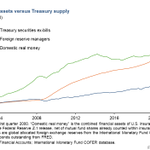
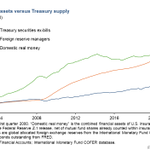
This may be true for the EU, but as @dismalscience and I point out, in the U.S. main driver may simply be the rapid growth of outstanding Treasuries relative to real money AUM.


Why are hedge funds now absorbing a much bigger share of issuance in sovereign bond markets in the US, the Eurozone and elsewhere? Because a decade of QE (and low yields) permanently changed the nature of financial intermediation, and hence the portfolios of insurance companies, pension funds and other financial intermediaries who were traditional buyers of long-dated government bonds.
Terrific work on this topic by @matteoleombroni together with Ciaran, Philippe and Stelios.🧵

Here's the article: dallasfed.org/research/econo…
