

@UNICEF Chief Statistician and Deputy-Director heading its Data & Analytics Section. Committed to giving voice to #everychild. Former @worldbank #SefazRJ #IPEA
Manhattan, NY
Joined February 2013
- Tweets7.5K
- Following1.1K
- Followers5.2K
- Likes12.2K







Pinned Tweet
High-income parents teach their children independence, low-income parents teach obedience. The evidence in the graphs below is striking.
An interesting theoretical model on how family values interact with social mobility.
buff.ly/3j4DGrx

João Pedro Azevedo retweeted

...some rethinking is needed of how development and humanitarian aid is provided, in world in which increasing numbers of the poorest people live in fragile or conflict affected countries...

I rather enjoyed writing this paper.
"A development bargain = elite bargain characterised by an elite commitment to pursue development. Aid works best where it exists, yet is needed most where absent. This paper maps what outsiders can do in such places." wider.unu.edu/publication/wh…
Anticipatory action rests on a simple idea: act before the shock, on a forecast, with the plan and the money already agreed. A forecast tells you where a flood, a drought or a displacement will strike. Only a baseline tells you whom it will strike hardest, and how many of them there are. You cannot anticipate what you have never counted.
For three decades, the MICS programme has helped member states produce that baseline in the hardest places: nationally owned, internationally comparable data on children from Afghanistan to Yemen, Iraq to Somalia, the State of Palestine to Ukraine. Today 35 of the 39 economies on the World Bank's fragility list take part, and 23 of the surveys in the current round are in those economies.
What makes that possible is an approach, not a one-off effort, and it follows the same logic as pre-arranged financing. Anticipatory action works because the finance is agreed in calm, not negotiated in crisis. Data has to be pre-positioned the same way: collected before the shock by national statistical offices, with UNICEF technical assistance, to a common global standard that measures the health, nutrition, learning and protection of children, women and families comparably across countries and over time. The data belongs to the country; the standard is shared by the world.
The chart below shows the reach: 427 surveys across seven rounds since the 1990s, with the darker blue marking fragile and conflict-affected economies in every round. "Fragile" is not a synonym for "unsurveyable", and a survey fielded in a quiet year is what gives a trigger its meaning in a bad one.
That is why child- and family-centric surveys belong in the FCV data architecture as its foundational, nationally owned layer: the comparable baseline that faster, lighter instruments (rapid assessments, early-warning feeds, remote monitoring) are calibrated against, not a substitute for them. It is the no-regret investment of the data system, useful whether or not the shock arrives. Without it, early action is sized by guesswork, and the most vulnerable children, women and families go uncounted exactly where and when acting early matters most.

On Tuesday in Berlin, countries take the floor on the future of demographic and health data.
At the World Health Summit (#WHS2026), the Inter-Secretariat Working Group on Household Surveys (ISWGHS) and the Gates Foundation are co-hosting a side event on what a sustainable future for these surveys in low- and middle-income countries should look like.
I will open the session as ISWGHS Co-chair, alongside Dr Anita Zaidi of the Gates Foundation, but the most important voices in the room will be national ones. Senior officials from the national statistical offices of Ghana, Malawi and Tanzania will share with ministries of health and other health data users what they have been trialling since the 2025 DHS funding shock: new implementation and financing models, and new uses of survey data for health planning.
Five things to get right — three the ISWGHS Task Force and its partners have already identified, and two I will add from UNICEF's perspective:
→ Country leadership and ownership of future surveys
→ Diversified, coordinated financing that no longer depends on a single donor
→ A whole-of-system view, where surveys, CRVS and routine health data complement one another
→ A differentiated approach for an unprecedented demographic transition. Ageing societies and countries with a child and youth bulge need different survey modules and emphases — care, chronic disease and intergenerational support in one; early childhood development, adolescent mental health, learning and skills, and reproductive health in the other — if the data are to inform multisectoral policies and programmes
→ Resilience across time. Within a generation, a lost year of nutrition, early learning or schooling is human capital lost for fifty years; between generations, a society that can only finance care for its elders by under-investing in its children is not resilient either. Future surveys must see both the life course and the transfers between generations
The outcome: an opportunities paper from the health sector's perspective, feeding the Blueprint due at the UN Statistical Commission in February 2027.
UNICEF will be there with two of us: Andrea Rossi, Chief of our Data Collection Unit and Global Coordinator of the MICS Survey Programme programme, and me, UNICEF Chief Statistician.
Through MICS and our country offices, and as a partner in the ISWGHS Task Force, UNICEF stands ready to support national statistical offices on this path.
If you are at #WHS2026, reach out to either of us — we would love to hear your take on this agenda. I will share what we hear.
#HouseholdSurveys #SDGs #DataForChildren #DemographicTransition

Launched at #UNGA81: the UN System Data Commons puts official statistics from across the UN in one place, ready for AI.
Try, Learn, Share
#UN80 #UNSystemDataCommons
linkedin.com/posts/unga81-ai…

Last week, the UN Secretary-General launched the UN System Data Commons: one gateway to official statistics from across the UN system.
One feature deserves more attention: you can connect it directly to the AI tool you already use (Claude, ChatGPT or Gemini). Instead of answering from memory, the AI retrieves official statistics from the source, and every figure can be traced back to the agency responsible for it.
To make this easier to try, I put together a short guide:
▶️ A narrated walkthrough of how it works
🛠️ A step-by-step setup guide for Claude, ChatGPT and Gemini
📊 Three examples to try: an infographic, a peer benchmark, and a country brief on the situation of children
👉 claude.ai/artifact/MuGrNpmoH…
A few things worth knowing:
• The system is federated. It connects the data platforms of UN entities rather than replacing them, and each keeps custody of its data.
• These are official statistics on countries, from countries, for countries, in many cases supported or harmonized by UN agencies.
• AI makes the data easier to reach, not automatically right. Always check the figures against official sources before using them.
I'd love your feedback. Try the setup, run one of the examples, and tell me in the comments:
1. Did the setup work in your tool of choice?
2. Where did you get stuck?
3. What would make this more useful for your work?
#OfficialStatistics #UNData #SDGs #AI #DataForChildren #UNGA #UN80 #UNSystemDataCommons #UN2Point0


The UN System Data Commons is live.
Statistics from across the UN system, searchable in plain language, AI-ready, and traceable to the original UN source.
26 UN entities committed, nearly 20 at launch.
Thanks to our Google partners.
data.un.org/
The UN System Data Commons is live: UN statistics, data from 26 agencies, searchable in plain language and AI-ready.
Why it matters: a UNICEF working paper tested 6 LLMs on 133,000+ responses. Average accuracy: 21.2%.
Thank you, UN System partner agencies, and Google Data Commons team.
@TechCrunch: techcrunch.com/2026/09/17/un…

Official stats + AI is exploding: 45+ MCP servers (and counting fast) now wrapping NSO, UN, World Bank, and UNICEF data. Duplication is everywhere and standards are lagging.
We spent decades building interoperability and comparability for data. We are still missing the equivalent governance layer for how AI consumes and reports official statistics.
Check out this landscape piece; and help us locate other MCPs on official statistics. Just share their link in the comments: pypi.org/project/unicefstats…
#data

@gioasempre makes a case the official statistics community should pay attention to.
His core move is to borrow from nuclear safety, where the IAEA's real contribution was never just what it forbade. It was the shared vocabulary, the incident-reporting infrastructure, the peer-review mechanisms - the INES scale that lets everyone classify an event the same way and learn from it. AI governance, he argues, needs an equivalent: a common taxonomy for incidents and agreed protocols at the boundaries where systems hand off to one another.
Those boundaries are no longer hypothetical for us. Cataloguing the ecosystem for my own work, I count 45 MCP servers exposing official statistics to AI agents as of April 2026 - roughly double a month earlier - across UN agencies, international organisations, and national statistics offices (running list: github.com/jpazvd/unicefstat… ). At that pace, this month very likely pushes the count higher still. The duplication tells the story: UNICEF data is wrapped by three independent servers, UNHCR data by another three, World Bank data by four. The Bank alone is pursuing several parallel initiatives - including its official data360 server, itself a multi-source aggregator meant to pull many providers under one surface. Even the would-be consolidators are multiplying. And the safeguards spread by word of mouth, not by standard - the OECD server pioneered an anti-hallucination instructions resource, the World Bank's data360 turned it into a system-prompt pattern, and I copied that pattern by hand into mine. Useful craft, passed peer to peer. But craft is not a standard. There is no shared registry of which servers touch a national figure, and no common way to name it when one goes wrong.
This is familiar terrain. Statisticians spent decades building the standards that make data comparable across borders. We know interoperability is not a constraint on a system; it is what lets a system be trusted, audited, and improved. The same logic now has to extend to how AI fails against our data - because without a common way to name and report those failures, every institution relearns the same lesson in isolation.
The burn pattern is only a lesson if we can all read it.
The first session of the UN Global Dialogue on AI Governance convenes in Geneva on 6-7 July. A good place to start.

A point that should concern anyone who works with data: the systems that let us count child deaths are themselves at risk.
Under-five mortality has fallen 51% since 2000 — one of global health’s real successes. We know that because of 25 years of consistent measurement: death registration, household surveys, methodological work, engagement with countries. As development aid is withdrawn, those systems are fraying and already-substantial data gaps are widening, just as progress slows and 60 countries fall off track for the 2030 targets.
A child who is never counted is easy to leave behind. Strengthening national health information systems — domestically financed, openly available, country-led — is not a technical footnote to child survival. It is part of how survival gets delivered, and how it is held to account.
Written with @PascaleAllotey, John Wilmoth and @FuHaishan — and built on a long-standing partnership across @WHO , @UNDESA , the @worldbankdata and @UNICEFData . I’m grateful to my co-authors for the collaboration and to the country teams who make the measurement possible.
#ChildSurvival #DataForChildren #GlobalHealth #OfficialStatistics

For our full piece at @GlobalHealthBMJ please check: doi.org/10.1136/bmj-2026-895…
After remarkable progress, newborn, child, and adolescent survival is now at risk bmj.com/content/393/bmj-2026…

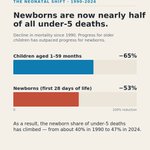
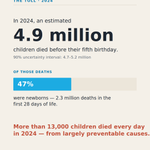
4.9 million children died before their fifth birthday in 2024. Nearly half — 2.3 million — did not survive their first 28 days.
New UN IGME estimates, published in The BMJ. What the data shows, briefly.

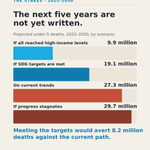
The next five years aren't fixed.
On current trends, 27.3 million children are projected to die before age five by 2030. Meeting the SDG targets would avert 8.2 million of them.

More than 13,000 children a day, from largely preventable or treatable causes.
The estimates tell us where the need is greatest.
Data: UN IGME, 2025 (Sharrow et al., BMJ 2026;393:e088684). Open at childmortality.org
#ChildSurvival #GlobalHealth