






Pinned Tweet
The world's income map has shifted since 1987.
Low-income countries went from 30% to 11%
High-income economies went from 25% to 41%
Learn more with the recently launched 2026-2027 @WorldBankGroup Country Income Classifications: blogs.worldbank.org/en/opend…

What if you could discover the world’s development data with one click? Now you can! #Data360, the @WorldBankGroup's flagship data hub is live!
Discover 10,000+ indicators and get the insights you need: data.worldbank.org/ | #DataMeetsDevelopment

We asked AI to read building energy laws in 119 cities. Not summarize them, but answer 60 legal questions per city, cite the exact provision and say “insufficient evidence” when needed.
Then another model—and humans—checked every answer.
See what worked: blogs.worldbank.org/en/opend…

Review what happened in our #WBGMeetings in Bangkok here! 👇

Weekly Update: #WBGMeetings recap
➡️ Jobs, Capital, Technology: The Plenary Playbook
➡️ Local Jobs, Smarter Tools: Small AI in Action
➡️ Ajay Banga Takes Civil Society's Questions
➡️ Data Is the New Collateral
➡️ $112 Billion Mobilized. What Comes Next?
🔗 bit.ly/4825PFz 🔗

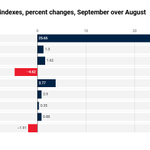
September commodity prices, in numbers:
Energy: +25.7%
Crude oil: +21.2%
Natural gas: +15.3%
Food: +3.8%
Precious metals: −1.9%
Gold: −2.1%
The latest @WorldBankGroup Pink Sheet: blogs.worldbank.org/en/opend…

Only about half of women ages 15–64 are engaged in income-generating work—around 30 percentage points below men.
That gap has barely changed since 1990.
The Atlas of Global Development 2026 looks beyond the global average: blogs.worldbank.org/en/opend… #WBGAtlas

Watch Ajay at #WBGMeetings on how digitalization is opening new pathways to finance for Micro, Small and Medium-sized Enterprises (MSMEs). Full replay: live.worldbank.org/en/event/…
The geography of poverty has shifted: Once centered in East Asia, now 2/3 of the global poor live in Sub-Saharan Africa.
Take a closer look at how inequality and fragility impact progress in three insightful charts: wrld.bg/NLpH50Z5z43 #EndPoverty

Should the world replace the extreme poverty line with a much higher threshold?
Doing so would change not just how poverty is measured, but whose deprivation receives the most attention.
Three reasons to retain an extreme poverty benchmark: blogs.worldbank.org/en/opend… #EndPoverty

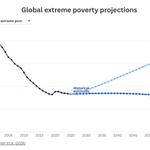
Our latest @WorldBankGroup poverty update revises the 2024 global extreme poverty rate down by 0.3 pp—from 10.4% to 10.1%.
That equals about 22.5 million fewer people than previously estimated.
What changed and why in our new PIP update: blogs.worldbank.org/en/opend… #EndPoverty

Caribbean statistical systems are improving, but the region still trails its income peers.
Across eight Caribbean countries, the average Statistical Performance Indicator score rose from 42.8 in 2016 to 60.1 in 2024.
What needs to happen next: blogs.worldbank.org/en/opend…

How can data & digital innovation help businesses access finance, grow, and create jobs? Discover how smarter solutions can unlock their potential as 1.2 billion people reach working age in developing economies over the next decade. #WBGMeetings
👉 live.worldbank.org/en/event/…
71% of surveyed frontier firms in emerging markets now use #AI. And half of adopters say they started in 2025.
But adoption does not always mean transformation. Firms are still experimenting or deploying AI on a limited scale.
New @IFC_org survey: blogs.worldbank.org/en/opend…

Nearly one in five people worldwide are estimated to be at high risk from climate hazards.
The new PARCH map lets you explore where exposure to floods, droughts, heatwaves and cyclones overlaps with poverty and other vulnerabilities.
Explore the map: blogs.worldbank.org/en/opend…

In 2024, 38.9% of people in economies impacted by fragility, conflict, and violence (FCV) lived on <US$3 a day, compared with 10.1% globally.
Progress has been made—but much more slowly.
Five takeaways from the 2026 @WorldBankGroup Scorecard update: blogs.worldbank.org/en/opend…

#AI adoption is widespread. Deep adoption is not.
Among surveyed firms using AI internally, 57% are still experimenting or deploying it on a limited scale. Just 10% have embedded it across core processes.
What’s keeping firms from moving further?: blogs.worldbank.org/en/opend…

The @WorldBankGroup’s Annual Report is out.
Discover how we mobilized a record $112 billion in private capital for jobs and economic growth: worldbank.org/en/about/annua…

Ajay at #WBGMeetings on how building opportunity in local economies and applying practical AI can help workers access skills and become more productive.
👉🏼 Watch the replay of this event: live.worldbank.org/en/event/…
A thriving digital economy starts with equal access.
#Data360 brings together indicators on connectivity, digital infrastructure, and inclusion, supporting efforts to close the global digital divide.
Explore the data: data360.worldbank.org/en/the… | #DataMeetsDevelopment

Only 1 day left to submit for Better Data for Better Lives: Innovations in Survey Measurement in the Age of AI!
🗓 Dec 8–9, 2026
⏳Deadline: Tomorrow, Oct 15
Submit your abstracts (800 words) or full drafts: forms.office.com/r/z1UEwdAsT…

Only about 23% of workers in economies impacted by fragility, conflict or violence (FCV) were in wage or salaried employment in 2025, compared with 47% across IBRD and IDA economies overall.
See the 2026 @WorldBankGroup Scorecard update: blogs.worldbank.org/en/opend…
