

Husband, father, pastor. Old Toyotas, Motorcycles, good coffee, not necessarily in that order. Maui No Ka Oi.
Maui, HI
Joined April 2009
- Tweets3.8K
- Following439
- Followers287
- Likes17





"This apostle was so full of affection and bowels that he could not choose but love his people, although the more he loved them, the less he should be beloved." ~ Thomas Watson on 2 Cor. 12:15
1
1
19
Y'all remember when Piper posted, "Farewell, Rob Bell?"
It'd be dope if we could get one of those for CT...
#ChristianityToday
3
111
Jay Haynes retweeted

Two top leaders of the Southern Baptist Convention have warned that we are facing an existential crisis, but differ about the nature of the threat.
The messengers will ultimately decide which threat we'd rather face.
Let me explain.
SBC President Willy Rice recently said the SBC could fall into a "chasm" of moral compromise if we do not clarify our position on women pastors. He said, this is "why I believe the Truth and Unity Amendment is so important."
This is an argument from conviction.
Executive Committee President Jeff Iorg recently warned that passing the Truth and Unity Amendment would open the door to hundreds of crippling lawsuits that would destroy the convention. He's afraid that clarifying our position on women pastors would cause the SBC to be sued into oblivion.
This is an argument from pragmatism.
So, who's right?
In my view, Willy Rice is right and Jeff Iorg is wrong.
Here's two reasons why I believe Iorg is wrong on this matter (this isn't personal; I'm disagreeing with his position).
First, his legal argument is incorrect. Attorney Jon Whitehead explain why on the Center for Baptist Leadership podcast a few days ago, listen to it yourself and make up your own mind (link in comments). Whitehead said we need not fear an avalanche of lawsuits if we pass the T&U amendment.
Second, even if Iorg were right about the lawsuits (he's not), then this is precisely the moment Christians should stand on conviction, not pragmatism.
The SBC exists to contend for and propagate our Christian convictions, not to run from them under threat of a lawsuit.
If the SBC does not have the courage to stand for the clear teaching of scripture, then what is the point of the SBC? Are we giving money to an organization that can get bullied by threats of litigation? That's not the SBC I know and love.
Ordinary Southern Baptists are courageous people, not cowards. Our entities should reflect that.
When faithful churches give their hard earned dollars to the Cooperative Program, they do so with the expectation to be funding their convictions, not mere self-preservation.
If we have to compromise God's word to save the SBC, then the SBC isn't worth saving.
That's what Willy Rice is warning about, and he's correct. This is a key issue for the future of our convention. The surface level issue is the Truth and Unity amendment. But the deeper issue is the need to stand for the truth of God's word even when it's not popular.
Willy Rice warned the "chasm" we're facing is filled with "the bones of a thousand gospel movements and institutions that were once vibrant and strong, but they are now empty institutional shells, tragic monuments to a once-great past."
Thus, the biggest threat to the SBC is a failure of nerve. We can't control lawsuits, but we can control our own faithfulness.
I'm confident Southern Baptists will make the right call in Indy next year.
Jay Haynes retweeted

Trevin Wax points out the “novelty” of removing churches from the SBC—that we went through the entire conservative resurgence without doing it.
But if you want to understand why such attempts are so common now when they hardly ever happened previously, there’s really only one date on the timeline that explains our current situation. It’s 2019.
One development in 2019 explains why we had very few challenges in the past but have so many now.
In 2019 as a part of abuse reform, the SBC amended Bylaw 8 to make the Credentials Committee a standing committee. And they opened up a portal online through which anyone could report churches for being out of friendly cooperation. That one act is what led to the current proliferation of challenges.
Before 2019, the CC only existed for two days every year. Their responsibilities were largely administrative. After 2019, they exist all year round, receive membership challenges all year round, and have the power to recommend removal of churches between conventions.
Before 2019, a “membership challenge” required a messenger to come to the annual meeting and challenge the seating of another church’s messengers. After 2019, anyone can go to the online portal (which is open 24 hours a day, 365 days a year) and make a membership challenge. They don’t have to be a messenger. They don’t have to attend the convention. They don’t even have to leave their home.
At the time in 2019, the rationale for this sweeping change was focused almost entirely on the ability to remove churches who aided and abetted abuse. It’s like no one considered the possibility that Southern Baptists might be interested in using the new structure to enforce close identification with the BF&M. But Southern Baptists have been interested in that, and here we are.
Had this structure been in place during the conservative resurgence, does anyone doubt that things would have proceeded much differently than they did?
When the history books are written about the SBC in our era, I predict they will identify 2019 as the key date that set in motion a chain of events that very few anticipated.

In the past decade, there have been debates over what it means to be a church “in friendly cooperation,” and what “dealbreakers” would sever that relationship.
baptistpress.com/resource-li…

Jay Haynes retweeted

Spengler's take on art (and why western art is in terminal decline) is fascinating.
For all cultures, the first true art form is architecture. This is the most immediate expression of a culture's "world-feeling". All other art forms then spring out from the architecture...
For Western culture, upward-reaching cathedrals were inspired by the forests of Northern Europe.
The prime symbol of Western culture is the perception of infinite space — a yearning to reach out of the darkness of the trees to the light beyond.
Later art forms all came from the cathedrals. Notice how sculptures of saints were originally attached to the cathedral, but later stepped out of the architecture to stand on their own feet.
Likewise, fresco paintings became detached from the walls as standalone oil paintings, and even classical music came from Gregorian chant, for which the cathedral was designed to carry and amplify.
Even western drama came from religious ceremonies (Spengler talks about how western drama is confessional in nature).
This is because all art forms (and all non-natural expressions of life) originate from religion. They may separate themselves physically from the church over time, but are still fundamentally tied to that metaphysical expression.
You cannot define individual art forms because they all blend into each other. Sculpture, painting, and music are merely words, and they are nothing without the prime urge that created them. This is why to define what art is you have to extract the cultural form, or the "inner form-language".
The artists of the present (in the Western culture) aren't really engaged in "art" at all, but merely a kind of craftsmanship. It lacks the spontaneity and necessity of the word-feeling that birthed the culture’s artistic expression.
"Of great painting or great music there can no longer be, for Western people, any question. Their architectural possibilities have been exhausted these hundred years. Only extensive possibilities are left to them."

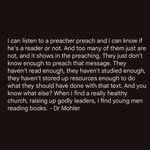
When I find a really healthy Church, raising that godly leaders, I find young men reading books. - Dr. Mohler

74


Jay Haynes retweeted

Kamala Calls For Peaceful Transfer Of Power To Adolf Hitler
babylonbee.com/news/kamala-c…

Jay Haynes retweeted
Election Officials Assure Everybody Things Are Looking Good And You Can Go To Sleep And They'll Take Care Of The Rest Of The Counting Overnight
babylonbee.com/news/election…


Jay Haynes retweeted

The messengers have been well served by @bartbarber moderating skills. Kind, humble, fair, and without condescension.
Numerous times he helped a messenger form an action when they didn’t know the proper language.
That’s the job of the moderator and he did it well.
Jay Haynes retweeted
The messengers to the Southern Baptist Convention just voted on a motion to unseat the messengers from FBC Alexandria because of their views on female pastors. I would ask my fellow messengers to consider two things about this vote:
1. The motion to unseat the church’s messengers was correct, and the Credentials Committee was right to recommend their removal. I expect for this to pass overwhelmingly, and that will be a good thing.
2. The opponents of the Law Amendment will argue that this vote is evidence that we don’t need the Law Amendment. They will also point to last year’s vote to remove Saddleback as evidence that we don’t need the Law Amendment.
But that argument against the Law Amendment is fatally flawed. Here’s why.
The Credentials Committee delayed a year before taking action on Saddleback, and they delayed two years before making a recommendation concerning FBC Alexandria.
The Credentials Committee only recommended Saddleback’s removal after their inaction was exposed on the floor of the Anaheim convention. The Committee only recommended the removal of FBC Alexandria after the committee’s inaction became public right before this year’s convention.
I am not saying that the committee is in bad faith. I’m sure these are good brothers and sisters, and I am grateful for their faithful labors. I’m simply saying that the Credentials Committee said that they were not clear about how to define a pastor in Anaheim. And it appears that they still lack clarity about how to act in cases like Saddleback and FBC Alexandria.
How many other churches like Saddleback have come before the committee without the committee recommending removal? I am aware of a handful, but they are still unknown to messengers.
All of this suggests that the committee needs the clarity that the Law Amendment provides. We need the committee to act expeditiously and not delay for years on end on churches like Saddleback and FBC Alexandria.
Don’t fall for the argument that the Saddleback and FBC Alexandria votes remove the need for the Law Amendment. Two conventions have come and gone since FBC Alexandria was referred to the Credentials Committee. They have had the opportunity to seat messengers for two conventions without any recommendation from the committee. Only when their messengers were challenged on the floor of the convention this year did the committee finally make a recommendation.
If you want the Credentials Committee to have clarity about how to act on churches like Saddleback and FBC Alexandria, then vote for the Law Amendment.
#SBC24

Jay Haynes retweeted

Whoever thinks women pastors and Nicene orthodoxy are matters of doctrinal precision ought not to be a pastor. Those are elementary Christian doctrines
Jay Haynes retweeted
I want to clarify something. Passing the Law Amendment does not mean that churches with female children’s directors are going to be kicked out of the convention. Nor does it mean that churches with female children’s “pastors” will be automatically excluded from the convention.
The Law Amendment does not change our process for credentials challenges. That process is already in place, as we saw last year with the removal of Saddleback and Fern Creek.
All the Law Amendment does is provide greater clarity to those who preside over that process, especially the Credentials Committee. The Credentials Committee asked for that clarity in Anaheim and delayed action on Saddleback for a year because of that lack of clarity.
If you want the Credentials Committee to have clarity about how to act concerning churches like Saddleback, then you should vote for the Law Amendment.
#SBC24
baptistpress.com/resource-li…